Environmentally friendly online shopping

During their studies, Rebekka Jochem and Jacobo Cuesta Wolf developed a shipping packaging that is robust and can be used multiple times.

Rebekka Jochem and Jacobo Cuesta Wolf from Wismar University of Applied Sciences have developed shipping packaging that is robust and can be used multiple times. It is intended to help reduce waste from the growing online mail order business and thus make online shopping more resource-efficient.

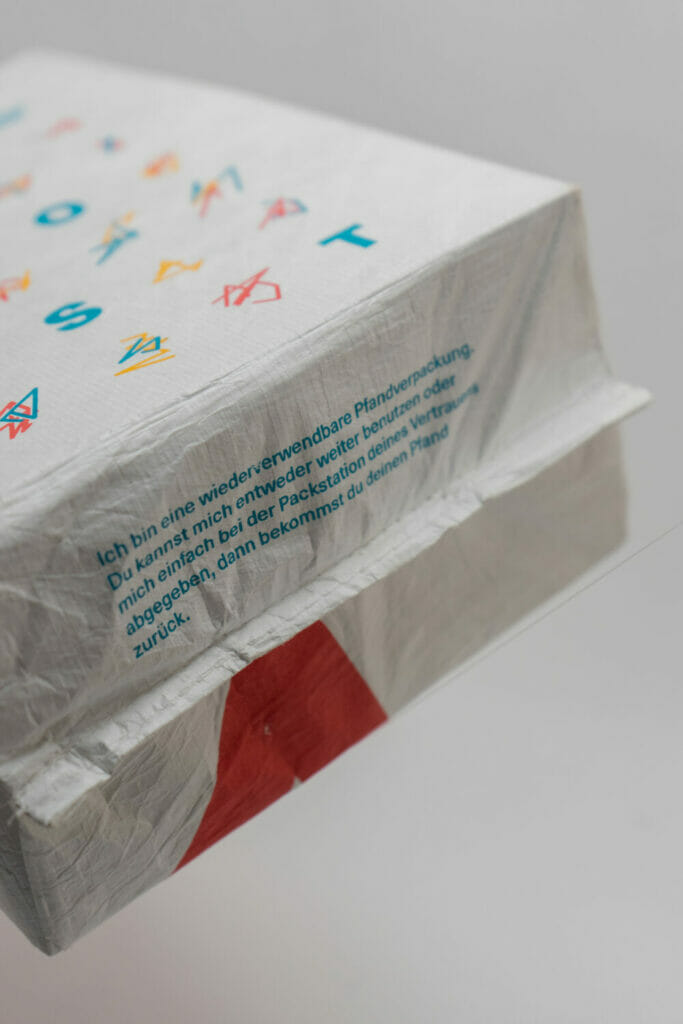
Repost is the name of the two young designers' shipping packaging. It was created as part of a semester project in the Design programme at the Faculty of Design at Wismar University of Applied Sciences. The Reusable, resource-saving parcel system for the mail order business is made of the tear- and waterproof material Tyvek and can be returned via the letterbox.

„Online retail has grown rapidly in recent years, which means that a lot more packaging waste is being generated. With our project, we wanted to help raise awareness of the problem and reduce this mountain of waste.“

Jacobo Cuesta Wolf

Display

Picture of shipping packaging
Repost is planned as a returnable deposit system. (Image: Jacobo Cuesta Wolf)

The two designers have therefore planned their colourful box as a deposit-based reusable system. Each box is designed so that it can be used around 30 times. After receiving the goods, the customer can fold up the box and send it back by post to the mail order company, which can then use it again. „We carried out tests and sent the prototype several times to family and friends, who then sent Repost back to us by post. The prototype has already completed 17 rounds,“ says Rebekka Jochem.

Low volume for return transport

The soft outer material of the foldable box is reinforced with recycled cardboard. It gives the box stability and protects the goods inside. Once the goods have been received, the sheets can be removed, folded and laid flat in the Tyvek sleeve, so that the box has a very small empty volume. „This allows the logistical effort for the return transport kept as low as possible be sent,“ explains Jacobo Cuesta Wolf. The concept also provides for different formats and a shipping label that is used as a seal. This clearly shows whether the packaging has been opened before it reaches the customer.

Picture of a man looking towards the lower left edge.
Jacobo Cuesta Wolf (Picture: Jacobo Cuesta Wolf)
Picture of a woman smiling at the camera.
Rebekka Jochem (Picture: Jacobo Cuesta Wolf)

Tyvek, a high-density polyethylene nonwoven from DuPont, is lightweight and durable, resembles paper to the touch and is also inexpensive. „Before we decided in favour of Tyvek, there were Material experiments, for example with biodegradable plastic, which could be cut like paper. We also experimented with whey and chitosan. However, the biomaterials didn't prove successful because they weren't robust enough to survive shipping undamaged,“ says Jacobo Cuesta Wolf. „What's more, a bio-based material doesn't necessarily have to be more sustainable,“ adds Rebekka Jochem.

The colourful design stylises the possible routes of the parcels in Europe. The journey of each box can also be documented on the back with stickers from the retailer. This allows all customers to trace the route of their parcel.

Last year, this clever idea was honoured with the German Packaging Award in the Young Talent category. The two designers have postponed their plan to found a start-up to market Repost for the time being, deciding instead to complete their Master's programmes.

http://www.jcwolf.de

More news from the magazine

One hundred years blue tin

Since 1925, the Nivea cream can has borne its deep blue colour, white lettering and round shape - a design that has remained stable over generations, markets and crises and is now celebrating its 100th birthday.
Read more "