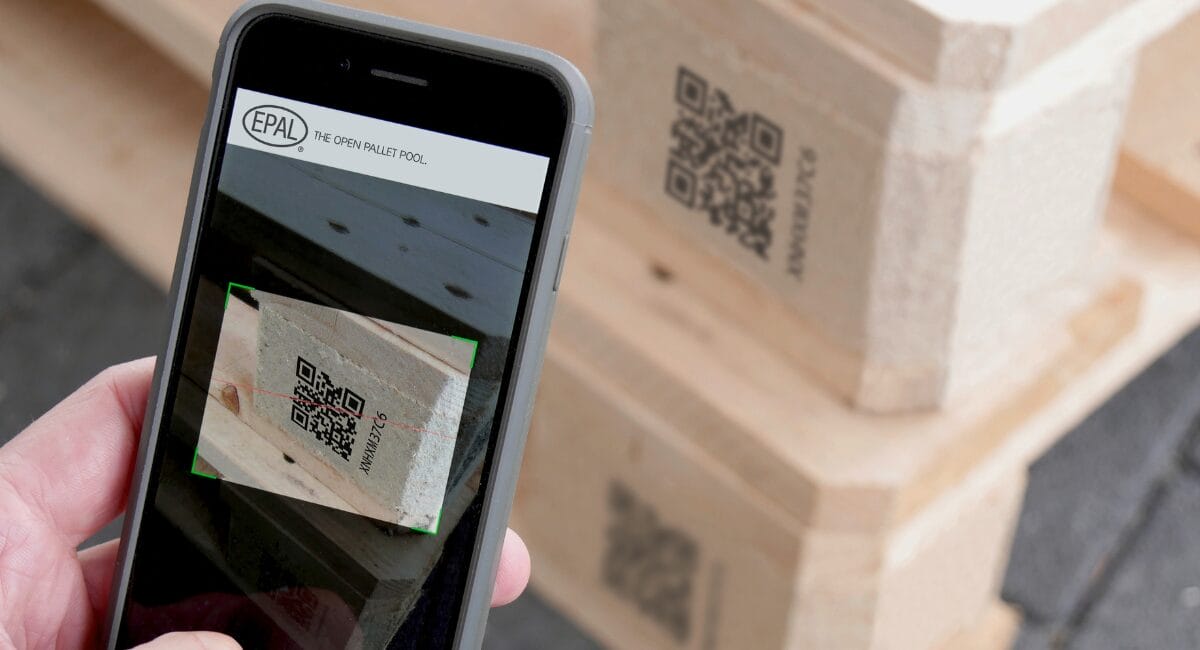
The European Pallet Association (EPAL) says it has reached an important milestone in the digitalisation of its open pallet pool: since the market launch in January 2024, 4 million EPAL Euro pallets with a QR code have already been produced and put into circulation.
The new EPAL Euro pallets QR are therefore set to establish themselves as an integral part of modern, digitally networked supply chains. More and more producers of EPAL Euro pallets are switching to the QR variant, meaning that availability and demand along the supply chain are increasing, according to the report. Despite additional labelling, the pallets remain fully compatible with the open EPAL pool and can be used and exchanged like classic EPAL Euro pallets.
Serialised pallets for transparent supply chains
Each EPAL Euro pallet QR is labelled with an individual QR code and a serial number. When scanned - automatically in the warehouse or manually - users can call up information on the location, utilisation and life cycle of the pallet without having to use additional labels or separate systems.

According to EPAL, the digital labels can be combined with other tools from the association, such as the digital pallet passport or the EPAL Pallet App. This means that data on the production site, repair history or sustainability figures can be retrieved across the entire supply chain. The aim is to increase transparency in pallet logistics and reduce the administrative workload for shippers, retailers and logistics service providers.
Digitisation of the EPAL pallet pool is being expanded
EPAL sees the 4 million QR pallets mark as an intermediate step on the way to a comprehensively digitalised pallet pool. Parallel to the EPAL Euro pallet QR, the association has started to serialise other pallet types such as industrial pallets and CP pallets with QR codes.
In total, there are currently more than 675 million EPAL Euro pallets and around 20 million EPAL pallet cages in circulation. With its principles of reuse, exchange, repair and recycling, the open EPAL pallet pool has been an example of a functioning circular economy in load carrier logistics for decades. According to the association, wooden pallets from EPAL contribute to CO₂ storage, avoid waste and improve the CO₂ footprint of users in industry, trade and logistics.
Source: EPAL