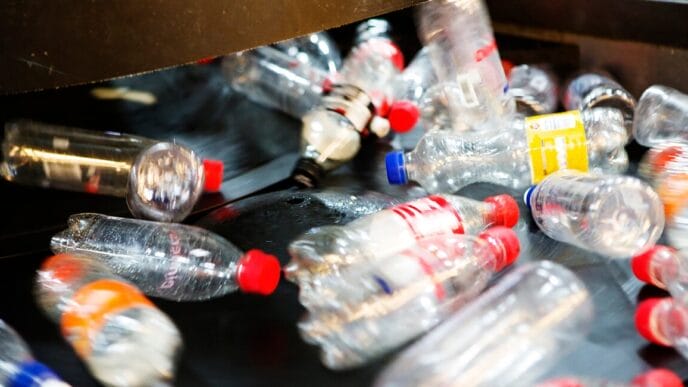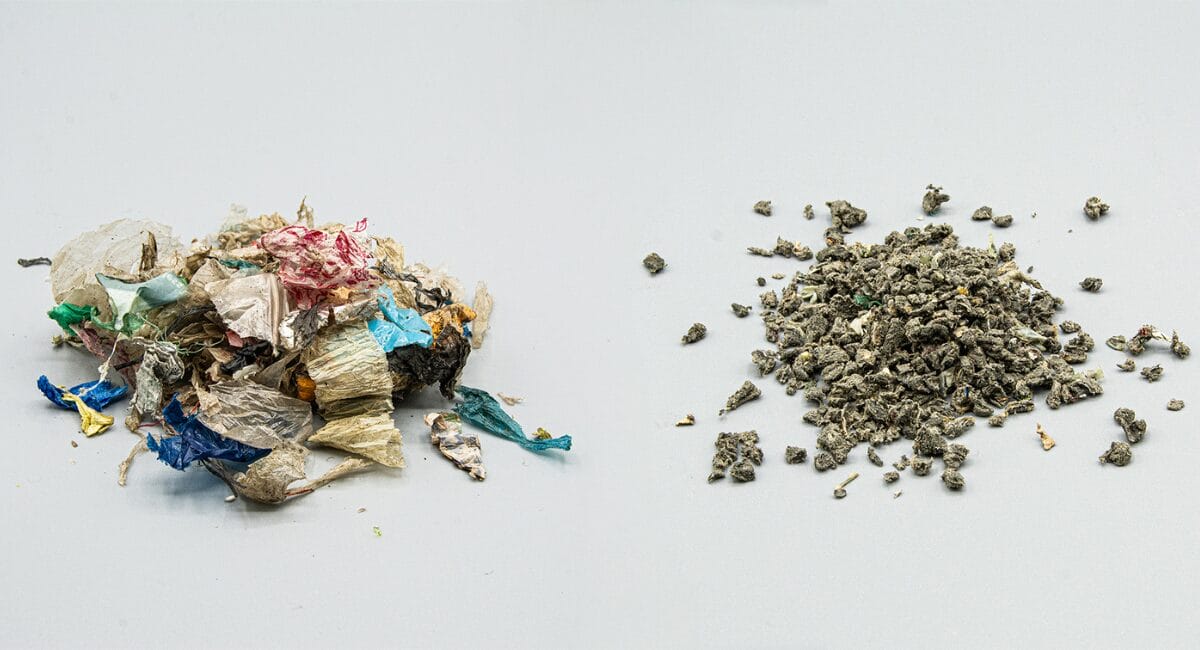
Erema will be presenting the Agglorema generation of machines at K 2025. The new recycling system has been specially developed for the processing of heavily contaminated post-consumer waste and produces agglomerates that are suitable as a starting material for chemical recycling, among other things.
The new machine series processes film waste with highly fluctuating moisture content from sorting plants on a large scale and produces agglomerates with a high bulk density, which are ideal as a starting material for chemical recycling, among other things.
„It is our job to build machines that support chemical recyclers in the recovery of low-grade waste fractions. Many chemical recycling plants require standardised, pourable starting material. Agglorema bridges the gap between highly contaminated, heterogeneous and often thin-layered waste streams and reliable feedstock for the reactor. It is a particularly robust and energy-efficient system.“
Klaus Lederer, Business Development Manager Chemical Recycling at Erema
High throughput with high tolerance to contamination
Agglorema processes heavily contaminated waste streams with a low bulk density (from 30 kg/m³) and a moisture content of up to 12 per cent. This is made possible by the combination of the Erema pre-treatment unit (PCU) with the patented Counter Current technology and a specially developed extruder screw. Even with strongly fluctuating composition of the feed material, This combination ensures stable process control, for example with regard to polymer, geometry and moisture.

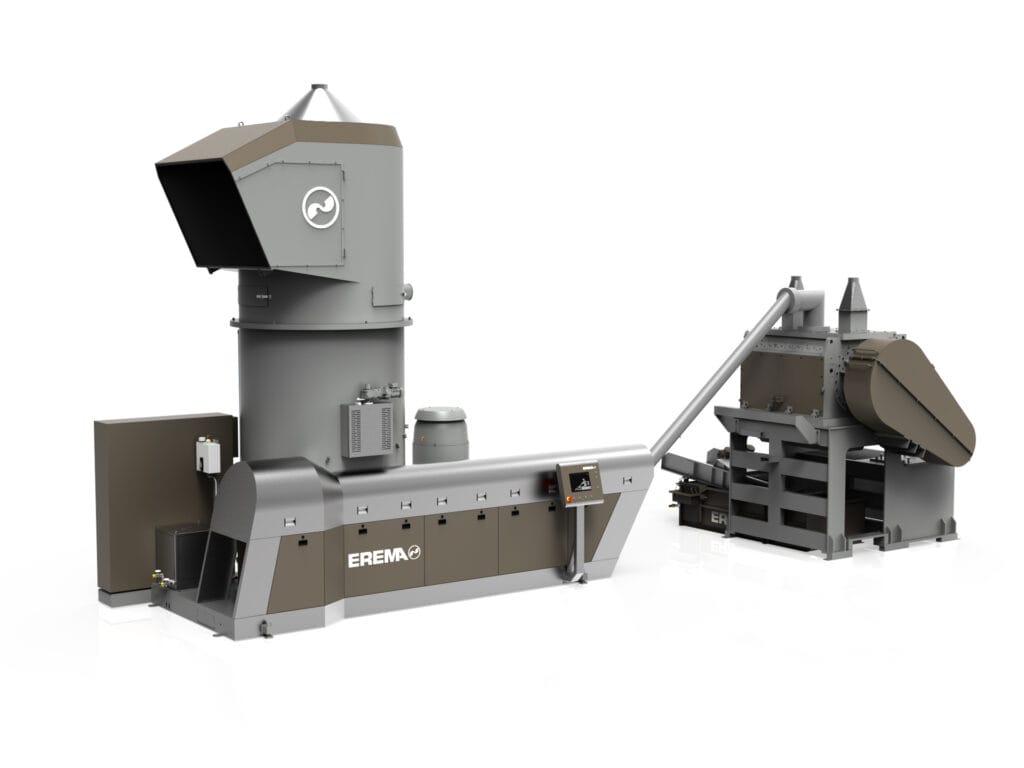
The material is homogenised, degassed, preheated and continuously fed into a short extruder without upstream drying. „Conventional agglomeration systems quickly reach their limits when the feed material has a low bulk density or fluctuating parameters. For Agglorema, however, this is not a problem thanks to the advantages of the PCU and the robust design of the system,“ says Klaus Lederer. He sees a particular advantage in the scalability of the Erema system. It processes up to 2.3 tonnes per hour and offers plenty of scope for increasing throughput.
From the extruder, the partially melted material strand is fed directly through a melting pipe into the water-cooled melt mill. There it is moulded into agglomerates with a bulk density of 280 to 380 kg/m³ and a defined particle size. Depending on the configuration, the residual moisture can be reduced to less than one per cent by downstream drying. The process sequence is deliberately kept simple and robust. The system utilises the advantages of extrusion, however, significantly reduces the process temperature and energy consumption. „Our specially developed extrusion technology only uses as much energy as the material requires,“ explains Klaus Lederer.
The Agglorema can be used both for Preparation of raw materials for chemical recycling as well as for mechanical recycling can be used. Agglomerates produced from mixed polyolefin fractions can be used to manufacture simple components, for example.
Source: Erema
Erema at the K 2025: Hall 9, Stand: C09 and in the Edvanced Recycling Centre: outdoor area, CE03