Single printers for printing and applying labels are currently still the norm, especially in the field of price labelling and labelling. The ES 7800 multi-roll printer from ESPERA supports the flexibilisation of production lines, especially for producers with a wide range of products or frequently changing product batches.
Increasing expectations from end consumers for fast availability and customised products are leading to an increase in the level of automation and the flexible design of production lines. This trend continues unabated in the food industry as well as in other branches of industry. In-house logistics processes are increasingly being automated in order to minimise delivery times from production to delivery of products and to meet the demand for small batch sizes down to batch size 1.
Networking of internal processes
ProMessa B.V. (Netherlands), a manufacturer of self-service meat, recognised this trend early on and automated its production processes accordingly. The company supplies up to 1,200 supermarkets every day with a wide range of meat products. Customers have the option of receiving products ordered in the morning on the same day, regardless of the batch size. These requirements are made possible by an optimally automated design and networking of the internal logistics process, including in the area of price marking and labelling.

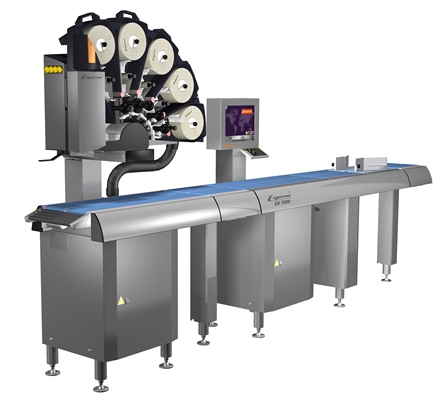
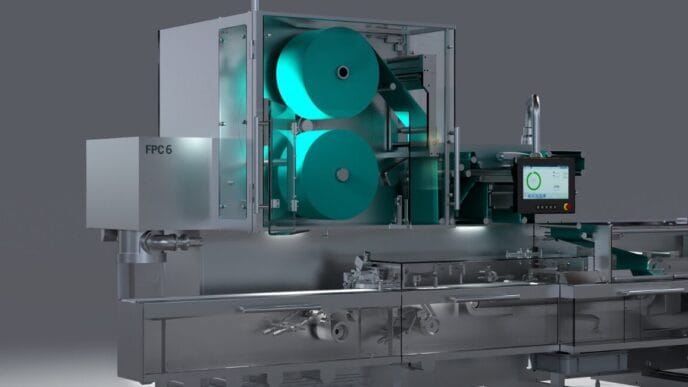
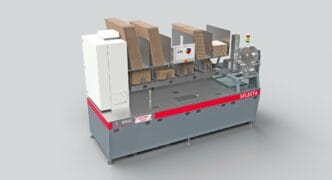
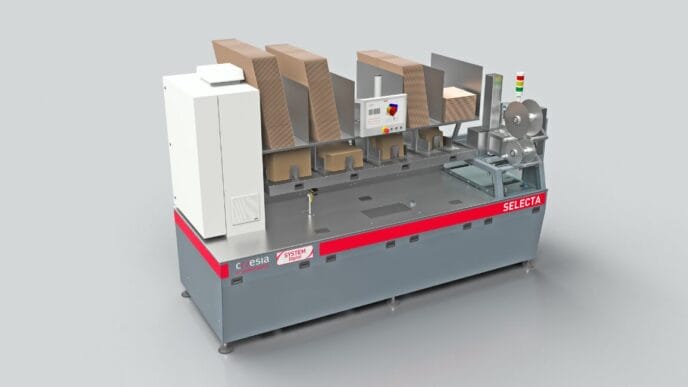
The advantage of the ES 7800 multi-roll printer from ESPERA-WERKE GmbH, Duisburg, is that each individual production line can be individually designed and therefore optimally utilised, regardless of which product is being weighed, printed and labelled. The multi-roll printer offers the option of printing and labelling up to five different products in parallel. It does not matter whether it is a chaotic product feed of different products or the same product that is labelled with individual labels for different customers.
The ES 7800 multi-roll printer from ESPERA can print up to five different labels using direct thermal and thermal transfer printing and apply them to up to 120 packs per minute. It can be combined with a bottom web printer. It has an automated printer cross adjustment and automatically adjustable product guides. In hygienic Stainless steel construction The integrated software for label and barcode design can be operated via a 15“ touch colour display.
The Control of the different multi-roll printer cassettes can be done in different ways:
Connection to an ERP system
Via the connection to an ERP system, the product feed is completely IT-controlled according to the data input and automatically forwarded to the multi-roll printer. This means that the product sequence stored in the ERP system is automatically adopted and forwarded to the multi-roll printer, which individually labels the products accordingly.
In the data preselection memory of the multi-roll printer, you can up to 120 products and processed piece by piece. The advantage is that article changeover times are completely eliminated. The label roll no longer needs to be changed when changing products, as the corresponding cassette of the multi-roll printer is controlled individually. This reduces changeover times to a minimum and at the same time enables optimum utilisation of production capacity. Due to the increasing trend towards the production of Lot size 1 the trend among ESPERA customers is that lines are often equipped with a total of two multi-roll printers (and thus a total of ten label cassettes). As with ProMessa B.V., up to ten individual labels can be printed and/or applied with this unique, patented solution.
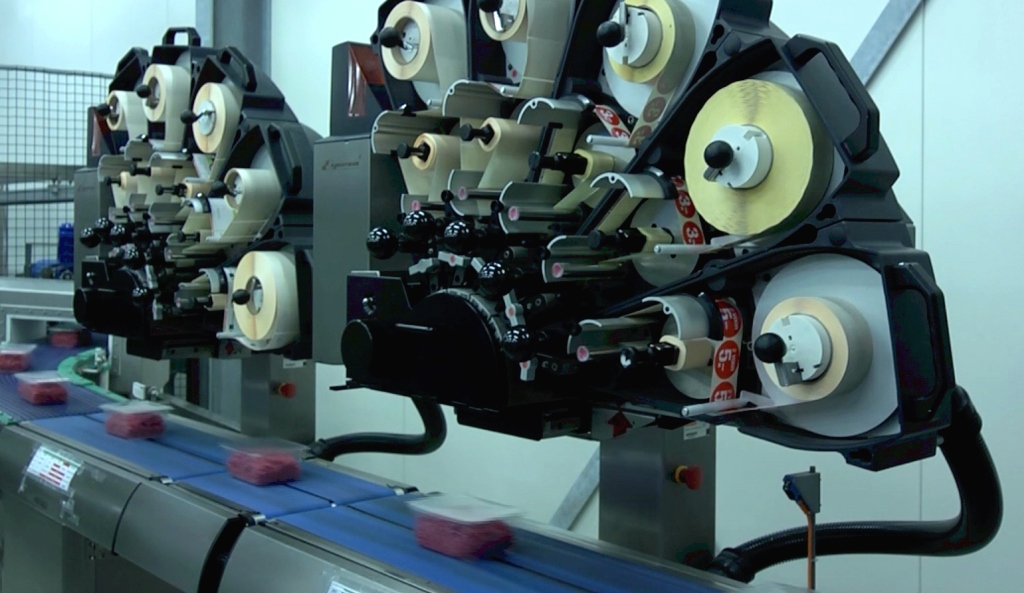
Control according to weight ranges or via scanner systems
Another option for controlling the cassettes is weight-dependent labelling. Depending on the weight range of the product, different label cassettes are controlled and the product is labelled individually. The installation of a camera or scanner on the multi-roll printer also enables the detection of different products and packaging colours. Depending on the colour characteristics of the packaging or the product in the packaging, the different label rolls are controlled and products are labelled individually.
Compact line and production design
By equipping production lines with the multi-roll printer, a single Customised line and Optimally utilised can be used. This not only reduces downtimes along the entire production process, but also enables a compact line and production organisation. In combination with the optimised ERP connection, ProMessa B.V has created an efficient and error-free process and significantly expanded its capacities. The company has thus achieved its goal of reacting quickly and efficiently to customer and market requirements.