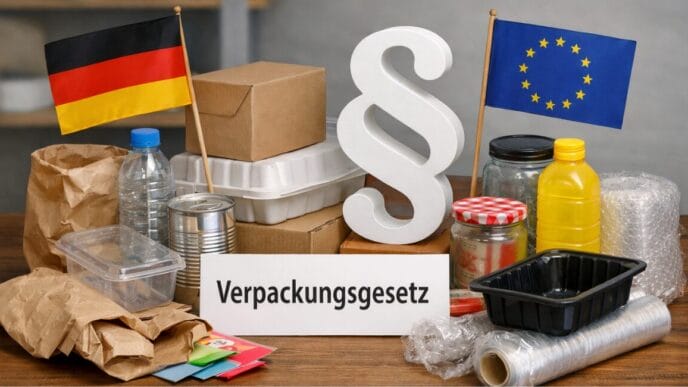
The time for interpretation is over. With the Guideline C(2026) 2151 final Has the European Commission published a document that the packaging industry urgently needs: an official interpretation of Regulation (EU) 2025/40, PPWR for short, before it largely comes into force on 12 August 2026. The guidance responds to specific stakeholder questions from industry and closes interpretational gaps that have led to considerable legal uncertainty in daily compliance work.
For packaging managers, sustainability officers, buyers and legal experts, this means: the strategic alignment of your own processes and product decisions must now – before the deadline – be measured against these official interpretations. Those who wait risk not only loss of conformity, but also, in case of doubt, liability risks. packaging journal has systematically prepared the key points of the guidelines for you.
- What is packaging and what isn't?
- Manufacturer or producer?
- Franchise businesses and branches
- PFAS in food packaging
- Recyclability
- Use of recyclate
- Compostability and packaging reduction
- Reusable packaging
- Labelling
- Deposit systems
- PPWR proposes ban on single-use plastics
- Conclusion
What is packaging – and what isn't it?
The seemingly simple question of what constitutes packaging under the PPWR has caused considerable uncertainty in practice. The guide clarifies several points of doubt that are of immediate relevance to specific industries.

The starting point is Article 3(1) of the PPWR. The criteria for classification as packaging are function (protection, handling, delivery) and intended use – not the material or the external form. The guidance applies these criteria to specific product categories.
Flower and Cultivation Pots Pots that are primarily intended for the sale and transport of plants – including those in which the plant was last cultivated – are considered packaging. Larger pots with a diameter of more than ten centimetres, which are exclusively for the production cycle in the nursery and are not intended for trade, are not covered by the term packaging. The limit is therefore not based on the material or size alone, but on the primary function in the flow of goods.
Medical application aids: Pre-filled syringes and infusion bags (IV bags) are integral components of their respective medical devices. As they are designed for administration rather than primarily for transport or protection, they do not fall under the packaging definition of the PPWR. This is an important clarification for the pharmaceutical and medical technology industries, which avoids costly double certifications.
Textile packaging Dust bags for shoes or clothing are considered packaging if they are intended for presentation or delivery to the end-user. Relevant to the fashion industry: textile sales packaging is explicitly exempted from the recyclability requirements under Article 6(11)(g). However, this exemption applies exclusively to the recyclability obligation – other PPWR requirements may still apply.
No packaging Tealight holders and grave lights are expressly not classified as packaging, as are adhesive films that remain in the manufacturing process purely due to process reasons (so-called process films) and never reach the retail trade.
Manufacturer or producer? A distinction with significant consequences
One of the most consequential clarifications of the directive concerns the distribution of roles within the supply chain. The PPWR consistently distinguishes between design responsibility and financial disposal responsibility – and assigns these to two different actors.
The Manufacturer The(Manufacturer) bears responsibility for the conformity of packaging design and labelling in accordance with Articles 5 to 12 of the PPWR. Crucially, there is only one single manufacturer per packaging EU-wide – the principle of Single Point of Responsibility. The manufacturer is the one who designs or commissions the packaging under their own name or brand. In practice, this role is typically filled by the brand owner or the bottler.
The Producer The producer, on the other hand, is responsible for financing waste management systems under Extended Producer Responsibility (EPR). The territorial principle applies here: for each Member State in which packaging is first placed on the market, an independent producer status arises. This means that a company active in twelve EU markets can appear as a producer in twelve Member States for the purposes of EPR obligations. This role typically falls to the importer or distributor in the respective country of destination.
The consequence for practical application is significant: companies that combine both functions – such as a brand owner who imports and distributes their products themselves – must clearly separate both roles internally and document them accordingly. Incorrect classification can lead to liability risks concerning conformity documentation (manufacturer role) as well as EPR fees (producer role).
Franchise businesses and branches: where corporate structures become a trap
For company groups and international corporations, the guideline clarifies two further points that regularly lead to uncertainty in compliance practice.
The franchise rule: Under the PPWR, micro-enterprises are exempt from manufacturer obligations in certain areas. However, this exemption does not automatically apply to franchisees. A franchisee can only be classified as a micro-enterprise if the franchisor holds less than 25 percent of the capital or voting rights. If the stake is higher, the economic data of the entire group are aggregated – and the thresholds for micro-enterprises are therefore usually exceeded.
Branch offices A mere branch without its own legal personality cannot act as an „importer“ as defined by the PPWR. This has practical consequences for non-EU manufacturers: they must either establish a legally independent subsidiary in the EU or appoint an authorised representative to assume the importer's obligations. A mere VAT registration in an EU Member State is not sufficient to reflect the importer's liability.
PFAS in food packaging: The three-stage testing protocol
From 12 August 2026, strict limits, effectively amounting to a ban, will apply to per- and polyfluoroalkyl substances (PFAS) in food contact materials. The guide defines the relevant limits and describes a testing procedure that can mean a significant cost relief for many companies.
The three significant threshold values are:
- 25 ppb for each individual PFAS (targeted single-substance analysis)
- 250 parts per billion as the sum of measured PFAS (including precursor degradation products, if applicable)
- 50 ppm as a total sum of all PFAS, including polymeric PFAS
The Commission recommends a three-stage testing protocol, requiring more extensive analyses only where an initial screening step indicates potential concerns.
Step 1 is Total Fluorine quantification (TF). If the measured TF value is below 50 mg/kg, the sample is considered fully compliant – not only with regard to the 50 ppm limit value, but automatically also with regard to the more complex test steps 2 and 3. Further tests are therefore completely unnecessary in this case. This is the decisive point for cost calculation: Companies whose packaging passes this initial test can save on complex follow-up analyses.
Step 2 is used when the TF screening value is exceeded. Pyrolysis GC/MS analysis is used to differentiate between organic fluorine (which indicates PFAS) and inorganic fluorine, which is not covered by the regulation.
Step 3 is the TOP analysis (Total Oxidizable Precursors), which is used for the final verification of the ppb limit values for individual substances and sum parameters.
Regarding stock levels, the guide states: There is no transition period for ongoing new production. However, packaging that was legally „placed on the market“ before 12 August 2026 – meaning it was already the subject of a sales offer after manufacturing was completed – may be sold off as existing stock. The crucial point in time is placement on the market, not the date of physical delivery or sale to the end customer.
Recyclability: A phase model with clear timeframes
The PPWR introduces a phased model for packaging recyclability, granting companies different deadlines for different levels of requirements.
From August 2026 The fundamental obligation for recyclability according to Article 6(1) applies. Every packaging placed on the market for the first time must initially comply with this entry obligation.
From 2030 – more precisely: 24 months after the entry into force of the corresponding delegated legal act – compliance with the specific „Design for Recycling“ (DfR) criteria in accordance with Article 6(2)(a) will become mandatory. These criteria are still being developed by the Commission. Until then, the European standard EN 13430:2004 remains the relevant reference for the presumption of conformity – companies complying with this standard can assume recyclable design until the new DfR criteria come into force.
From 2035 Finally, recyclability must be demonstrable on an industrial scale – the so-called „Recycled at Scale“ criterion. Packaging for which no sufficiently scaled recycling process exists will no longer be recognised as recyclable for the purposes of the PPWR from this point onwards.
Use of recycled materials: Exceptions are possible, but not automatic
Article 7 of the PPWR mandates minimum quotas for the use of post-consumer recyclates (PCR) in plastic packaging. The guidance clarifies the conditions under which exemptions from these quotas can be claimed.
Two categories are automatically exempt from the minimum quotas: Firstly, plastic parts that make up less than five percent of the total weight of the packaging unit. Secondly, food contact packaging, if the use of recyclates jeopardises product safety – for example, because the recycling technology used has not yet been approved for food law.
Important: These exceptions do not apply generally and without further proof. Manufacturers must actively justify and demonstrate in their technical documentation why no suitable technology is available for the use of an exception. A mere assertion of the exception requirements is not sufficient.
Compostability and packaging reduction: a paradigm shift for the premium segment
Regarding compostability, the guide clarifies that Member States have the option to mandate specific compostability for certain product categories – specifically mentioned are coffee pods and very light plastic carrier bags – in order to optimise biowaste collection. However, this is a national option, not an EU-wide obligation. Companies must monitor the respective national implementation measures.
The implications of Article 10 on packaging reduction are far-reaching. The guide contains a clarification at this point which has significant consequences for the premium segment of the packaging industry: The criteria of „marketing“ and „consumer acceptance“ have been removed as permissible justifications for performance. An increased packaging weight can no longer be justified solely by optical quality, feel, or brand experience in the future. Only functional criteria – product protection, logistical requirements, legal stipulations – remain as acceptable justifications.
Furthermore, from 2030, there will be a strict void limit of 50 percent for transport and e-commerce packaging, in accordance with Article 24. Packaging that contains more than half of its internal volume as void space will no longer be permitted from this time.
Reusable packaging: Who is responsible for the quota?
Article 11 of the PPWR defines the conditions for reusability. A packaging is not considered reusable solely due to its physical stability. It must be able to be emptied and refilled without damage, meet health protection requirements, and be recyclable at the end of its useful life.
From 2030, transport packaging will be subject to a reuse target of 40 percent. The guide clarifies the question of feasibility: buckets or drums for viscous substances such as paints will only need to be designed for reuse if cleaning does not require disproportionate costs or resources. For dry goods, on the other hand, such as grain, reuse is generally classified as technically feasible.
A question of practical importance concerns responsibility for meeting the quotas: the packaging user – for example, the bottler – is responsible, not the manufacturer of the empty packaging. This means that compliance responsibility in the supply chain cannot be shifted onto the packaging producer.
For the HORECA sector, the guide clarifies that drinks kegs are not considered packaging in the B2B sector that counts towards end-consumer quotas. Only formats that are supplied directly to consumers – such as bottles – are taken into account when calculating quotas.
Labelling: The end of national special paths from August 2028
From 12 August 2028, a unified labelling requirement for the material composition of packaging will apply EU-wide. The guideline clarifies: The continued use of existing national abbreviations according to Decision 97/129/EC is prohibited from this date. This is an abrupt stop with no transition period for stocks that are newly brought into circulation from this date onwards.
For stock planning, this means that packaging designs that currently still use national labelling systems must have been switched to the harmonised EU labels by August 2028. Companies with long printing cycles or large pre-production volumes should incorporate this deadline into their planning calendars now.
Regarding the format of labelling, the Commission has made an important policy decision: the prioritisation of digital labels for material composition is not currently being pursued by the Commission. Physical labels remain the standard here. Conversely, the exact opposite applies to EPR-related information: physical labels for EPR information are expressly forbidden. This information may only be provided digitally.
Deposit Systems: The one-off exceptional window closes in 2028
The PPWR generally obliges Member States to introduce deposit return systems (DRS) for plastic bottles and metal cans by 2029. The aim is a collection rate of 90 percent. An exemption from this obligation is only possible if a Member State can demonstrate a collection rate of 80 percent in 2026.
The crucial point of the guidance: The application for this exemption is a one-off option. Member states that do not use the reporting window by January 2028 will permanently lose the right to an exemption and will be obliged to introduce a DRS. For the beverage and packaging industry, this means: The question of whether or not a member state will introduce a DRS will be answered for all relevant markets by early 2028 at the latest.
For trade, the guide regulates the return obligation: Final distributors must take back returned goods of the material types that they themselves stock. The reimbursement of the deposit amount must not be made dependent on the presence of a receipt.
PPWR proposes eliminating the single-use plastics directive: the 5% threshold as a key factor
The relationship between the PPWR and the existing Single-Use Plastics Directive (SUPD) has historically been a frequent point of contention. The guidance clarifies the hierarchy between them: in the event of conflicts concerning the prohibitions listed in Annex V of the PPWR, particularly for single-use packaging in the HORECA sector, the PPWR takes precedence over the SUPD.
Crucial for product development is the so-called 5% threshold: if composite packaging consists of more than five percent of its weight in plastic, the PPWR prohibitions in Annex V apply in full. If the plastic content is five percent or less, the packaging is considered mono-material – and is therefore exempt from the specific prohibitions in Annex V.
This threshold is the central measurement for product developers working with composite materials. Precise documentation of plastic content in product data sheets is now mandatory – not only for internal compliance but also for correct classification with regard to Annex V prohibitions.
Conclusion: The groundwork must be laid now
The release of the Guideline C(2026) 2151 ‘Final’ marks the start of the final compliance phase before the PPWR comes into effect in August 2026. The Commission has thereby answered the key interpretation questions – and simultaneously made it clear to companies that waiting is no longer an option.
Four strategic priorities should be at the top of the agenda now.
- First, this PFAS-ScreeningFood contact packaging must be tested according to the new three-stage protocol. The procedure, if applied correctly, offers significant savings in analytical costs – but it must be formalised and documented.
- Secondly, the Master Data UpdateThe 5% threshold for plastic content in composite materials must be recorded in the product data sheets. Only on this basis can the Annex V prohibitions be correctly applied.
- Thirdly the Role inventoryCompanies with international structures must check whether their EU branches can operate as separate legal entities and whether the importer and manufacturer roles are correctly assigned.
- Fourthly, the Minimisation checkPackaging whose weight or volume has so far been justified by marketing arguments will lose its basis of conformity from 2030. Development departments must now develop functional justifications – or adapt the designs.
In the coming 24 to 36 months, further implementing acts will follow, particularly the specific design-for-recycling criteria. However, technical documentation must already be aligned today with the requirements that the guideline has now made binding.