The results of the annual update of market data from European Bioplastics (EUBP) forecast continued dynamic growth in the global bioplastics industry.
According to forecasts, the global market is set to grow by 36 per cent over the next five years. The global production capacity for bioplastics will expected to increase from around 2.1 million tonnes in 2020 to 2.8 million tonnes in 2025. Innovative biopolymers, such as biobased PP (polypropylene) and above all PHAs (polyhydroxyalkanoates), are driving this growth forward.
Since PHAs came onto the market, the share of this important polymer family has continued to grow. Production capacities are set to increase almost sevenfold over the next five years. The Production of polylactic acid (PLA) will continue to grow due to new investments in PLA production facilities in China, the USA and Europe. Biodegradable plastics currently account for almost 60 per cent of global production capacity for bioplastics. PHA and PLA are bio-based, biodegradable and have a wide range of physical and mechanical properties.

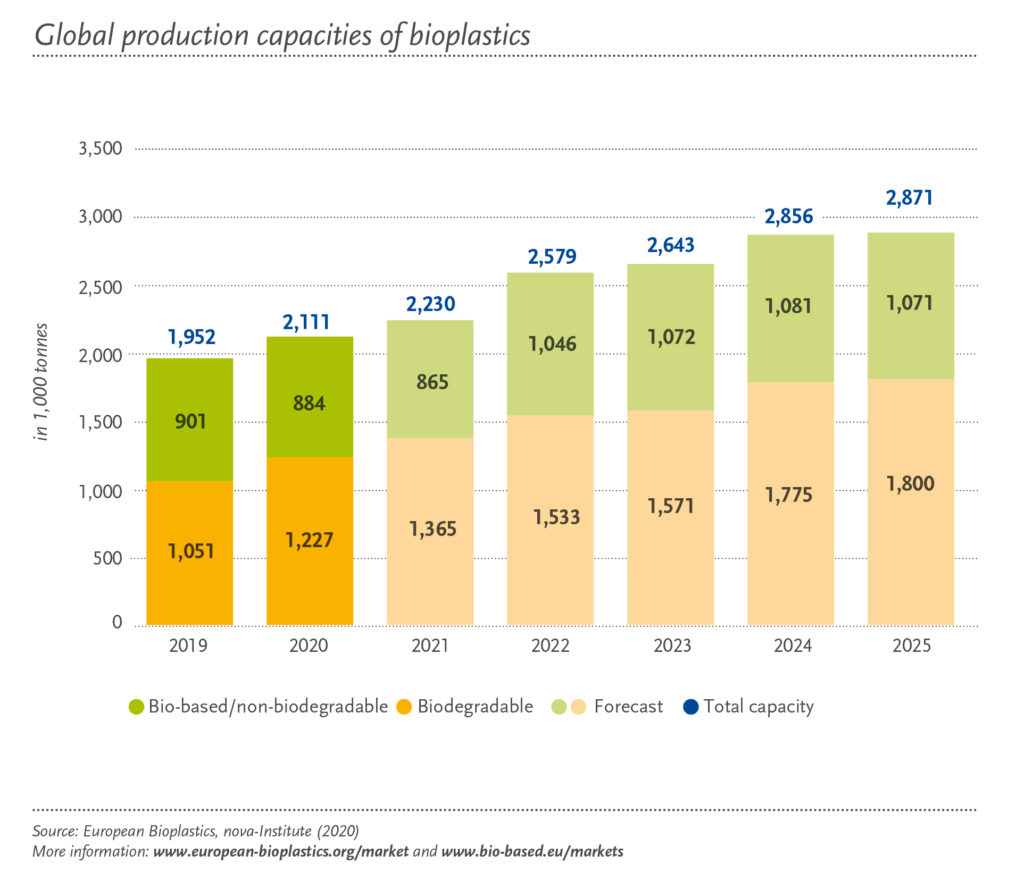
Bio-based, non-biodegradable plastics, including the drop-in solutions bio-based PE and bio-based PET (polyethylene terephthalate) as well as bio-based PA (polyamides), currently account for 40 percent (0.8 million tonnes) of global production capacity for bioplastics. For biobased PE, the following are planned in the coming years New capacities in Europe and South America go into operation.
PEF suitable for beverage bottles
In contrast, bio-based PET will only make a small contribution to overall capacity. Intentions to increase production capacity have not been realised at anywhere near the pace forecast in previous years. Instead, the Focus shifted to the development of PEF (polyethylene furanoate). The new polymer is expected to be launched on the market in 2023. PEF is comparable to PET, but is completely bio-based and also has superior barrier properties. This makes it is an ideal material for beverage bottles.
Packaging remains the largest application area for bioplastics, accounting for almost 47% (0.99 million tonnes) of the total bioplastics market in 2020. The data also confirms that bioplastic materials are already being used in many other sectors and that the application portfolio is continuing to diversify. Segments such as consumer goods or agricultural and horticultural products are continuing to increase their relative share.
European Bioplastics emphasises low land consumption
In terms of regional capacity development, Asia remains an important production centre with a share of 46%. At present a quarter of the production capacity in Europe. According to forecasts, this share will grow to up to 28 per cent by 2025.
„Recently, our industry announced significant investments, including in the heart of the European Union. Europe is well on the way to becoming a major producer of bioplastics. The material will play an important role in achieving a circular economy. ‚Local for local‘ production will accelerate the introduction of bioplastics on the European market.“ Hasso from Pogrell, Managing Director of European Bioplastics.
Experts estimate that 0.7 million hectares of land will be used to grow the renewable raw material for the production of bioplastics in 2020. It still accounts for 0.015 per cent of the global agricultural area of 4.7 billion hectares. Despite the forecast market growth over the next five years the proportion of land used for bioplastics will increase only slightly to 0.02 per cent. „We never tire of emphasising that there is no competition between renewable raw materials for food and animal feed and their use for bioplastics,“ says von Pogrell. „94 per cent of all arable land is used for pasture, feed and food.“.
The Market data update 2020 was developed in co-operation with the nova-Institute (Hürth, Germany). The data for the global production capacities of bioplastics are based on the market study „Biobased building blocks and polymers“ by the nova-Institute (2020).
SourceEuropean Bioplastics