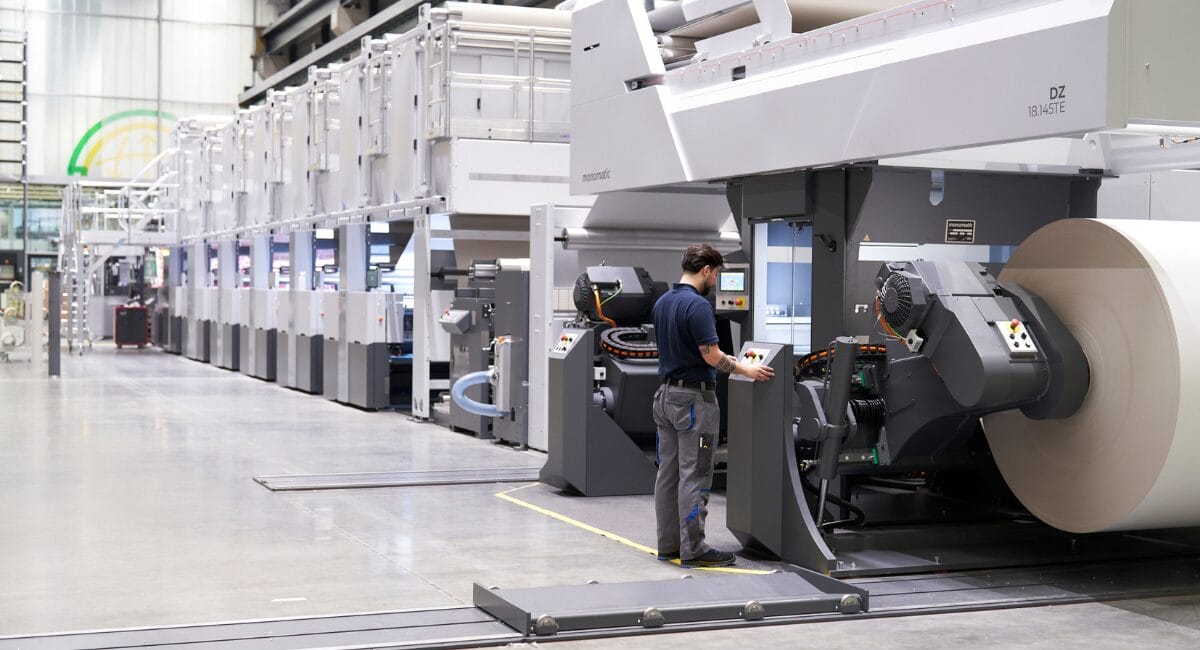
Heidelberger Druckmaschinen AG has made a successful market launch with the Boardmaster. The company is now planning to expand the range of applications for the inline web-fed flexographic printing press to include the flexible paper packaging segment and thus meet the high demand for sustainable packaging.
„The growing global demand for sustainably produced, cost-effective, recyclable and compostable packaging makes the flexible paper sector an attractive growth market for us. Our Boardmaster web-fed flexo printing press, with its ability to process water-based inks, coatings and barriers at a production speed of up to 600 metres per minute and an availability of up to 90 percent, offers the ideal conditions for this.„
Christian Steinmaßl, Head of the Packaging segment at Heidelberg
From the drupa In 2024, a complete Boardmaster will be available for customer demonstrations in the Print Media Centre (PMC) at Heidelberg's Wiesloch-Walldorf site. The machine comes with several options for different customer requirements to show prospective customers as many automation and inspection functions as possible. The Boardmaster is available in a total of four printing widths - from 850 to 1650 mm.
The development of the system focussed on key challenges and customer requirements: high cost pressure, quality and operational reliability, sustainability and a high level of investment security. „Systems are already in production in the USA. The order situation is very good and we have enquiries from all over the world,“ says Steinmaßl. Print shops that produce large-format offset food and beverage packaging are also showing interest. Boardmaster is focussed on the highest possible Effectiveness of the entire system in non-stop operation with flying job changeover designed.

The availability reaches up to 90 per cent, the printing speed 600 metres per minute. Compared to previous comparable systems, this corresponds to a Doubling of productivity. Maintenance costs have been reduced by 50 per cent compared to systems with other printing processes. High level of automation and simple operation make it possible to produce with a small workforce. This also counteracts the shortage of skilled labour. The AI-supported Intellimatch printing plate and sleeve scanner is used to ensure the high quality of the print results.
Source: Heidelberg