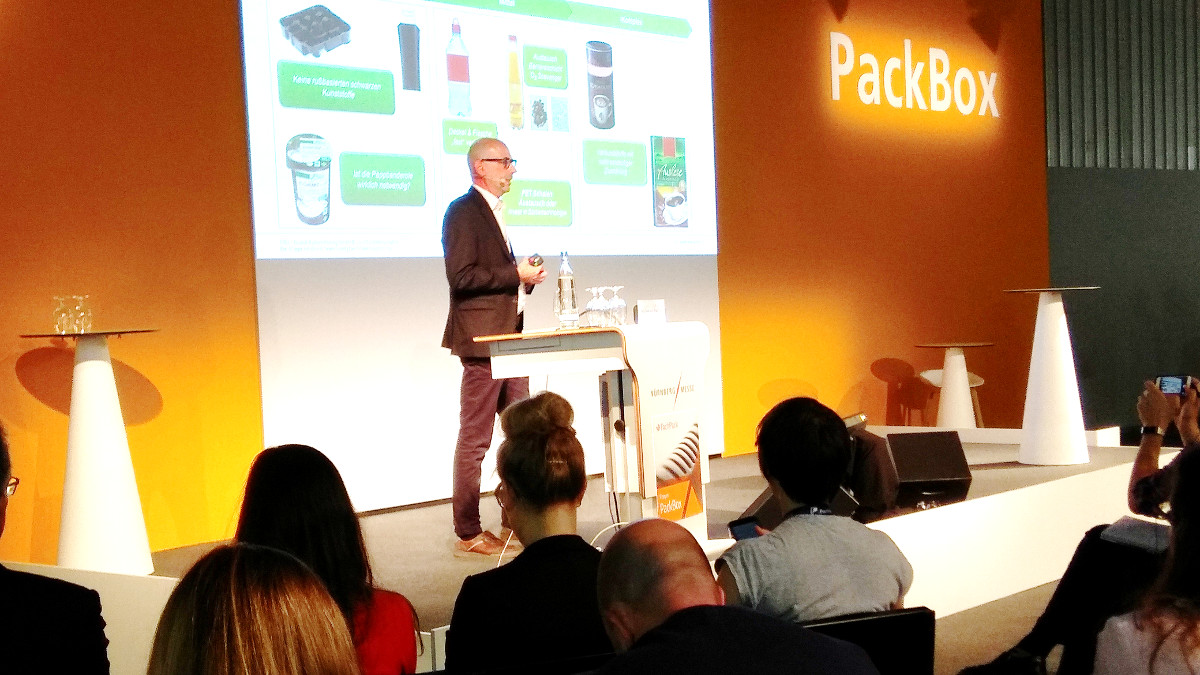
The Packaging Act is already taking effect. In the packaging industry, it has helped to raise awareness of recycling-friendly packaging and improve the collection and sorting infrastructure. Nevertheless, much remains to be done. This is what Dr Norbert Völl, from „Der grüne Prunkt“, said during a presentation at FachPack 2019.
The press spokesman for the waste disposal and recycling specialist spoke to more than 200 people at the Forum on Wednesday, 25 September PackBox. He reported on his company's experience with the Packaging Act, which came into force at the beginning of the year. The central office Packaging register (ZSVR) and the packaging register LUCID are „a good idea“, he said. From the point of view of waste management companies, however, he still sees a need for action. This is because one of the aims of the law was to reduce the number of „free riders“ - i.e. those companies that do not fulfil their existing obligation to register packaging.
Online retailers sometimes miss out on necessary registrations
The fact that many companies still use their circulated Packaging quantities Dr Völl concludes from a comparison of the total quantities placed on the market - around 2.5 million tonnes per year according to the Gesellschaft für Verpackungsmarktforschung - and the packaging reported to LUCID - around 1.8 million tonnes. Among other things, this difference indicates that not all companies fulfil their packaging obligations. Obligation to register would comply. LUCID currently lists around 170,000 „distributors“. However, more than 700,000 were originally expected.

However, Dr Völl repeatedly pointed out that educating consumers as well as the Distributor of packaging is still inadequate. It can therefore be assumed that a large proportion of the missed registrations in LUCID could be due to ignorance. The Green Dot believes that „a major problem area of the Online trading is.“ Smaller retailers in particular do not realise that they not only have to report the shipping packaging, but also the product packaging of their deliveries.
Municipalities receive 20 million euros for information campaigns
On the consumer side, on the other hand, there is a lack of correct waste sorting: „We have a relatively large amount of residual waste in the yellow bags.“ The consequence of this is that Household waste collections too few recyclable materials to provide sufficient „Post-consumer recyclate“ (PCR). Every year, Der Grüne Punkt makes 20 million euros available to local authorities for waste separation education programmes. Many cities and municipalities use this money very sensibly. Nevertheless, the Waste separation It is prone to errors, often seems illogical and is also not standardised nationwide. Dr Völl gave the example that paint buckets made of polypropylene belong in the yellow bag. Cleaning buckets made of the same material are disposed of in the residual waste.
„We don't have a standardised infrastructure in Germany. For example, you don't have a yellow bag or a yellow bin in the city of Munich.“
Dr Norbert Völl, Press spokesman „Der Grüne Punkt“
Standardised regulations for the handling of plastic waste make sense. The ideal solution would be Recycling bin under municipal management, the costs of which the Dual systems should participate. However, corresponding negotiations with the municipalities are complicated.
There is also a lack of clarity when it comes to incentives for recycling-friendly design
On the subject of „Incentives for Recycling-friendly packaging design“Dr Völl was open to a uniform fund model in which all dual systems would participate. An independent body would then check the recyclability of packaging and also the actual recycling and grant premiums on a standardised basis. The Packaging Act currently assigns this task directly to the dual systems. This is confusing for users because the requirements differ from country to country and there are no standardised procedural rules.
Der Grüne Punkt supports its customers with the software „RecyclingCOMPASS“, which uses a catalogue of questions to provide specific information on how good the recyclability is.
Industrial solutions for more PCR are still pending
The Recyclability is one challenge, the actual reuse of the plastic is the other. The Packaging Act also calls for significant improvements in this area, especially in the field of PCR. Although there are promising approaches for turning household waste into new, high-quality Product packaging to make. However, industrially available solutions are still a long way off. However, great progress has been made.
However, Dr Völl also makes it clear that consumers and companies would face higher costs: „If we recycle more and use more Circular economy then that costs money.“
[infotext icon]You will find the following articles on the introduction of the Packaging Act on our website:
[/infotext]