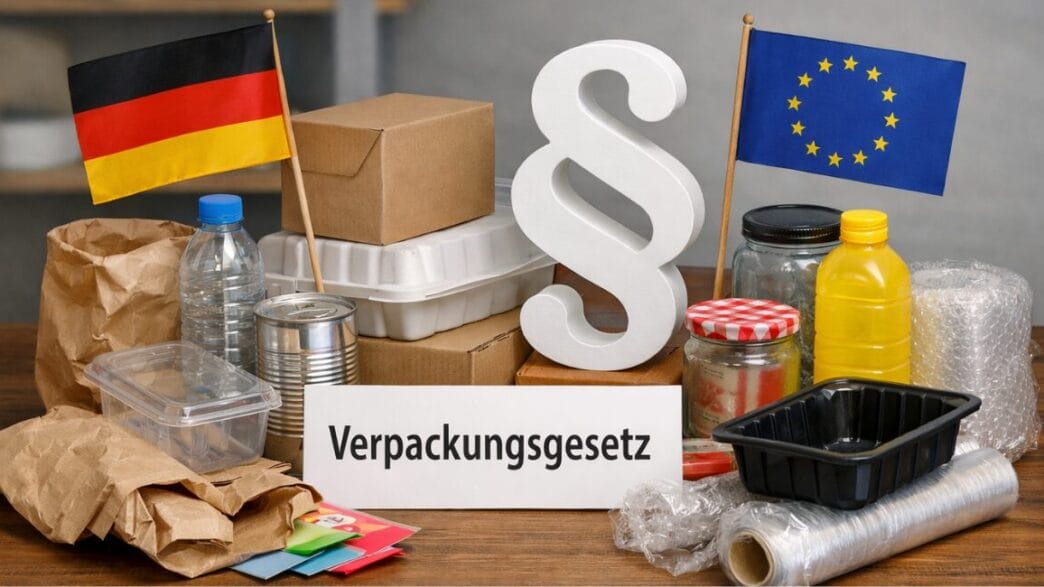
Last Friday, the Federal Council issued its opinion on the draft of a new Packaging Law Implementation Act. The aim is to harmonise German law with the EU Packaging Regulation (PPWR) - if possible without additional bureaucracy for companies.
The Federal Council has commented on the draft of the new Packaging Law Implementation Act. The chamber of the federal states supports the aim of adapting German packaging law to the EU Packaging Regulation without creating additional bureaucracy. At the same time, it is calling for some points to be tightened up, such as ecological incentives and practical enforceability.
The planned Packaging Law Implementation Act is intended to adapt the current Packaging Act to the EU Packaging Regulation 2025/40, which has been in force since February 2025 and will apply directly from August 2026. According to the draft law, proven national structures are to be largely retained, particularly in terms of extended producer responsibility, system participation and reporting processes. The Federal Council supports this basic approach, but is calling for changes in several areas.

Federal Council insists on bureaucracy reduction
In its statement, the Federal Council emphasises that national implementation should not go beyond the requirements of European law. Small and medium-sized companies in particular should not be burdened with additional authorisation, documentation or reporting obligations. The Federal Government should therefore examine whether new obligations for manufacturers of packaging not subject to system participation and additional financing regulations for the Central Agency Packaging Register are actually necessary or could be designed to minimise bureaucracy.
The Chamber of States is also calling for a more practicable organisation of individual detailed regulations. For example, it is in favour of transitional regulations in the current calendar year in order to avoid financing gaps in the dual systems. In addition, local authorities should be explicitly named in the law when it comes to requirements for waste avoidance and recycling when using public spaces.
More weight for ecological control
In terms of content, the Federal Council is focussing on the ecological design of the participation fees. In the view of the Chamber of States, the current regulation has had too little of an incentivising effect. In future, the recyclability of packaging should be more strongly reflected in the system fees. In addition, it should be examined whether the use of post-consumer recyclates can also be given greater consideration.
Life cycle instead of blanket priority for reusable packaging
The Federal Council also favours a more life cycle-based assessment of packaging systems. The statement states that even high-quality, recyclable disposable packaging could be ecologically equivalent or even more favourable than reusable packaging in individual cases, depending on the context of use. The entire life cycle and the specific energy, resource and transport costs are decisive.
The Federal Council is also in favour of further economic incentives to strengthen the circular economy. In the view of the federal states, these include not only recycling-orientated fees, but also reliable demand markets for recyclates. Stimuli via public procurement or European minimum recyclate quotas for other product groups are mentioned, for example.
Industry warns against overregulation
The Federal Association of the German Waste Management, Water and Circular Economy (BDE) welcomes individual approaches such as the more ecological structure of the system charges. According to the association, this so-called eco-modulation could create important incentives for recycling-friendly packaging design and promote investment in the circular economy.
The BDE is particularly critical of proposals to shift recycling quotas in favour of chemical recycling. The recycling rate for plastic packaging subject to the system was already just under 71 per cent in 2024 and was achieved exclusively through material recycling. In the BDE's view, a shift within the same overall quota would not create any additional recycling, but would remove important material flows from the existing system. Frequent reviews of the quotas could also impair planning security for investments.
No „gold plating“ effects
At the same time, the association warns against so-called „gold-plating“ effects, i.e. national regulations that go beyond the EU requirements. These include additional reporting obligations, a possible unilateral right to set fees for public waste management organisations and increased requirements that do not follow directly from the EU regulation. In this context, the association warns against so-called gold plating and competitive disadvantages for Germany as a business location.
All in all, the Bundesrat supports the adaptation of German packaging law to the EU Packaging Regulation, but wants to weigh up the ecological impact, economic feasibility and bureaucratic burden more carefully. The decisive factor for the packaging industry is therefore likely to be how the Federal Government takes up the numerous requests for scrutiny and proposed amendments in the further legislative process.
Source: Federal Council; BDE