Slightly more packaging waste, plastic recycling rate to rise
According to the Federal Environment Agency, every German consumes 220.5 kilograms of packaging material per year. 70 per cent of packaging waste is recycled. The still too low recycling rates for plastic and the increasing amount of neodymium magnets in packaging waste are a cause for concern.
21 August 2020
The consumption of plastic packaging has risen slightly in recent years, according to data from the Federal Environment Agency. (Figure: Federal Environment Agency)
Every German consumes 220.5 kilograms of packaging material per year. This figure from 2016 was announced by the Federal Environment Agency yesterday, Wednesday 25 July 2018. This means that all Germans together generated 18.16 million tonnes of packaging waste in 2016. Even though the increase compared to 2015 was only 0.05 per cent and 70 per cent of all packaging waste is recycled, Germans consume an above-average amount of packaging material. The European average for packaging consumption was 167.3 kilograms.
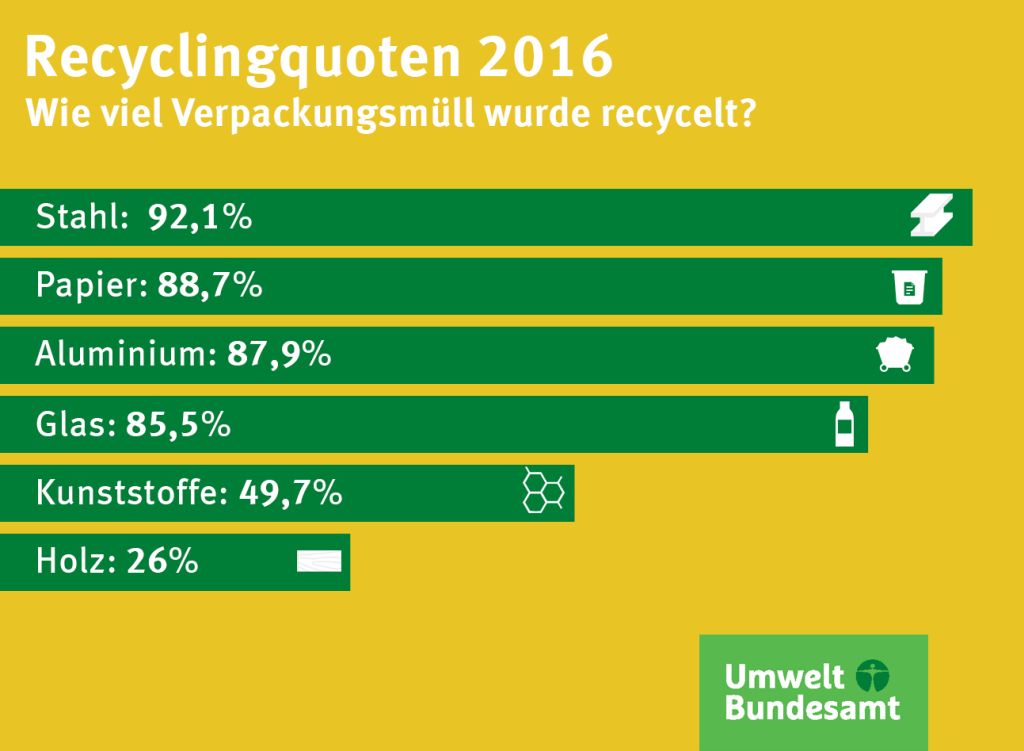
Despite all the recycling successes, there are Plastic packaging There is still a need for action. According to the Federal Environment Agency, the current recycling rate for plastics is 49.7 per cent. The new recycling law that will come into force on 1 January 2019 Packaging Act However, the first step is to demand a plasticRecycling rate of 58.5 per cent and even 63 per cent from 2022.
Steel is the „recycling leader“, wood is in last place. The plastics recycling rate of 49.1 per cent needs to be improved. (Figure: Federal Environment Agency)
More plastic recycled than incinerated for the first time
However, more plastic packaging was recycled than incinerated for the first time in 2016. This is because the recycling rate increased by 0.9 per cent.
At 92.1 per cent, the recycling rate for steel is the highest. Further „Highly recyclable“ raw materials The best performers are paper and cardboard with a recycling rate of 88.7 percent, aluminium with 87.9 percent and glass with 85.5 percent. Wood performs weakly. Only 26 per cent of it is recycled.
Display
10.9 per cent of waste was exported for recycling. For paper and cardboard waste Import and export In the case of glass packaging, more was imported than exported. 10.6 per cent of plastic packaging waste was exported, while nothing was imported.
Federal Environment Agency President Maria Krautzberger (Image: Federal Environment Agency/Photostudio29d)
„We produce far too much packaging waste - a sad top position in Europe. This is bad for the environment and for the consumption of raw materials. Firstly, we need to further increase recycling and the use of recyclates in order to conserve resources. And above all, we need to avoid waste, even in the production phase, by avoiding unnecessary and unnecessarily material-intensive packaging. In addition, reusable systems, which have clear ecological advantages over disposable packaging, should be strengthened.“
47 per cent of packaging waste from end consumers
Most Packaging waste 53 per cent are produced by business, industry and other institutions. This is what the Federal Environment Agency in its communication on the Packaging waste statistics in more detail. This means that 47 per cent of packaging waste is caused by end consumers. This corresponds to 103.5 kilograms per capita.
24.9 kilograms of consumer packaging waste consists of plastic. In 2015, it was still 25 kilograms. However, the proportion of Glass and aluminium packaging, which are very energy-intensive to produce.
The Federal Environment Agency also criticises the fact that the amount of packaging is not significantly reduced because packaging is equipped with additional functions such as dosing aids or elaborate closures. This increases the amount of packaging. Recycling is also becoming more difficult. The packaging volume is also being increased by Trend towards smaller portion packs.
Neodymium magnets are not recycled separately
The Federal Environment Agency points separately to the increasing proportion of Neodymium magnets in packaging waste. Around 4.5 tonnes were generated in Germany in 2017. Around 1.5 tonnes of this was pure neodymium. The rare earth neodymium is not currently extracted separately from the waste volumes and sent for recycling. The magnets are used in the closures of short-life packaging, for example in some folding boxes.