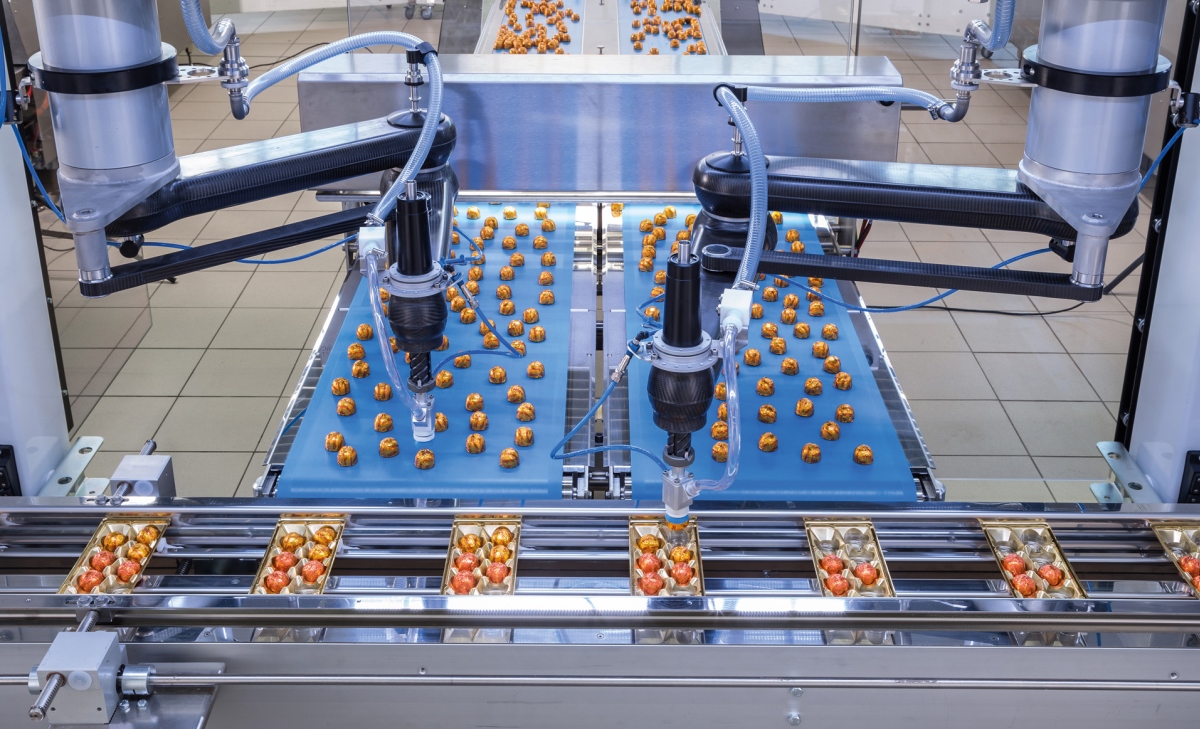
Do packaging machine manufacturers and their customers tend to favour maximum flexibility or do they prefer complete solutions for one packaging application at a time? Opinions on this vary widely. That's why we want to know what renowned packaging specialists think.
Maximum flexibility or application-specific complete solution: At first glance, these two requirements appear to be incompatible. But is that really the case? How do you deal with this supposed contradiction in Schubert, for example? Our interview with Martin Sauter, Head of Sales at Gerhard Schubert GmbH.
pj: Mr Sauter, which trend is more relevant for Schubert - highly flexible packaging systems or rather individual complete solutions?

Martin Sauter: At first glance, these two requirements seem incompatible. For us at Schubert, this means Flexibility and complete solution, but not opposites. That's why we don't have to make a directional decision. Thanks to their modular design and our holistic view of the entire packaging process, our TLM machines unite both sides. However, the market is now demanding the following at various points Significantly more flexible solutions. And technological developments - keyword "digitalisation" - are also calling familiar and proven processes into question.
pj: In your opinion, which developments require a particularly high degree of flexibility?
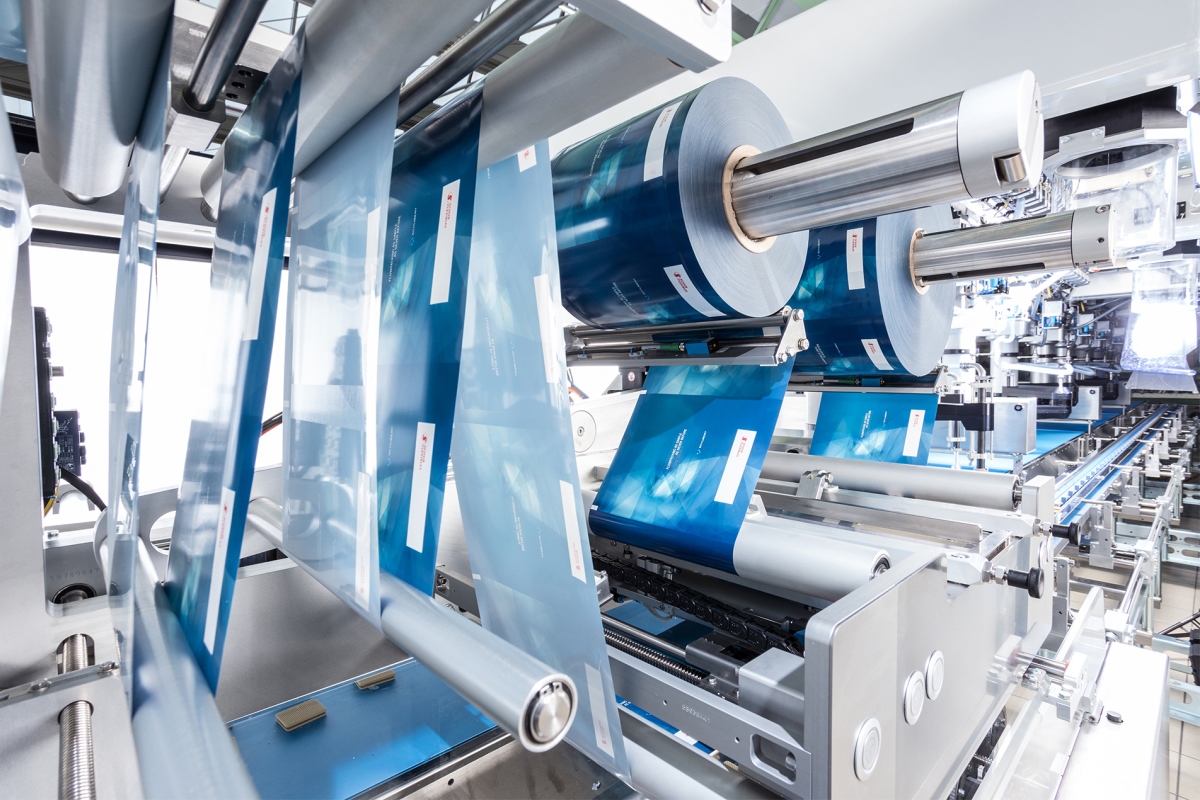
Martin Sauter: We consider one of the current topics to be the Open question about the packaging material. There is currently a great deal of dynamism in the sector. This is because Packaging that is as environmentally friendly as possiblewhich also provide optimum protection for the product and are cost-neutral for the end consumer. More cardboard instead of plastic, more paper barrier layers instead of multi-layer barrier film: this is what the future looks like.
However, these alternatives can already be used in our machines. After all, paper-based packaging has been part of the Schubert world for more than 50 years. But manufacturers are facing a new challenge and want solutions that can be retrofitted. That's why we prioritise the development of new Great focus on flexible application options and test new packaging materials for quality and process suitability ourselves with our own machines. In the case of new types of film, for example, the tightness of the tubular bag packaging and the quality of the seal seam are scrutinised in one of our flow modules.
pj: How do you assess the increasing trend towards personalised products in this context?
Martin Sauter: "Mass customisation" is definitely a second key development for the packaging industry. The variety of products is constantly increasing, not only in terms of the product itself, but also in terms of the Packaging variants and the Personalisation options. This means that production units are becoming smaller and changeovers have to be carried out more frequently. Manufacturers therefore need more and more highly flexible packaging systems that allow quick and easy format changes and are ready for use again immediately afterwards.
This is exactly what our philosophy is all about: A Schubert system should immediately deliver faultless production results without a start-up curve. Particularly in fast-moving sectors such as the cosmetics industry, where the "time to market" These functions are essential for smooth and efficient production. However, digitalisation plays into our hands here and opens up new possibilities on an unimagined scale.
pj: What exactly are you talking about here?
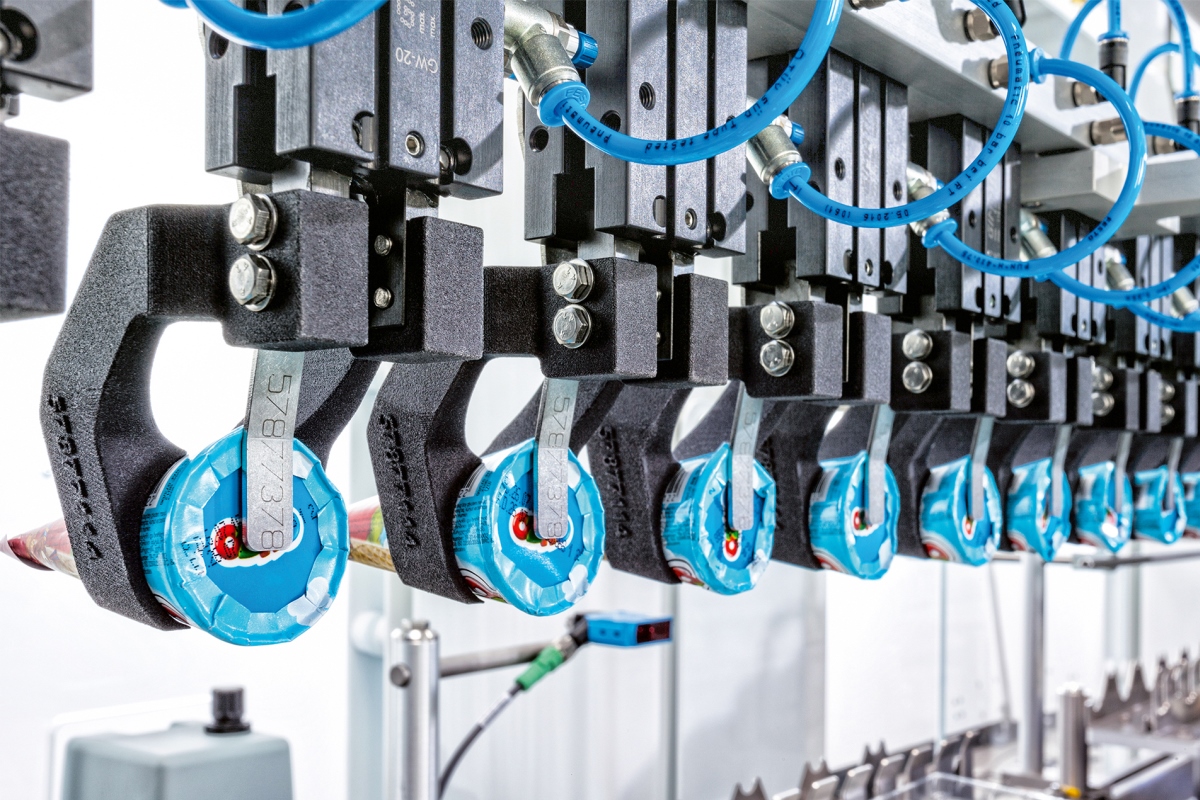
Martin Sauter: A new digital option that is growing rapidly in the industry is the additive manufacturing. We use the procedure for the 3D printing of format parts for robot tools on. Customised 3D tools that are form-fit to products can now be changed in minutes or even printed directly in production via our part streaming platform.
A second way, which allows more flexibility, is via the Machine controlSchubert uses the international OPC-UA standard as the machine language for its VMS packaging machine control system, so that our TLM systems can be easily integrated into turnkey solutions. In addition, the GS.Gate industrial gateway, which is now integrated into every new Schubert machine, offers new options for Preventive maintenance and fast service. This minimises the risk of machine failure.
pj: And how do you integrate flexibility into your machines?
Martin Sauter: We think of flexibility primarily from the product side. Different products with different pack sizes can be packed in different configurations on just one machine. I am also referring to various products such as bottles and biscuits. This is the standard we set ourselves and by which we measure ourselves.
For this we have two machine typesn: on the one hand the Picker linesthat pack individual products out of the mess. This corresponds to 100 per cent flexibility. And secondly TLM systems with product grouping - either with pick-and-place robots, which results in around 70 per cent flexibility in this calculation, or with mechanical pre-grouping. In this case, we could talk about 50 per cent flexibility, although this figure can be increased again by using interchangeable pre-grouping tools. This is where the Flexibility in the tool. However, the mechanics only make up part of how flexible a machine is. That is why we consider mechanics, electrics and software as an integrated system, the variability of which is ultimately mapped in the VMS packaging machine control system.
From the product it then continues via the Secondary and tertiary packagingDifferent pack sizes, individual products, variable product arrangements, cartons, tubular bags or trays, each made from different materials - these are all variants that we can realise on one and the same machine using modular technology. Schubert machines practically have flexibility built in by design.
pj: So what does a complete solution mean for Schubert?
Martin Sauter: In principle, this is exactly the case: thanks to the flexible technology, we are able to seamlessly reproduce the entire packaging process from the naked product to the ready-to-deliver pallet in a Schubert system. We consider the upstream and downstream processes for every order in order to provide the customer with the best solution. We also integrate intermediate processes, for example in track-and-trace solutions for the pharmaceutical industry. Classic stand-alone machines have long ceased to be a focus at Schubert; we build systems with at least two and up to any number of integrated processes.
For us, a complete solution also means the Expansion of our technology portfolio. In recent years, we have developed numerous processes that we can now integrate into the TLM systems ourselves. These include processes such as deep drawing, sealing or punching, but also processes such as filling liquids or dosing powders. As a complementary technology, we are developing our robots without a protective space, which Cobots. So you could say that Schubert supplies complete solutions that are and remain flexible in themselves.
Further information on http://www.schubert.group