E-commerce does not yet play a major role in German food retailing. Nevertheless, the trend towards online food shopping is unstoppable. Manufacturers of packaging machines must also adapt to this. They need to become much more flexible.
At the Grocery shopping Germans are conservative. They prefer to shop in one of the many grocery stores. In 2016, only 1.1 per cent of the Online trading on Food sales between Flensburg and Berchtesgaden. In the UK, however, it was already 6.9 per cent and in France 5.3 per cent.
The Filling and Packaging Processes Working Group of the Industrial Association for Food Technology and Packaging (IVLV) was interested in why this is the case and how the digitalisation of food shopping will affect value creation in the German food retail sector. The „Fraunhofer Research Institution for Casting, Composite and Processing Technology“ (IGCV) spent a year researching the topic on behalf of the IVLV. „If packaging processes are realised at a different point in the Value chain will take place because food is only packaged in a local and decentralised distribution centre?“ Will entire links in the existing value chain be eliminated? These were questions that were investigated with the help of market analyses and forecasts as well as expert interviews.

Value creation to be distributed across different channels in future
„The authors of the study, Lucas Kiefer and Martin Schreiber, found that “the„ value creation process in food retail will no longer exist in the future. They identified "Images of the future“, which give rise to various requirements for packaging technology. The conventional process of a producer handing over his goods pre-packaged for sale in stationary retail is now only one scenario. Much more frequently than this model, in which the added value including the packaging lies with the producer, the study postulates that in future: „The point of sale is in the virtual shopping basket.“ Products will be presented on internet platforms and, depending on the customer's order, combined into individual deliveries, packaged separately and then delivered.
There are already online offers for almost every taste: Germany-wide e-Commerce portals for food, regional offerings as well as shops with and without fresh produce. Value creation is shifting towards sales and distribution. Producers deliver their goods more frequently „loose“ or in bulk to shippers, where they are customised and packaged according to customer requirements. Innovative logistics systems are important key technologies to ensure the flexible and short-term availability of food ordered online.
Individual packaging concepts are required for every customer flavour
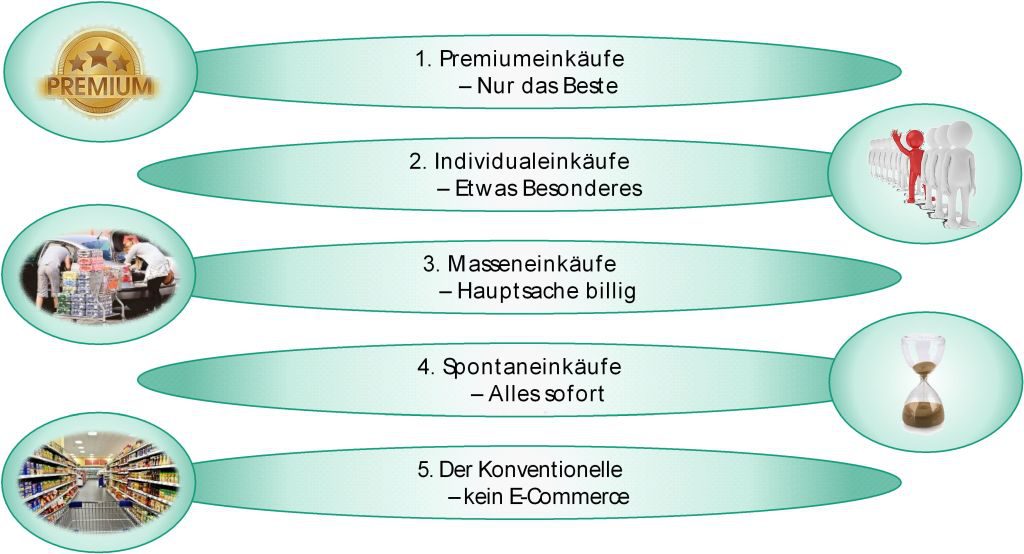
Because every customer's taste is different, but customers want to be supplied quickly with even the smallest quantities, manufacturers of packaging machines face particular challenges: The demand is for „more flexible packaging systems in terms of format, design and quantity“, write Kiefer and Schreiber. This applies in particular to the future images of „premium purchases“, „individual purchases“ and „impulse purchases“ mentioned in the study.
While premium shoppers order particularly high-quality niche products from small retailers or directly from producers, individual shoppers put together their purchases from a huge range on large internet portals. Spontaneous buyers, on the other hand, intuitively decide in favour of ready-made dishes or assortments and order from specialist mail order companies. The difference between the models lies in the fact that the premium purchase case tends to require small machines that can be easily operated by the producers, while in the other two cases, picking and packing takes place in centralised or centralised warehouses. decentralised logistics centres take place. Above all, the systems must be flexible and allow for quick batch changes. However, high-quality packaging made from ideally sustainable materials is always required.
The model that corresponds to the family bulk shopping of the analogue world in the digital world is somewhat different. In future, bulk shopping will also be done online and then possibly collected from a supermarket as a pre-packaged and pre-paid parcel. According to the IVLV study, packaging for this case must above all be „square, practical, good“ and easy to transport. Packaging machines must therefore be able to bundle and pack large quantities of products flexibly.
No standardised packaging in online retail
What are the reasons for the trend towards e-commerce in food retailing? Are packaging machine manufacturers up to the challenge? The „packaging journal“ asked the authors of the study about this M.Sc. Lucas Kiefer and M.Sc. Martin Schreiber.
pj: What are the main factors that will help e-commerce achieve a breakthrough in this country?
Martin Schreiber: The success of e-commerce in the food sector primarily depends on a strong customer focus, a diverse product range and a service offering that is tailored to the needs of customers.
In particular, products with a strong emotional connection to the customer, such as meat of a particular origin, will increasingly be ordered online in future. As these products have so far only been ordered by small retailers in small batches, they are expensive and only available in limited quantities. E-commerce makes them more accessible and ensures higher sales figures for these products. These niches will become increasingly important for producers. One of the main target groups for e-commerce will be older consumers. Several studies show that the number of so-called „silver surfers“ over the age of 50 is rising sharply. Those who can win over this group with services such as intuitive order processing or delivery at the desired time will be able to derive a very lucrative business model. Companies will have to adapt their value chain accordingly.


pj: Highly networked systems are needed to be able to react quickly and flexibly to online orders. Can the necessary investments be made by small providers?
Lucas Kiefer: This question can be answered by taking a look at the technical developments in the consumer industry. Whereas 20 years ago, only experts were able to develop and operate online shops and IT systems for intelligent order processing, today there are a large number of providers. In contrast to large providers, smaller companies and providers have the advantage that the digitisation effort of the value chain and the resulting data volumes are significantly lower. This means that more cost-effective IT solutions can be utilised. Smaller providers can also utilise platforms that provide the necessary infrastructure and thus increase the reach of their offering.
pj: The protective function of packaging plays an important role, especially for food. At the same time, consumers expect lightweight, flexible and recyclable packaging. Which materials will be used in particular?
Lucas Kiefer: A key finding of the study is that there will not be „one“ e-commerce in the food sector. We therefore do not anticipate any major changes in the area of packaging and materials in the near future. In our view, the future image of mass purchases on the Internet that we have drawn, which several of the experts interviewed associated with the „grey“ standard packaging that will have a significant impact on the packaging industry, represents the final stage of expansion of e-commerce in the food sector.
pj: Are packaging machine manufacturers already prepared for the new target group? Small retailers and producers certainly place different demands on the machines in terms of flexibility and ease of use.
Lucas Kiefer: For a long time, packaging machine manufacturers have specialised in the highest possible overall system efficiency and high throughput. From an ecological point of view, this was the best way to minimise food waste. However, machines designed in this way have major deficits in terms of volume and format flexibility. Several system manufacturers have already recognised this and are currently involved in research projects in which the Fraunhofer IGCV is also represented. These include „RoboFill - individual filling of beer“ and „AutoPack - optimisation and flexibilisation of secondary packaging using physics-based simulation“. However, according to the results of the study, the majority of manufacturers are not equipped to meet these requirements.
pj: Let's look five years ahead: will we be able to have a normal purchase delivered to our homes within a few hours? And how will these goods be packaged?
Martin Schreiber: „Same day order, same day delivery“ is what many customers want. However, this form of delivery is very expensive. High levels of investment are required to be able to offer this across the board. Consumers would have to pay an additional fee. German consumers will probably only accept this in individual cases. It is much more likely that there will be a variety of logistics and transport systems and that consumers will choose the channel that suits them best. We expect models with logistically optimised route planning and correspondingly short delivery times. The so-called self-collection concept in particular will take a large share of the market. This trend can also be observed in our neighbouring European countries.