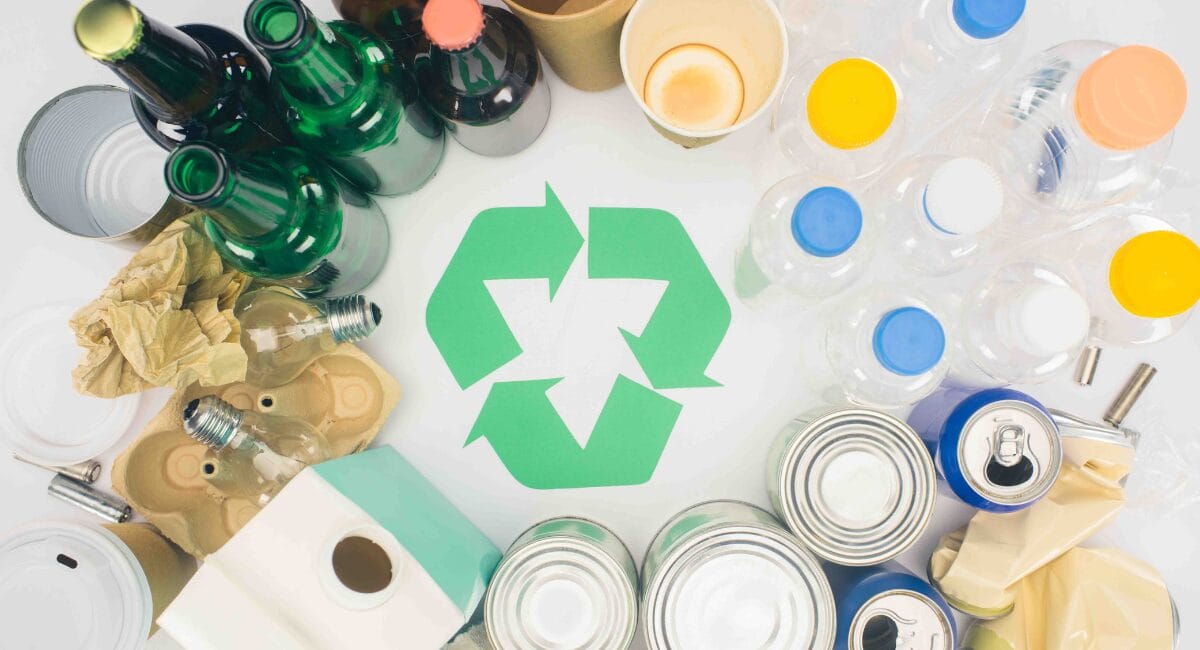
In Switzerland, the recycling of recyclable materials, particularly in the packaging sector, is mainly organised by non-profit recycling systems. How these systems are financed, why this organisation makes sense and to what extent the political framework conditions could change in the future is shown by the umbrella organisation Swiss Recycle with its new co-management.
Since 1970, the annual production of municipal waste from Swiss households has more than doubled: from 309 to 698 kilograms per person. This increase is partly due to economic growth. However, not only has the amount of waste increased over the same period, but Swiss legislation has also changed to such an extent that it continues to have a significant influence on separate collection and recycling today.
The Environmental Protection Act (EPA) of 1983 laid down the following important principles for separate collection: Waste must be recycled as far as possible and disposed of in an environmentally friendly manner and, if feasible and sensible, domestically. This goes far beyond the packaging sector.

In the 1990s, recycling developed rapidly in Switzerland, and numerous systems and industry organisations such as PET Recycling Switzerland in 1991 were set up. These so-called recycling systems were consistently responsible for the separate collection, transport and utilisation of various recyclable materials. During the same period, the overarching umbrella organisation Swiss Recycle (then known as Swiss Recycling) was founded and has since played an important role in raising awareness, networking and imparting knowledge about recycling and the circular economy in Switzerland.
Different financing models
Depending on the recyclable material, the recycling systems are financed according to different models. In the case of glass bottles, for example, there is a prepaid disposal fee (VEG). This describes a charge that is based on a legal basis and is levied with the purchase price when a product is placed on the market in order to cover the costs of subsequent disposal or recycling.
The advance recycling fee for aluminium cans, tinplate and steel sheet or PET beverage bottles, on the other hand, corresponds to a price surcharge that is levied at the producer, importer or retailer level and covers the financing requirements for recycling the product in question. This so-called VRB is usually added to the sales price of the beverage.
For a Swiss importer, for example, this means that he must must pay an early disposal fee on imported beer in glass bottles from Germany. The data for this settlement is collected during the customs declaration.
In addition to the pre-financed systems, the collection and disposal of materials such as waste paper is regulated by framework agreements with the customers, which guarantee the collecting municipality a revenue for the material. In some municipalities, collections for cork or polystyrene are also offered free of charge and financed by recycling companies.
Revision of the Swiss Environmental Protection Act
Swiss politicians have now decided to go one step further in the direction of closing the cycle. On 15 March 2024, the National Council and Council of States therefore passed an amendment to the Environmental Protection Act (EPA), which was set in motion by various political initiatives.
The planned amendment to the EPA will enshrine the principle of conserving resources and strengthening the circular economy in law. The EPA will also be amended in other places, particularly in the chapter on waste legislation. New Art. 30d USG clearly states that waste must primarily be sent for reuse or material recycling.
The USG now also provides for a relaxation of the municipal waste monopoly. Based on nArt. 31b para. 4 LPE, the Federal Council may designate municipal waste that may be collected voluntarily and without a licence by private providers. This liberalisation is intended to promote corresponding business models and improve the recycling of waste. As a result, a higher recycling rate is expected for mixed plastics (plastic) and beverage cartons, for example. Reliable figures are not yet available.
Influence of the PPWR on the Swiss packaging industry
However, not only the revision of the Environmental Protection Act, but also new regulations from Europe are having an impact on the Swiss recycling landscape. On 11 February 2025, the new EU Packaging Ordinance (PPWR) came into force, bringing with it far-reaching changes affecting the design, materials, take-back and data obligations of packaging.
For example, certain Disposable plastic packaging such as hotel toiletries prohibited and minimum recyclate content for packaging with plastic content (ten to 30 per cent depending on the product) or reduction targets (five per cent by 2030) are defined therein. The recyclability of packaging is a prerequisite: only packaging that can be recycled may be placed on the market in the EU. Design for recycling guidelines will be published by 2028.
The requirements for the technical documentation and declaration of conformity are very demanding, but are also intended to create fair competition. The PPWR therefore does far more than just impose new quotas: it focuses on system change, data quality and the assumption of responsibility along the entire value chain.
Whether as exporters, through supply chain relationships or through regional proximity: Swiss companies are affected by these changes. It is therefore important to be prepared, to review and improve the circularity of their own products and to scrutinise their data structures.
New co-management for 360-degree circular economy
While the EU is increasingly focussing on quantitative targets, only a few quotas have been defined in Switzerland to date. However, this is not seen as a disadvantage: What is needed are holistic targets and the framework provided by politicians. The industry must then implement these accordingly.
And the industry delivers: The recycling systems or industry organisations enable a coordinated, holistic implementation of closing the loop. Proven extended producer responsibility (EPR) systems, such as those in the area of PET beverage bottles, show how a cycle can be closed holistically.

Swiss Recycle, the umbrella organisation for Swiss recycling systems, is committed to a sustainable circular economy in Switzerland from an economic, ecological and social perspective. Together with its members and partners along the entire value chain, the organisation realises synergies and develops forward-looking solutions for optimising separate collection, recycling and closing the loop in Switzerland.
Since March 2025 Rahel Ostgen and Viviane Pfister took over the management of Swiss Recycle together. Both have been colleagues in the organisation for some time and are looking forward to tackling this new challenge together. „We are working flat out to continue pursuing our vision of a 360-degree circular economy. In future, we not only want to position ourselves more clearly as an overarching competence centre, but also focus our activities in the areas of awareness-raising, knowledge, networking and implementation on this goal,“ says Viviane Pfister with motivation.
Digitalisation and increased efficiency are also current keywords at Swiss Recycle. „Interest in recycling and the circular economy has risen steadily in recent years, and efficient processes and resources will enable us to meet this demand even better in future,“ adds Rahel Ostgen.