Ideas for food packaging made from renewable raw materials

Food packaging made from bio-based plastics is seen as an alternative to traditional plastic packaging, but has so far only been insufficiently adapted to their high technical requirements. By funding four research projects, the Federal Ministry of Food and Agriculture (BMEL) aims to open up new areas of application for bio-based plastics in food packaging.

Food packaging made from bio-based plastics is seen as an alternative to traditional plastic packaging, but has so far only been insufficiently adapted to their high technical requirements. By funding four research projects, the Federal Ministry of Food and Agriculture (BMEL) aims to open up new areas of application for bio-based plastics in food packaging.

The food industry in particular is calling for alternatives to conventional packaging. Bio-based plastics based on renewable raw materials are repeatedly cited as a solution. As food packaging, however, they still have a number of technical and functional weaknesses.

Four approaches are specifically promoted

With the call for funding "Bio-based plastic packaging for food", the BMEL has invited research and industry to develop ideas for improving the potential uses of bio-based plastics in the food industry. Four research approaches have emerged from this call and are now being funded by the BMEL via its project management organisation Fachagentur Nachwachsende Rohstoffe e. V. (FNR).

What they all have in common is that the packaging should have as high a bio-based content as possible and that it must be recyclable. In addition, all four approaches deal with demanding areas of application in terms of packaging technology.

Display

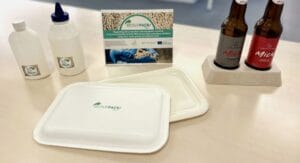
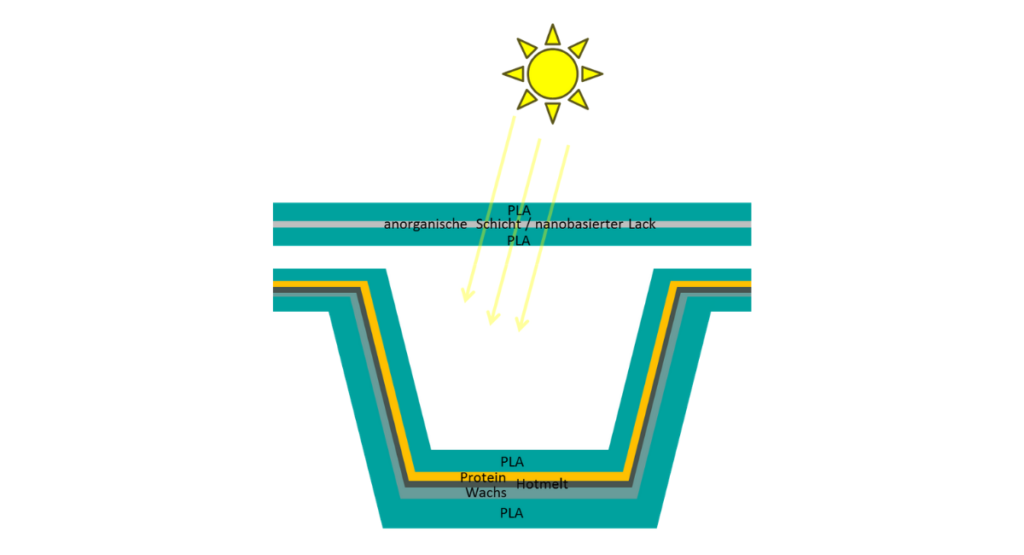
PLA4MAP - PLA trays with improved barrier properties for use in MAP packaging concepts for sensitive foods

(Graphic: Fraunhofer IVV)

Sensitive foods, such as sausage, cheese, etc., are often packaged in a modified atmosphere (MAP). The bio-based plastic polylactide (PLA) is not always suitable for this process, mainly due to its high water vapour permeability.

With PLA4MAP The aim of the project is to develop a recycling-friendly packaging concept for MAP packaging based on PLA. The packaging will consist of a thermoformed PLA tray and a PLA sealing film. The tray and sealing film will have a multi-layer structure in order to fulfil the various requirements of the food to be packaged and the packaging process. The entire packaging unit should be recyclable.

Technology development for bio-based pouch packaging

Stand-up pouches (pouch packaging) are currently booming on the packaging market. However, they are not yet available in bio-based plastics. The three project partners want to develop bio-based films and test their suitability for pouch packaging. To this end, the production of bio-based pouch packaging is being investigated on a special test facility.

In particular, the sealing of the seams, which must take place in an efficient and reliable production window, poses a challenge for the material. The aim is to produce pouch packaging from mono-films with as high a bio-based content as possible, so that simple material recycling is possible.

Bio2Bottle - Novel biodegradable bottles made of bioplastics with a high bio-based content and high barrier

The bioplastic bottles currently available on the market have various disadvantages: Bottles made from polylactide (PLA) are too permeable to water vapour and bottles made from bio-PET are not biodegradable. Four partners from research and industry now want to produce bottles made from polyhydroxyalkanoates (PHA).

The PHA compounds should be easy to process and have good material stability and a high water vapour barrier. They must also be CO2- and oxygen-permeable. In order to be able to use the bottles made from this material for microbially susceptible liquids, they must be able to be sterilised with gamma rays. The material should be recyclable, but also biodegradable.

The PHA bottles will initially not be used for food, but for window cleaning agents and liquid products for organic farming.

BioPrima - Bio-based shrink film as primary packaging for freezing applications in the food sector

Shrink films contract when exposed to heat. This means that they wrap around the product like a second skin, either as primary protection, e.g. for frozen pizza, or as transport protection, e.g. for a pack of drinks bottles. The first bio-based shrink films have been on the market for some time, but are not suitable for deep-freeze applications.

Set here the two network partners on. Based on thermoplastic starch (TPS), they want to develop a shrink film with a very high bio-based content (up to 100 %) that can be frozen, processed on an industrial scale and is both biodegradable and recyclable.


Source: FNR - Agency for Renewable Resources

Green Packaging - More news

Sturdy bags with recycled polythene

ExxonMobil and the Selene Group have jointly developed sturdy bags made from 50 per cent recycled polyethylene. This innovation is designed to support the circular economy without compromising performance.
Read more "