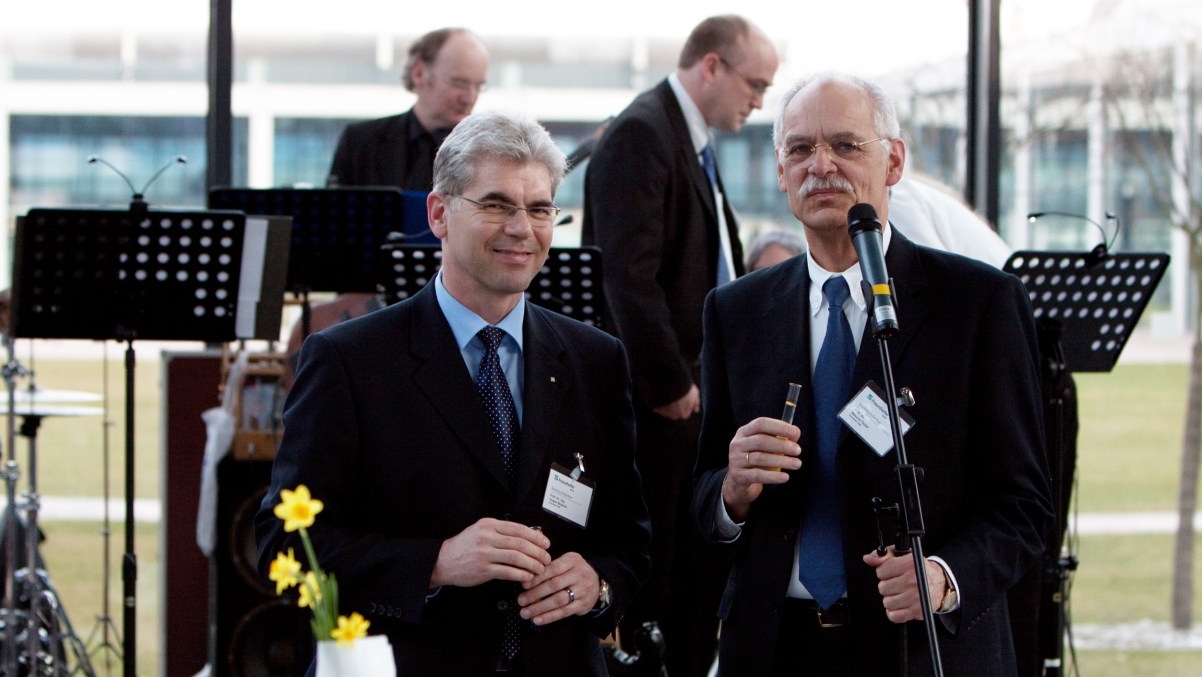

A young institute with a long tradition: this was the motto under which the Fraunhofer Institute of Optronics, System Technologies and Image Exploitation IOSB celebrated its tenth birthday, focussing on current and future challenges such as „AI engineering“.
AI engineering, i.e. the engineering, plannable and methodical use of artificial intelligence processes, is the topic of the future, as became clear at the institute's anniversary event on 6 March 2020 at the ZKM (Centre for Art and Media) in Karlsruhe. Although AI engineering is already being used in many contexts today, the processes are usually like a ‚black box‘ whose functioning is not fully understood and whose results can hardly be predicted.
Created in 2010 by the Fusion The Fraunhofer Institute for Information and Data Processing IITB in Karlsruhe and the Ettlingen-based Research Institute of Optronics and Pattern Recognition (FOM) of the Research Society for Applied Natural Sciences (FGAN), the Fraunhofer IOSB is today an important centre of research and development in the field of optronics and pattern recognition. Research and technology partner for public authorities and companies and significantly involved in developments in areas such as sensor data management, intelligent video evaluation, mobile robots and the digitalisation of production / Industry 4.0.

„The merger of the two long-established institutes IITB and FOM has now clearly proven to be a success story,“ said Prof. Dr.-Ing. habil. Jürgen Beyerer, Director of Fraunhofer IOSB, on the occasion of the anniversary.
Strong growth as an indicator of success
Without having set out to do so, the institute has grown significantly, from a total budget of just under 40 million euros in 2010 to around 63 million euros in 2019. „If you successfully research, develop and work on relevant topics and if you completely satisfy your customers and donors, then that's how you grow,“ Beyerer continues.
The merger came about in the course of the 2009 Integration of FGAN into the Fraunhofer-Gesellschaft. Fraunhofer IOSB celebrated its foundation on 17 March 2010 at Messe Karlsruhe. The roots of the two institutes, which merged in 2010, can each be traced back to the 1950s can be traced back. However, they came from different traditions: While industrial contracts have always been a central pillar at Fraunhofer, the FOM and its umbrella organisation FGAN were completely in the service of defence research and were financed by the Federal Ministry of Defence.
Broad range of expertise - focus on digitalisation and AI
Relieving the burden on people through intelligent sensor systems: this is the vision of research at the Fraunhofer IOSB. To this end, the institute covers a broad, interrelated spectrum of expertise that is unique in this combination.
It ranges from the physical principles of signal generation, optical sensors and the (real-time) evaluation of sensor data to the utilisation of the information it contains for people and machines. Interoperability through open standards, IT security, data protection and innovative human-machine interfaces are important aspects.
Artificial intelligence (AI) and machine learning (ML) methods are a key tool that is frequently used in research and development work at Fraunhofer IOSB. This was also made clear at the celebratory event, where experts from industry and science discussed the topic of AI and machine learning. ‚Digitalisation: What remains? What will?‘ discussed.
„Today, everyone is trying to solve more or less every problem with ML methods and AI,“ stated Institute Director Jürgen Beyerer. „However, the results are often unpredictable.“
AI engineering: making artificial intelligence plannable
This results in an important research focus for the Fraunhofer IOSB for the coming years: AI Engineering - In other words, the challenge of turning the use of AI and ML into an engineering discipline. „In other words, how do we get from purely data-supported processes to a methodical process model, as is usually the case in the engineering sciences,“ explains Beyerer.
According to Beyerer, the researchers at Fraunhofer IOSB are working on this in various application contexts, ranging from controlling the energy system to mobile robots and industrial automation. This topic is also at the top of the agenda at the Karlsruhe Research Factory, which is currently under construction and will be operated by Fraunhofer together with the Karlsruhe Institute of Technology (KIT).
According to Beyerer, the aim is to Systems controllable even when using AI algorithms to be able to understand their decisions and plan their performance in advance: „Engineers normally proceed in such a way that they can be sure at design time that a system will do what it is supposed to do at runtime. We also want to achieve this when using AI and ML - and we are working hard to do so.“
[infotext icon]About the Fraunhofer IOSB:The Fraunhofer-Gesellschaft is the leading organisation for applied research in Europe. Under its umbrella, 74 institutes and research facilities work at locations throughout Germany. One of these is the Fraunhofer Institute of Optronics, System Technologies and Image Exploitation IOSB with a total of around 700 employees in Karlsruhe, Ettlingen, Ilmenau, Lemgo, Görlitz and Beijing. Its main areas of research are Industry 4.0, Information management and multisensory systems, that support people in perceiving their environment and interacting with it. [/infotext]
Source: Fraunhofer IOSB