Plastics are an important resource that must be recycled and not released into the environment as waste. In order to be able to control and optimise the material flows in a targeted manner, the material flows and the quantities entering the environment must be known.
Based on this common claim, six associations and organisations in the plastics value chain have developed a Pilot study on global plastic flows including the handling of post-consumer plastic waste was commissioned. The results have now been published as part of the world's leading trade fair K 2019.
„The Global Plastics Flow Study was the first time that data and facts on the Circular economy in 44 countries around the world documented in a standardised and comprehensive manner and the previous weak points in waste collection and recycling clearly identified,“ explained Dr Jürgen Bruder, Managing Director of the IK Industrievereinigung Kunststoffverpackungen and project manager of the study, emphasised the unique contribution of the survey in the fight against waste discharges into the environment.
„The amount of waste that ends up in the environment is dramatic and must be a wake-up call for the entire value chain. Waste management in all its variants must be the common goal of business and politics. Hot spots with an increased need for action to reduce unorganised waste treatment are clearly identifiable from the study results.“
What is special about the study is that the results were not obtained from a helicopter perspective, but through extensive regional surveys. The measures are just as varied as the results: While waste collection must be prioritised in some regions of the world, Europe, for example, needs to expand recycling and enforce the landfill ban.

The study was conducted by the Conversio Market & Strategy GmbH in close co-operation with associations of the Global Plastics Alliance and numerous other institutions.
Key findings on material flows in 2018
The comprehensive study provides important figures on the global production of plastics, their recycling and the loss of recyclable materials. The following key findings emerge at a global level:
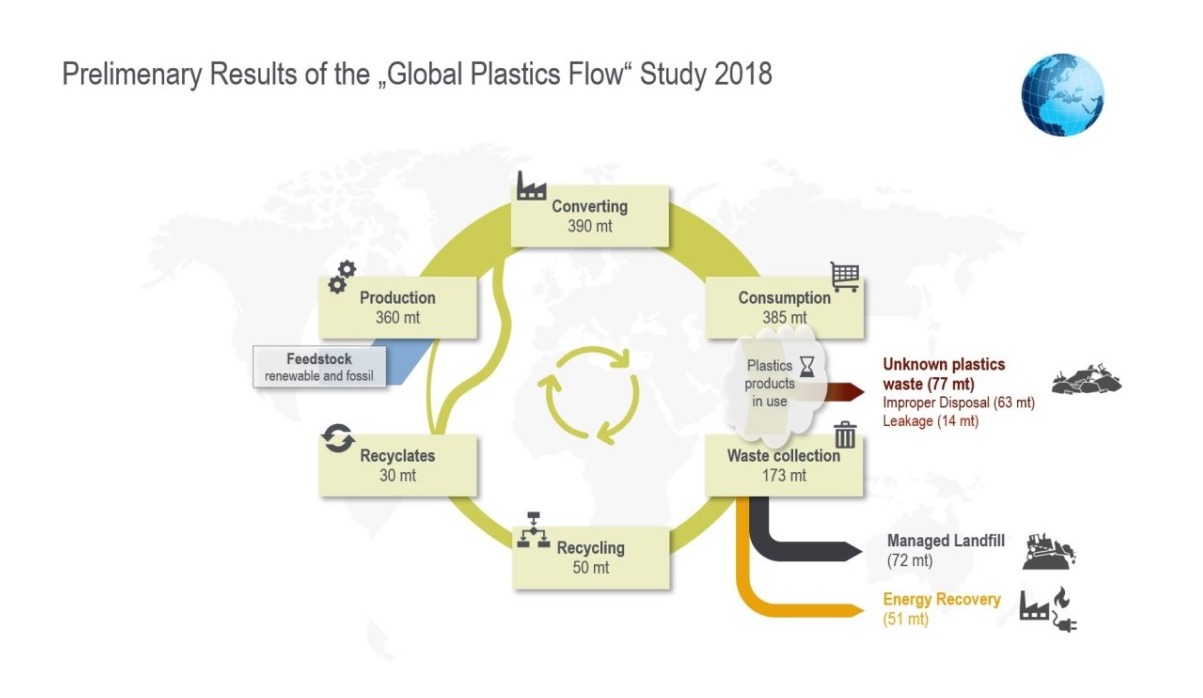
- Production: Worldwide, 360 million tonnes of plastic are produced.
- Processing: In addition to the 360 million tonnes of virgin material, a further 30 million tonnes of recycled material are used, meaning that a total of 390 million tonnes of plastics are processed every year.
- Post-consumer waste: Around 250 million tonnes of consumer plastic waste per year are generated from the sum of used plastic goods.
- Waste management: Of this, 173 million tonnes of plastic waste is collected.
- Waste discharges into the environment: 63 million tonnes of plastic waste are disposed of improperly, for example in uncontrolled landfills, and 14 million tonnes are carelessly thrown away (leakage)
While closed loops are defined differently around the world, there is a consensus among the partners involved in the study that the Collecting, sorting and recycling post-consumer waste plastic must have top priority in order to prevent the material from entering the environment. In addition, it must be ensured that the Trade in waste no additional emissions into the environment.
[infotext icon]The summarised study is available as a download available at: http://www.k-online.com/GPFStudie [/infotext]Structured data collection, global cooperation, high representation rate
The Global Plastics Flow Study is an important step towards collecting, processing and evaluating global data on post-consumer plastic waste in a systematic structure. The participating associations and organisations from Germany and Europe want to use the study to Providing impetus for the global discussion of measures against waste discharges into the environment. The study will make a contribution to the Global Information Project of the „Alliance to End Plastic Waste“ an open source database especially for prioritising investments in waste management.
At the same time, the study is intended to Starting point for future studies serve to document progress in global waste management. This is another reason why one of the objectives of the organisations involved in the study is to involve further stakeholders and thus expand and further verify the breadth and depth of the data now available in a first draft.
For the current data, information on plastics from production to waste from 44 countries could be processed, which together cover around 60% of the world's population and around 80% of global GDP.
The focus of the country and continent-related and Global data collection and analysis stand:
- the plastic material flow from production through processing and consumption to waste
- Subdivision of plastic flows into the areas of packaging and non-packaging
- Different loss rates, i.e. environmental inputs of plastic waste per country/continent
- Various waste management systems, each with specific disposal structures (recycling, energy recovery, organised landfill, etc.)
- different framework conditions for plastics collection, recycling and disposal.
Source and pictures: IK Industrievereinigung Kunststoffverpackungen e.V. (Industrial Association for Plastic Packaging)