


Green technology
How companies save energy with modern motor control
In industry, many motors run continuously - even when full power is not required. This is not only a burden on the climate, but also on the balance sheet. The use of frequency inverters promises a simple solution here: they help to significantly reduce energy consumption, wear and CO₂ emissions. The following article shows how this works.
Energy costs - and it costs a lot. But it becomes even more expensive when it simply goes up in smoke. In industry, countless motors run continuously, at full power, even when there is no demand. The result: extreme power consumption, machine wear and CO₂ emissions. And: It would be easy to avoid. Because the solution is a frequency inverter. It regulates how fast a motor really needs to turn instead of constantly running at full throttle. And that is not only easy on the wallet, but also on the environment.
Why motors often work too much
Pumps or ventilation systems are usually operated via on/off switching - so either full power or nothing at all. Uncomplicated, but unfortunately inefficient. This is because very few processes require 100 % of power on a permanent basis. A lower speed would often be sufficient.

But how can this be realised? With frequency converters! Frequency inverters regulate the frequency and voltage of the motor, which influences the speed. A fan that only runs at 80 % instead of 100 %, for example, not only consumes 20 % less energy - but often over 40 %. This is due to the physical relationship between speed and power consumption: small differences in speed = large differences in consumption.
So instead of running motors stubbornly at full load, the frequency inverter adapts the power precisely to the demand.
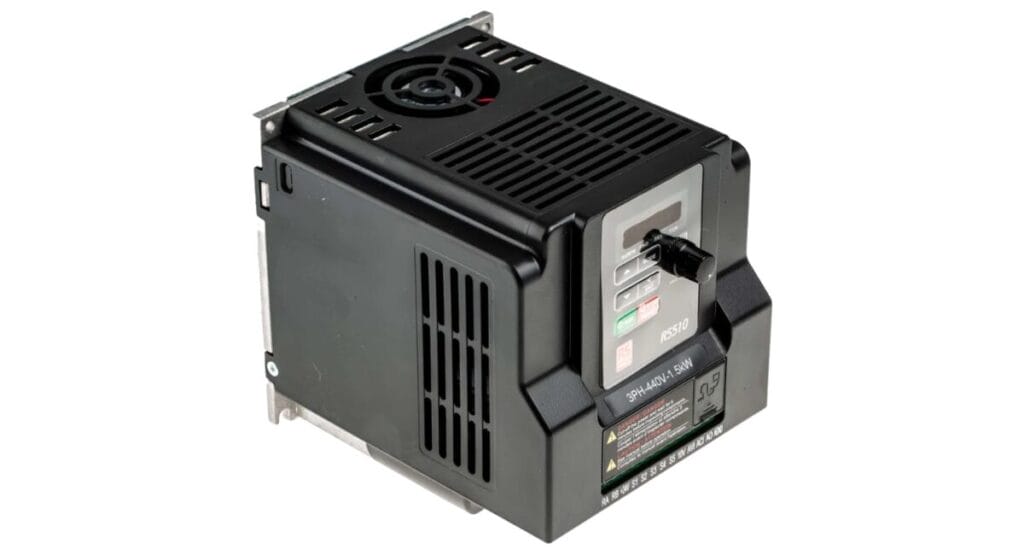
Typical areas of application - and potential savings
Frequency inverters make sense wherever motors do not always have to run at maximum power. Examples?
- ventilation systems: Full power instead of day & night - adjust according to air quality or room occupancy.
- Conveyor belts: Only as fast as the product is flowing.
- Water pumps: Adaptation. To pressure, demand or time.
- Cooling and heating systems: Precise temperature control.
The best thing is that many of these systems are already there - they just need a small upgrade.
Environmentally friendly AND economical
Sure, Sustainability sounds good. But does it also benefit the balance sheet? The answer: and how! In many cases, the investment pays for itself within a few years. Some companies even report savings of over 30 %. And that's just one aspect.
Because less power consumption not only means lower energy costs, but also more relaxed machines. Instead of starting at full throttle, the motors start gently and stop smoothly. This reduces wear and tear and also saves on maintenance costs. Machines last longer and breakdowns are less frequent - all thanks to a little clever speed regulation.
Not to forget: The environmental aspect. Less energy consumption = fewer emissions. For companies that are serious about their sustainability goals - or simply have to fulfil them - this is a clear plus point.
Digitalisation and Industry 4.0 - when frequency inverters think for themselves
Frequency inverters are now smarter than many an office PC. In modern industrial environments, they communicate with other machines, servers or cloud-based control centres via Modbus, Profinet or Ethernet/IP. Real-time communication is no longer a dream of the future for them.
The great thing about it is that you don't even have to stand next to it. Many of these devices come with clever features - automatic fault diagnosis, for example. Or remote maintenance if something goes wrong. Some even optimise load distribution independently. This makes frequency inverters a real must-have in the digital toolbox of every future-orientated company.
Promotion & future - Turn now and save twice
And if you're thinking: „Sounds good, but it'll probably cost a fortune!“ - Don't worry. In many countries there's money from the state. Funding programmes for energy-efficient technologies are now standard when it comes to the big goal: achieving climate targets, reducing CO₂ emissions and still remaining economical.
In short, it has never been easier to integrate modern technology into production processes and receive subsidies at the same time.
Because one thing is clear: the future of industry is saving energy, it is electric, networked and anything but wasteful. Frequency inverters play a key role in this. They ensure that energy arrives where it is really needed - and in exactly the right amount. No waste, no unnecessary idling.
Upgrading now not only saves electricity and money. They are also positioning themselves strongly in an economy that is increasingly focusing on sustainability, digitalisation and smart solutions.
The bottom line? Small appliances, big savings
Frequency inverters play a key role when it comes to efficiency, sustainability and cost savings. If you control your motors precisely instead of just letting them run, you can drastically reduce your energy costs. And you can also make a contribution to climate protection.
So why run at full speed when you can do better? It's worth taking a look at the speed - for the environment, your wallet and the future.
