30 years ago today, on 28 September 1990, „Der Grüne Punkt - Duales System Deutschland Gesellschaft für Abfallvermeidung und Sekundärrohstoffgewinnung mbH“ was founded in Bonn.
Once founded as a non-profit organisation, Der Grüne Punkt is now a competitively oriented group of companies with production facilities for recycled plastics and its own product development. The group operates in the business areas of take-back systems, secondary raw material development, production and marketing, as well as in consulting on Design for Recycling and Use of recyclate.
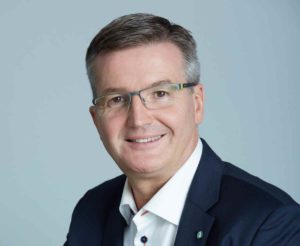
„Back then, nobody would have believed that Der Grüne Punkt would one day become a role model for similar companies around the world. But that's exactly what it is today. And we are proud of it. Thanks to Der Grüne Punkt, waste separation has become completely normal in Germany. Numerous similar companies have sprung up all over Europe based on this model. And countries around the world are following our Role model, to set up collection and recycling systems for packaging waste.“ Michael Wiener, CEO Green Dot

Founded in 1990 by industry and trade
At the end of the 1980s, Germany was faced with a growing mountain of waste. Municipal waste was mainly collected as residual waste and deposited in landfill sites. The then Federal Environment Minister Klaus Töpfer therefore required companies that place packaged products on the market to take back the packaging after use and recycle it. Or alternatively to commission a third party to do so, but in any case to bear all the costs. Der Grüne Punkt was founded in 1990 to fulfil this obligation. By 1993, it had set up a second - dual - disposal system for packaging waste only. Initially, this was done in anticipation of the Packaging Ordinance, which only came into force in 1991.
The immense costs for the nationwide introduction of the yellow bin, yellow sack, glass container etc. were borne by industry and trade. Packaging initially became more expensive as the costs were passed on to the product costs. As a result, many companies cut back on packaging or made it lighter.

To finance its tasks, the The Green Dot„ trademark“ was introduced as a licence mark. As many countries followed this example, the logo with the two green arrows became one of the most recognised trademarks worldwide in the 1990s.
Introduction of the competition in 2003
As Der Grüne Punkt was the only operator organising the dual system, it was not allowed to make a profit. This changed in 2003 when, following decisions by the European Commission and the Federal Cartel Office Competitors in the market occurred. The introduction of competition in the tendering process for waste disposal contracts and between the system operators, as well as technical innovations, halved the costs of the dual system between 2000 and 2015.
„We were and are not a company like any other,“ emphasises Michael Wiener. „What we do is largely determined by political decisions in Brussels and Berlin. What is separated and recycled at all?“ The Packaging Act, for example, with its higher recycling targets, has ensured that companies in the circular economy in new and better sorting systems invest. „We are committed to making sensible decisions. And we show what is possible,“ emphasises Wiener. In 2010, Der Grüne Punkt itself entered into the production of recycled plastics. Today, it operates two recycling plants for plastic waste from the Yellow Bag and its own facility to develop new products from recycled plastic.
Innovative plastics recycling
The recycling loop has been closed with plastic packaging that is made from waste and can be bought everywhere today. Plastic packaging from the supermarket shelf has once again become plastic packaging for the supermarket shelf. The basic material for this is Systals, The Green Dot's plastic recycling programme. „Technically, high-quality recycling of plastic waste has long been possible. Economically, however, it is not making any progress,“ says Wiener. The reason: new plastics are becoming cheaper and cheaper due to falling oil prices and large production capacities, while plastic recycling is still more of a niche business.
„It's like with renewable energies: you need the political will to change.“ It would be conceivable for Wiener, for example, Minimum utilisation rates for recyclates for various plastic product groups. The European Union has already introduced such a quota for PET drinks bottles. From 2025, they must consist of at least 25 per cent recycled material. „This has significantly stabilised the market for high-quality PET recyclates. We need something like this for other product groups and types of plastic,“ Wiener is convinced.
It is precisely because of innovative products made from recycled plastic that Germany is still the role model for recycling worldwide. „The Green Dot is still a figurehead,“ Wiener is convinced. „My colleagues and I have been working every day for 30 years to live up to this claim. And you can still expect a lot from us.“
At the beginning of March 2020, for example, a nationwide Information campaign „Waste separation works“ , which informs consumers about correct waste separation.
[infotext icon]The Der Grüne Punkt - Duales System Deutschland GmbH (DSD) helped introduce and establish the dual system in Germany with the Green Dot as its trademark. It stands for intelligent take-back systems and the development and marketing of innovative recyclates and services. Systec Plastics produces premium recyclates under the Systalen brand for the international market at its Eisfeld and Hörstel sites. The companies are combined in DSD - Duales System Holding GmbH & Co. KG[/infotext]
Source: DSD - Duales System Holding GmbH & Co. KG