A study by the Gesellschaft für Verpackungsmarktforschung (GVM) has scrutinised the trend towards replacing more and more plastic packaging with paper composites and examined the effects on the circular economy.
Experts from industry, politics and science have been critically observing the trend towards the substitution of pure plastic packaging with paper composites for some time. i.e. packaging made from a material mix of paper and plastic. It is not uncommon for these to be Less plastic This means that the packaging is advertised as being particularly environmentally friendly. This trend can be observed more frequently, especially with service packaging and higher-priced food and organic products.
A study by the Society for Packaging Market Research (GVM) on behalf of the IK Industrievereinigung Kunststoffverpackungen now confirms these concerns and comes to three key conclusions under the heading: Paper composites harm the circular economy.

Insight no. 1: Paper composites cause more packaging waste
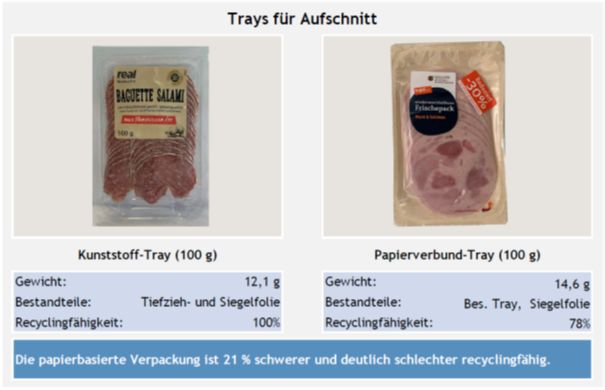
Paper composites are already increasingly replacing pure plastic packaging and their Share will continue to increase until 2025. The decisive factor is their good marketability in times of general plastic bashing. On average, paper composites require 40 per cent more material to package the same amount of products. It is expected that paper composites will generate 25 thousand tonnes more waste in total by 2025.
Insight no. 2: The material mix of Paper and plastic cause recycling problems
As a rule, only the fibre content of the composite packaging is recyclable, which is usually over 70%. The only option for the remaining plastic coating is energy recovery. In addition, the GVM states that the actual recycling of the fibre content is currently lagging far behind the theoretical recyclability and that the increasing proportion of composites in composite packaging is not yet fully recyclable. Increasing problems with waste paper recycling is prepared. It is therefore particularly regrettable when easily recyclable plastic packaging is replaced, which is the case in the majority of cases.
Insight no. 3: Plastic packaging that cannot be recycled or can only be recycled to a limited extent is also replaced
Paper composites are also partially replacing plastic packaging, which currently has limited or no recyclability. However, due to the investments currently being made in the circular economy, GVM assumes that the Further significant improvement in recyclability in the plastic packaging market by 2025 becomes. Substitution with paper composites therefore competes with the optimisation of recyclability in the plastic packaging market.
Sustainability strategies focus on recyclable plastic packaging and the use of recyclates
„As is so often the case, it's worth taking a second look, even behind green-looking headlines and advertising messages,“ says Dr Isabell Schmidt, IK-Managing Director and expert for the circular economy confirmed her sceptical stance. „The Replacing plastic packaging with paper composites is greenwashing. If the special properties of plastic as a packaging material are important, then paper fibres should be completely avoided and fully recyclable plastic packaging should be chosen.“
The interviews conducted by GVM show that many distributors also want to follow this path. Many market participants express strong doubts about the ecological benefits of paper composites and want to strengthen the use of recycled plastics in the interests of sustainability. The vast majority of respondents do not want to replace their plastic packaging with paper composites.
The study conducted by GVM analyses the following questions: How strong is the substitution by paper composites expected to be by 2025? In which market segments will it take place? And what impact will it have on material consumption and the recyclability of packaging?
All plastic-coated paper packaging with or without aluminium is counted as a paper composite, even if the paper content is over 95%. The substitution of plastic packaging with pure paper packaging and other materials as well as the trend towards unpackaged goods were not included in the study. Recyclability is measured according to the Minimum standard of the Central Agency Packaging Register.
Source: IK Industrial Association for Plastic Packaging