The environmental impact caused by the disposal of plastic is a recurring topic of discussion. A recent study by ETH Zurich has now taken a look at the beginning of the life cycle of plastic and has come to new conclusions: More CO2 emissions are produced during the production of plastic than during its incineration.
In addition to the visible pollution caused by plastic, there is also a great deal of pollution that is not visible at first glance: in 2015, the plastics industry was responsible for 1.6 billion tonnes of global CO2 emissions, with the According to the researchers, the majority of these emissions (around 96 per cent) are generated during the production of plastics. The Researchers at ETH Zurich conclude that twice as much fossil energy is burned in the production process as is contained in the plastic as a raw material.
Outsourcing of production
So far, research has mainly focussed on the environmental damage caused by the disposal of plastic. And this damage is already enormous: the waste management system prioritised in Germany and some other European countries Incineration of plastic packaging produces an average of three grams of CO2 from every gram of plastic and also represents a waste of this valuable raw material.

The fact that the production of new plastic causes more CO2 emissions than incineration makes Virgin Plastic's carbon footprint worse than previously feared. According to the study, the decisive factors for the amount of energy used in production are primarily the steadily increasing use of coal-fired electricity in production. This applies primarily to the Booming plastics industry in emerging markets such as China, India and Indonesia, where the energy required for new plastic mainly comes from climate-damaging coal-fired power plants. According to the study, many EU countries and western industrialised nations have outsourced the energy-intensive production of plastics to these countries.
Climate protection through the circular economy
The increased use of renewable energies would help to reduce the CO2 footprint in the production of plastic. However, it would be more effective to Replacing the production of new plastic with closed-loop management. High-quality plastic recycling thus contributes to active climate protection.
„The study once again makes clear what we have known in principle for years: The Recycling plastic is essential to protect the climate and the environment. And we show that it is possible. Other manufacturers are now called upon to follow our example. We believe that politicians have a duty to promote plastic recycling through targeted incentives so that it becomes more attractive for companies to use recyclate from a financial perspective too.“
Reinhard Schneider, Werner & Mertz owner
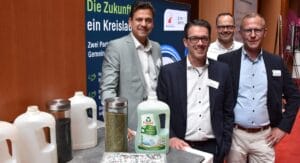
The switch to recyclate is failing for many manufacturers primarily due to the higher price compared to new plastic made from fresh crude oil. Werner & Mertz is prepared to bear these temporary additional costs. The mid-sized company has sold all of its transparent PET bottles of the brand Frog to 100 per cent used plastic. The company not only uses post-consumer material from the European beverage bottle collection (bottle-to-bottle), but since 2014 has also been using an increasing proportion of recycled material from European household collections such as the Yellow Bag (now 50 per cent).
Source: Werner & Mertz
Werner & Mertz - More news


Werner & Mertz and PreZero start co-operation

Cooperation for innovation in recycling

Red recyclate is now recyclable

PET bottles with a high proportion from the Yellow Bag