Hydrogen in tinplate production

thyssenkrupp Rasselstein is involved in two research projects that are looking at how hydrogen as a fuel can also reduce CO2 emissions in steel processing, i.e. not just in steel production.

The Federal Ministry for Economic Affairs and Climate Protection is funding two joint projects in which thyssenkrupp Rasselstein GmbH is involved. Both projects deal with the question of how hydrogen as a fuel can reduce CO2-emissions in the steel industry can also be reduced in further processing, i.e. not only in steel production.

Both research projects are part of the long-term decarbonisation strategy of thyssenkrupp Steel Europe AG, which, in addition to iron and steel production also includes all downstream production processes. They are based on thyssenkrupp Steel Europe's voluntary commitment to be completely climate-neutral by 2045.

The research projects are an important part of the sustainability strategy at the Andernach site for Germany's only tinplate manufacturer: By 2045, the company aims to produce around 400,000 tonnes of CO2-save emissions. Both projects are about the Use of hydrogen in the energy-intensive annealing processes of tinplate production. These processes are required to restore the crystalline structure of the material that has been destroyed during cold rolling.

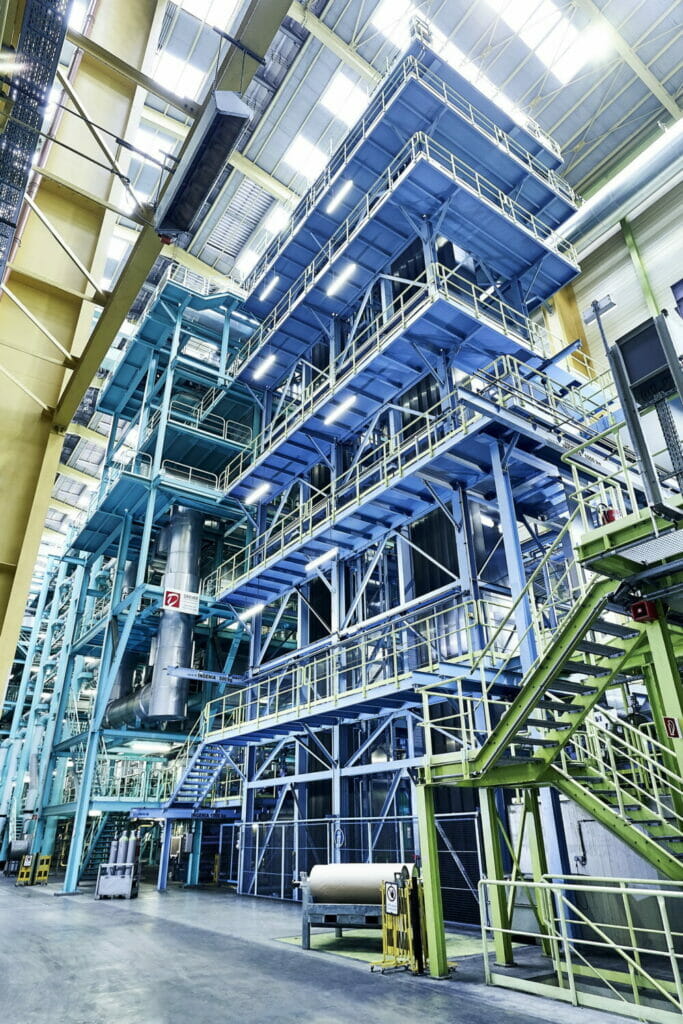
Replacing natural gas with green hydrogen

The research project „FlexHeat2Anneal“ the focus is on the use of hydrogen in the continuous annealing process, in which the ultra-fine strip is unwound and recrystallised over rollers at high temperature in short throughput times.

Display

To date, natural gas has been used primarily for annealing the ultra-fine strip. In future, the fossil fuel is to be gradually replaced by the addition of green hydrogen.

„The planned flexible use of hydrogen in annealing raises various questions. Hydrogen burns hotter than natural gas, for example. The burners and radiant heating pipes must therefore be adapted. The exhaust gas also contains a lot of water vapour as a result. We will only be able to judge what this means for the process once we have completed our tests in the laboratory and applied our findings to the large-scale plant in real operation. And of course we need adapted security concepts, to operate our systems reliably at all times, even with hydrogen.“

Torsten Schmitt, Expert and responsible electrical engineer for the maintenance of conveyor systems at thyssenkrupp Rasselstein

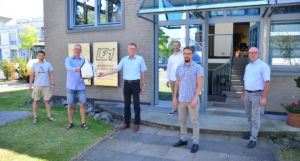
thyssenkrupp rasselstein hydrogen research
The „FlexHeat2Anneal“ research project focuses on the use of hydrogen in continuous annealing. (Image: thyssenkrupp Rasselstein)

100 per cent hydrogen

The aim of the „H2-DisTherPro“ research project is to substitute carbon-containing fuel gases with hydrogen in discontinuously operated thermal processing plants. This is being trialled, up to 100 per cent hydrogen on the bell annealers from thyssenkrupp Rasselstein. In this process, the ultra-fine strip remains stacked as coils for up to 48 hours and also recrystallises here.

The research project focuses on dThe adaptation of the infrastructure to integrate hydrogen, The focus is on modelling the discontinuous annealing process with hydrogen heating and long-term testing on selected annealing bonnets.

„Here, too, safe operation must be guaranteed and consistently high product quality ensured. As part of the research project, a test facility for the development of a suitable burner technology is being set up in the Duisburg technical centre of the VDEh Operations Research Institute. At the same time, the internal energy processes in Andernach are already being adapted for the subsequent installation of a demonstrator.“

Dr Peter Kirchesch, Project Manager Research Projects at thyssenkrupp Rasselstein. 

As part of the three-year project, the thyssenkrupp Rassselstein GmbH together with thyssenkrupp Steel Europe AG, VDEh Betriebsforschungsinstitut GmbH and Küttner Automation GmbH. With the tests, the partners are conducting practical basic research that is of interest far beyond their own plant.

„Whether for melting, moulding, forming, drying or heat treatment: Burner technologies are used in various industries. The more we decarbonise, the more knowledge we can harness for various industrial processes.“

Dr Daniel Schubert, Competence Centre Metallurgy of thyssenkrupp Steel in Duisburg

Sourcethyssenkrupp Rasselstein

Science and research - More news

Thanks to Tetra Pak, the MAX IV research centre is now all about fibres.

Tetra Pak launches research project

Together with the Swedish research centre MAX IV in Lund, the packaging manufacturer Tetra Pak is launching a project to research fibre materials. The aim is to gain insights into the nanostructure of packaging materials.
Read more "

University of Hohenheim participates in EU research project MyPack

In the MyPack project, the participating researchers and companies are driving forward the market launch of innovative and sustainable packaging based on renewable raw materials. The University of Hohenheim in Stuttgart is also involved. Measured by the amount of funding, the project is one of the most important at the university.
Read more "