
Hygiene and food packaging

Dr Andrea Dreusch writes about the strict legal regulations imposed on packaging manufacturers in the food sector.

Back in issue 3/22, Dr Andrea Dreusch wrote here about the strict legal regulations imposed on packaging manufacturers in the food sector. The microbiological area in particular can quickly become a stumbling block for inexperienced producers. A well thought-out hygiene system is therefore a must.

When the HACCP analysis (Hazard Analysis and Critical Control Point) has identified microbiological risks, hygiene measures are often the solution. But hygiene is more than just cleaning and disinfection. Packaging manufacturers would do well to include this topic in a management system. The result is low germ loads on the products and satisfied customers.

Hygiene management

DIN 15593 deals with hygiene management in the production of food packaging. As is usual with harmonised management standards, everything from management duties and documentation to procedures for dealing with faulty products and complaints as well as the topics of monitoring and control and internal audits are regulated in a familiar manner. The standard also requires a Hazard analysis, risk assessment and prevention programmes.

The points described here cover the basic measures to avoid contamination. They enable the control of microbiological inputs, even if the formulations are kept very open and require the company to be more specific with regard to its own processes. The approach to continuous improvement is also the basis for the rapid detection of errors in this management system., the correct correction and sustainable prevention of recurrence.
Display

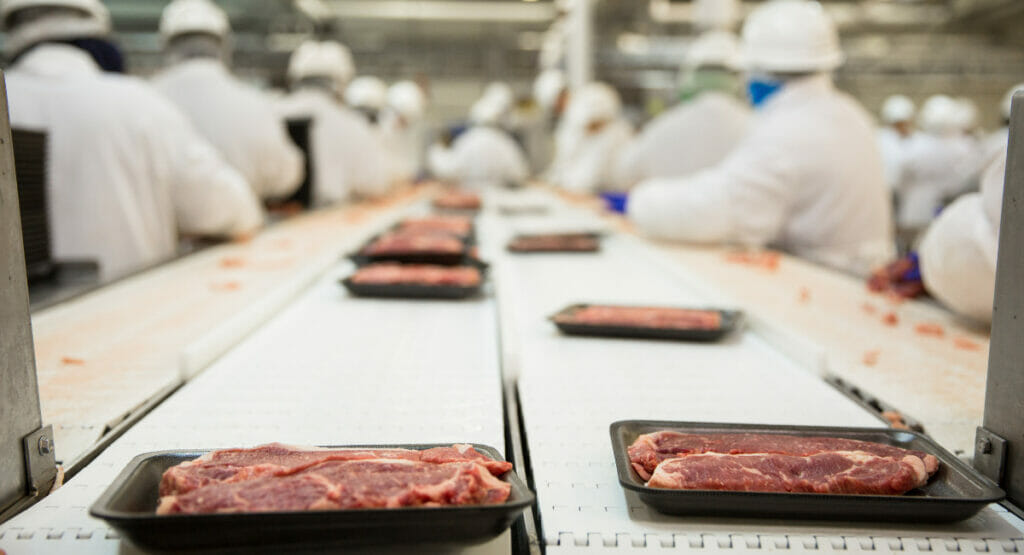
Picture of a production line for meat products
(Image: El Nariz/shutterstock)

Prevention programmes

It is by no means sufficient if only „cleaning and disinfection“ are regulated for „hygiene“. DIN 10553 lists generally sensible precautionary programmes for the production of food packaging. They are also described in DIN ISO/TS 22002-4. The standard, which is part of the FSSC system, recommends preventive regulations for people, machines, materials, methods and the environment.

With regard to the equipment used (machine), for example, it requires a „hygienic design“. More detailed guidance can be found in DIN EN 1672-2. The private sector standards such as IFS PACsecure or BRCGS Packaging Materials help with useful guidelines.. The company decides which topics need to be considered on the basis of a risk assessment. Once all the necessary prevention programmes have been implemented, the System validated and released with a step check.

Preparation

Packaging should support the shelf life of the food. This means that it should not provide a breeding ground for germs, nor should it itself harbour germs in significant quantities. Permitted materials and possible substance transfers are extensively regulated by law. The germ limits are more difficult. Here, meaningful specifications are often sought in vain.

It can therefore be useful to comply with the limit values proposed for the food sector itself. DIN 10516 makes recommendations here. The Standard proposes limit values for cleaned and disinfected surfaces. For quick tests according to other test parameters, suitable values can be found in DIN 10502-2.

Table with details
(Dr Andrea Dreusch, Director CPM Unternehmensberatung Lebensmittelsicherheit in Karlsruhe)

Regardless of which values are to be used, it is essential to clarify the test method and the permissible fluctuation range with the customer in advance.

Stage control - Validation

Validation shows whether the prevention programmes are suitable. A microbiological step-by-step check is suitable for this purpose. In practice, a Floor plan with layout plan The following table should be used to record where microbiological contamination could occur during a tour of the plant. As a minimum, people, machines, materials, methods (e.g. dust generation, extensive manipulation) and the environment (e.g. air inlets, doors) must be taken into account. Critical points can then be analysed to determine whether any germs introduced are subsequently reduced (e.g. heating processes).

The points where no subsequent reduction is possible are potential test points. As many of these as possible should be checked in an initial intensive review. Microbiological swab tests provide the most comprehensive informationTests can be carried out to determine whether, how many and/or which germs are present at a specific location. The tests are available from laboratory service providers. Depending on the risk, however, it may not be necessary to test so intensively. Rapid tests such as the CleanCard (e.g. from Amfora Health Care) provide information about contamination. This does not necessarily determine whether germs are present on the surface, but „the dirtier, the more likely“ may be sufficient information.

If checkpoints are contaminated, the cause must be found in order to make adjustments to the relevant prevention programmes. If there are entries from employees, the personnel hygiene system needs an update. If it is an entry via the ventilation system, countermeasures must be taken here.

Verification

The The system of prevention programmes and all processes that are subject to or influence hygiene management must be reviewed regularly. be carried out. BRCGS Packaging Materials recommends: „The frequency of testing and sampling shall be in accordance with industry practice or customer requirements and shall be based on risk analyses.“ IFS PACsecure recommends: „The audit plan shall be regularly reviewed and updated based on results, changes in legislation or issues that may affect product safety, quality or legality.“ Validation checkpoints should be followed up here in order to recognise trends at an early stage.

Depending on the results, the Gradually reduce the number of samples or increase the intervals between tests can be used. It is also conceivable to compare rapid tests with swab tests and then use these regularly at the less relevant points. Expensive microbiological tests can then be reserved for special cases. A well-designed system can thus ensure stable product safety at moderate cost.

http://www.cp-management.de
http://www.praxistrainings-lms.de

Guest author: Dr Andrea Dreusch, Director CPM Unternehmensberatung Lebensmittelsicherheit in Karlsruhe

More news from the magazine

Packaging users | Irony in the luxury segment

In his new column, Harald Braun, our packaging user, shows why luxury products sometimes deliberately forgo glamorous packaging. The deliberate break in image - from grey cardboard to sober typography - can even be a sign of strength in the premium segment.
Read more "

Sonja Bähr | Packing alone is not enough!

In her new column, packaging expert Sonja Bähr explains why packaging needs to do more than just be recyclable. Only when protection, function and convenience are right can products be convincing - and sustainability have any effect at all.
Read more "