Packaging is becoming increasingly „smarter“. Seamless „track and trace“ is the norm. The first practical solutions for interaction between packaging and mobile devices are already available. Nevertheless, „smart packaging“ has not yet established itself on a broad front. There is much to suggest that logistics will play a pioneering role in the development of packaging in „Industry 4.0“.
Food packaging can indicate the freshness of their contents. In the USA, fish and seafood packaging is already labelled with so-called TTI indicators that react to UV light with colour changes. In Europe, from 2010 to 2014, the large-scale project „IQ Freshlabel“. Other solutions are based on coating the inside of the packaging with substances that react to the metabolic products of spoilt food. Until the implementation of Industry 4.0 in the packaging industry but there is still a long way to go.
Food packaging such as that just described is described as „active“ because it provides changing information depending on the condition of the packaged product. On the way to „Industry 4.0“, however, packaging is needed that can do more and is actually „intelligent“ because it interacts with its environment and reacts to external information. The freshness information on the food packaging could, for example, be transmitted via QR code scanner, RFID or „Near Field Communication“ (NFC) can be read out, documented and processed.

Such technologies could also be used to Consumer packaging additional information and interaction options for consumers. Although almost every consumer has an internet-enabled smartphone and could use such services, they are rare. One reason for this could be the high costs, suspects Rüdiger Lobitz in an article for the Federal Centre for Nutrition at the Federal Agency for Agriculture and Food. The Federal Environment Agency offers another explanation for the hesitant market penetration of intelligent packaging in a study from March 2017: Such packaging can be recycled more poorly than conventional products.
„Smart“ packaging solutions have long been common practice in track and trace
In other areas „Smart“ packaging solutions on the other hand, has long been established. Seamless „track and trace“ of the supply chain is not only standard in the medical and pharmaceutical industries. Intelligent packaging can identify and localise goods and provide information about their condition. They network with other components in the supply chain, communicate with their environment and can initiate autonomous actions, explains Franz Emprechtinger, Innovation Manager at Austrian company Lead Innovation Management GmbH, in a post on the company blog.
In logistics in particular, but also in production, digitalisation is turning things upside down, says Volker Lange, Head of Packaging and Retail Logistics at Fraunhofer Institute for Material Flow and Logistics (IML) in Dortmund. This development will also indirectly change sales packaging.
"The Digitisation connects the real world with the virtual world,“ says Lange. He speaks of a developing „Internet of things and services“. Consumers put together their own products online, which are then delivered in automated, yet customised production and packaging.
Networking and sensor technology enable additional interactive functions
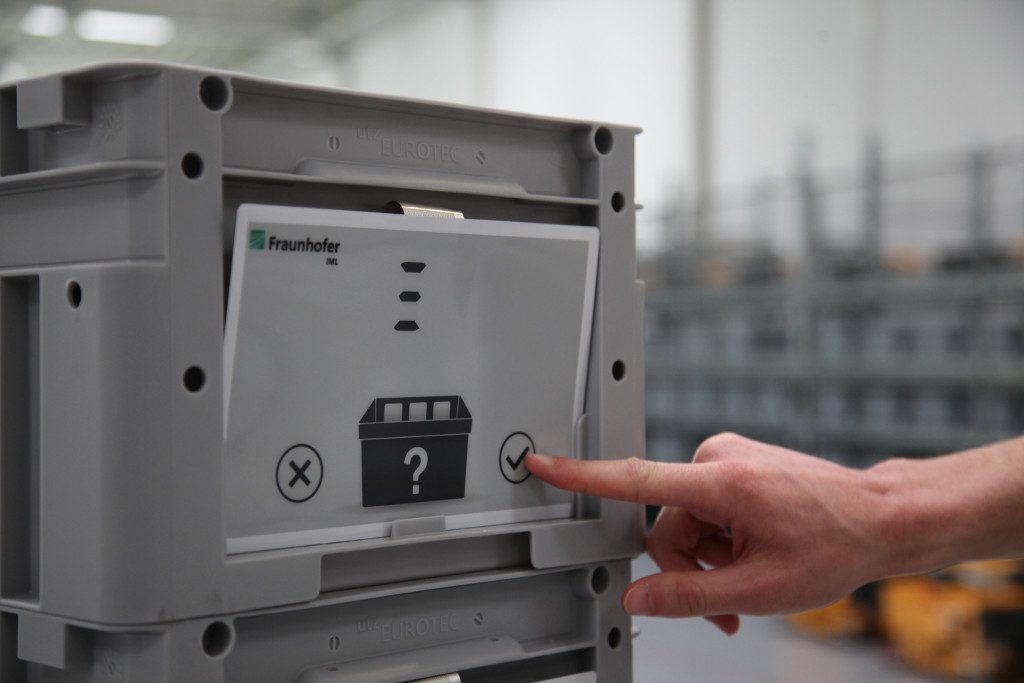
Some of the Fraunhofer IML's developments are already providing a glimpse into the future of the logistics and packaging sector. The electronic picking system „Pick-by-Ink“ (P-INK), for example, extends the functions of Kanban cards and fits into the holders on most picking containers anyway. A transmitter on the shelf ensures that the card is activated on the next crate to be processed and labelled with the appropriate information. Picking processes can thus be controlled efficiently. The cards enable interaction because the pickers can enter additional information, which is then sent wirelessly to the higher-level control system.
Fraunhofer IML has also worked with intelligent pallets and Air freight containers are involved. These are equipped with extensive sensor technology as required. They record data on shocks and vibrations, temperature and humidity and exchange it in real time with other system components. This information can be transferred to apps or data glasses. With these tools, warehouse workers are informed directly where a pallet is located, what is inside it, whether the cold chain needs to be interrupted and where the container needs to be transported to.
Mass production of individual items
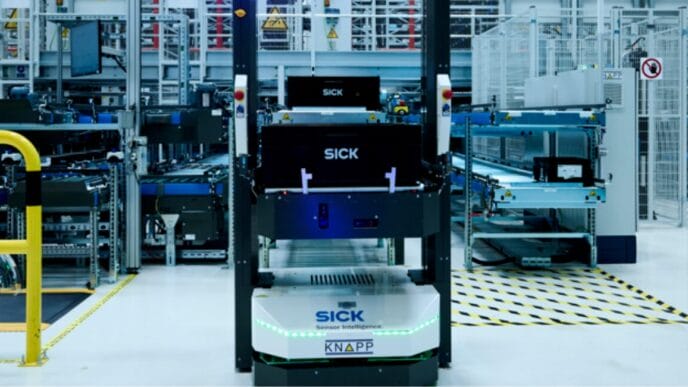
With intelligent, largely automated Warehouse logistics industrial production will change drastically. Communication technology and sensors will take over the control and monitoring of production.
An illustrative example of this type individualised mass production can be found at the breakfast cereal mail order company „Mymuesli“. Its customers put together a customised muesli online from more than 80 ingredients, reports Angela Hengsberger on the Lead Innovation blog. This is then mixed on special equipment and packaged fully automatically. The boxes and bags that arrive at the customer's door appear ordinary, but are the result of a highly networked, „intelligent“ process.
In the digital future, consumer packaging may not look that much different than it does now. Dortmund expert Volker Lange also assumes this. He believes it is likely that packaging functions will be differentiated depending on the distribution channel. So far, product packaging for bricks-and-mortar and online retail has mostly been identical. Only outer packaging is added for shipping. In the mail order business, however, transport and product packaging are increasingly being combined. There, the transport and protective functions take centre stage. The classic product packaging, which primarily has to fulfil the sales and information function, is then only found on the shop shelf.
Durable, precisely fitting transport packaging from the 3D printer
How transport packaging can also be customised automatically by printing it on the 3D printer produces, The Dortmund Institute for Packaging Technology (IfV), part of the Dortmund Association for the Promotion of Innovative Processes in Logistics (VVL), has also trialled this process alongside the Fraunhofer IML. Its deputy director Jörg Loges will report on a 3D printing process for customised packaging at Logimat 2017. Based on CAD data of the product, software creates a model of precisely fitting transport packaging with the least possible use of materials. The packaging is then printed using hard-wearing, elastic filament made from Chinese grass.
At Fraunhofer IML, 3D printing is also used to make packaging lift off. There, the Transport drone „Bin:Go“ is encased in a spherical grid structure. This structure, which according to Volker Lange could only be produced in this way using a 3D printer, protects the rotors and a loading box for goods with a maximum weight of 700 grams. The highlight: the drone for the Intralogistics only flies when it has to overcome large differences in height. Otherwise, it rolls automatically to the programmed destination to save energy.
The path to drone-based parcel delivery therefore seems to be mapped out. If this happens, packaging will face new challenges. They would then have to be able to withstand being dropped from greater or lesser heights.