IPV industry survey: lack of skilled labour, too little planning security
What are the effects of the coronavirus pandemic? What about the shortage of skilled labour? The annual industry survey by the German Paper and Film Packaging Association - expanded to include the effects of coronavirus - provides some insight.
4 September 2020
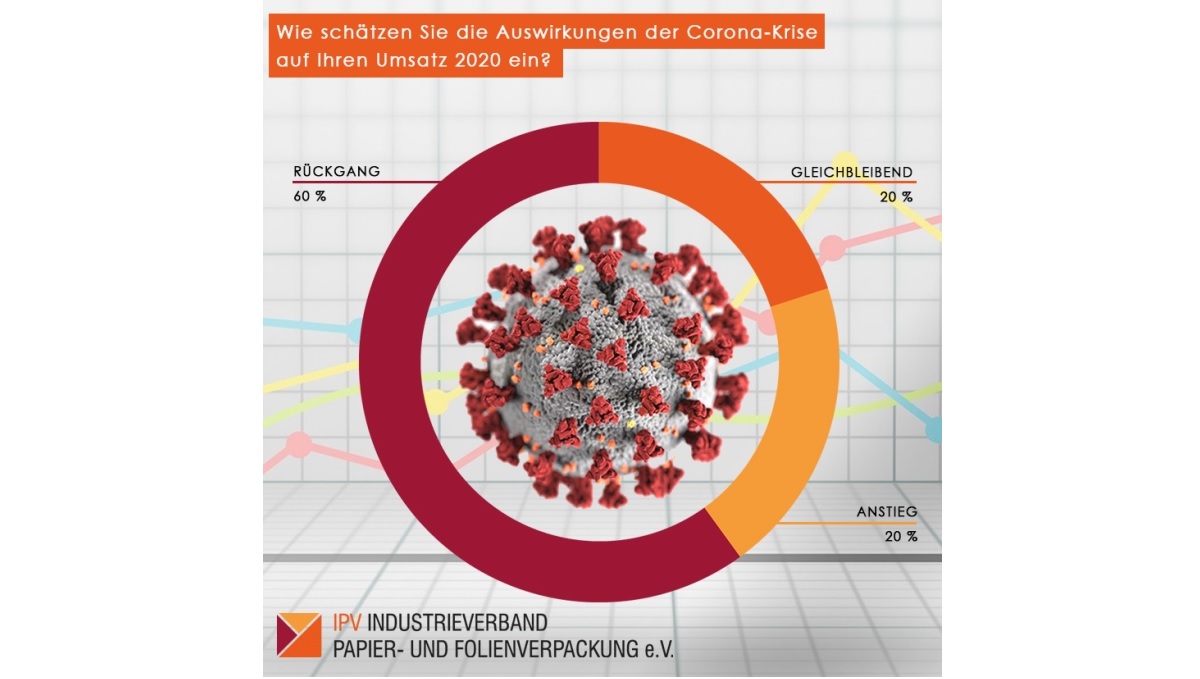
According to the industry survey, the sudden lockdown has already had a negative impact on around 60 per cent of association companies. (Image: PPV)
The annual industry survey conducted by the Industrial Association for Paper and Film Packaging (IPV) on the status quo in the sector was already fully finalised in March. The coronavirus lockdown then changed all schedules. The association therefore decided to include this development in its industry survey.
The extended annual survey now reveals the following picture: for around 60 per cent of the association's companies, the sudden lockdown has already had a negative impact on turnover or turnover expectations. According to the association, this is a Serious change to the original survey. In the first survey (at the beginning of February), a good 70 per cent of member companies expected business development to be similar to last year. Now, only 20 per cent of companies are reporting an increase in turnover, while the figures remain constant at 20 per cent.
A good half of the companies that are expecting a drop in sales this year also believe that this will be not a temporary development is not the case. Customers in the catering and hotel sectors and large parts of the retail trade (with the exception of the food industry, online retail and large supermarkets) are too strongly and directly affected for this. From the perspective of packaging manufacturers, there are no real beneficiaries of the COVID-19 pandemic on the customer side. However, the majority of companies do not expect additional work or costs as a result of coronavirus.
Industry survey: Solides 2019
A look at the past year: 50 per cent of companies were able to achieve a return of at least two per cent. In 2018, the figure was 80 per cent. This was already an indication that the Economic situation in the industry could become more difficult. The expanded survey now clearly shows that economic uncertainty has been further exacerbated by the pandemic.
Display
According to some manufacturers, corona has contributed to a general change in consumer behaviour. The economic impact will also reach consumers' wallets in the medium term. A third of the companies that took part in the industry survey stated that they had already recorded a drop in sales last year.
(Image: IPV)
„The product bans on plastic carrier bags being discussed in the political arena and the still unclear restrictions of the new Single-Use Plastics Directive are a brake on economic development. Companies have a right to expect politicians to fulfil their claim to Design and control and demand planning security.“ Klaus JahnIPV Board Spokesman
Customers want new, fibre-based products
Plastic packaging and the corresponding manufacturing companies are facing a difficult future. This is another result of the industry survey. There is still a major challenge in the still lack of alternative substitutes. At the same time, the trend towards paper packaging as a substitute for plastic is continuing and gaining momentum. Not only is the development of alternative composite products being driven forward by various players, research has also made progress in areas such as the barrier protection function of paper.
80 percent of companies state that customer demand for fibre-based replacement products is strong or even very strong. The Recyclability is at the centre of this. However, the negative image of plastics in the public eye and the desire to avoid plastic entering the environment also play a major role in the high demand for paper substitutes. Products made from renewable raw materials are favoured.
Industry survey: acute shortage of skilled labour
In addition to the current pandemic, the shortage of skilled labour continues to be a long-term concern for the industry. 75 per cent stated that in the past year do not fill their training places to have. There was simply a lack of applicants. Or the qualifications of the existing applicants were too low to justify hiring them. 90 per cent of companies complain about a current shortage of skilled workers.
Compared to the already high figure in the last industry survey, this is another 20 per cent more. The lack of labour is making production more difficult and extending delivery times. Vacancies are becoming increasingly difficult to fill despite the still good prospects. The member companies of the IPV are trying to counteract the shortage of skilled labour through internal qualification and further training, among other things.
Recognised as systemically relevant
According to the industry survey, a good 60 per cent of manufacturers also see opportunities in the coronavirus crisis. The appreciation of flexible packaging appears to have increased significantly, particularly due to its protective and hygienic function. This was not the case a few months ago. Companies were correspondingly annoyed by political decisions - at EU level and in Germany. Companies criticised how quickly politicians made decisions that had a massive and direct impact on the future of the industry.
(Image: IPV)
„We have missed the appreciation of packaging for the protection and shelf life of food. Anyone who sees it as a disposable commodity fails to recognise its benefits for retailers and end customers. Since the coronavirus pandemic, however, there has indeed been a noticeable change in sentiment. Packaging is no longer regarded as waste. Their function for hygiene protection is being discussed again. Also by consumers, by the way.“ Karsten Hunger, IPV Managing Director
The association therefore continues to criticise the German government's plans for stricter implementation of the European Single-Use Plastics Directive. Above all, the unresolved effects of extended producer responsibility on the subject of littering and a far-reaching authorisation to issue regulations on the subject of product bans are being criticised. Many companies fear that there will be further product bans in Germany in the short term. The association hopes that the experience of the coronavirus crisis will perhaps bring about a change of heart.
[infotext icon]
The Industrial Association for Paper and Film Packaging (IPV) represents the interests of flexible packaging companies and manufacturers of cellulose napkins and tablecloths as well as their suppliers. It was founded in 1949 and is based in Frankfurt[/infotext].
Source: Industrial Association for Paper and Film Packaging