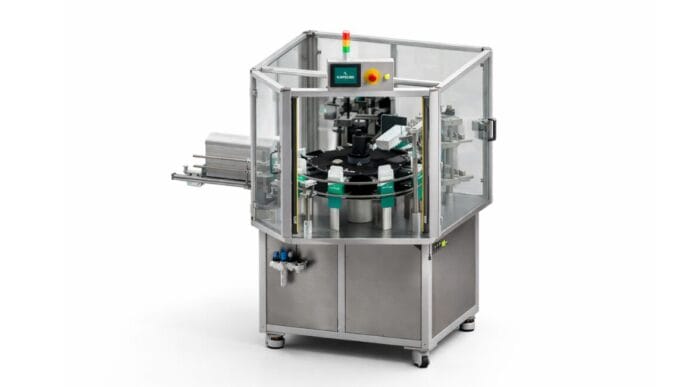
For variable data printing on pharmaceutical blister packs, Hapa, a specialist in printing solutions for the pharmaceutical industry, offers the new ‚Variable Data Printer VDP 827‘, a standardised inline coding solution with drop-on-demand technology.
Mechanical embossing processes are still the predominant technology for printing variable data on blister packs. However, factors such as long set-up times or poor legibility can reduce overall equipment effectiveness (OEE) and also jeopardise patient safety. The Swiss company Hapa now offers a new inline coding solution for pharmaceutical blister packs.
The new Variable Data Printer VDP 827 is a standardised inline solution for variable data printing with Drop-on-demand technology (DOD) on pharmaceutical blister packs. Thanks to its compact design, the VDP 827 can be easily integrated into blister machines, according to Hapa. The VDP concept was developed in consultation with the leading suppliers of blister machines. It is based on Hapa's proven Webjet technology and is therefore an accepted standard.

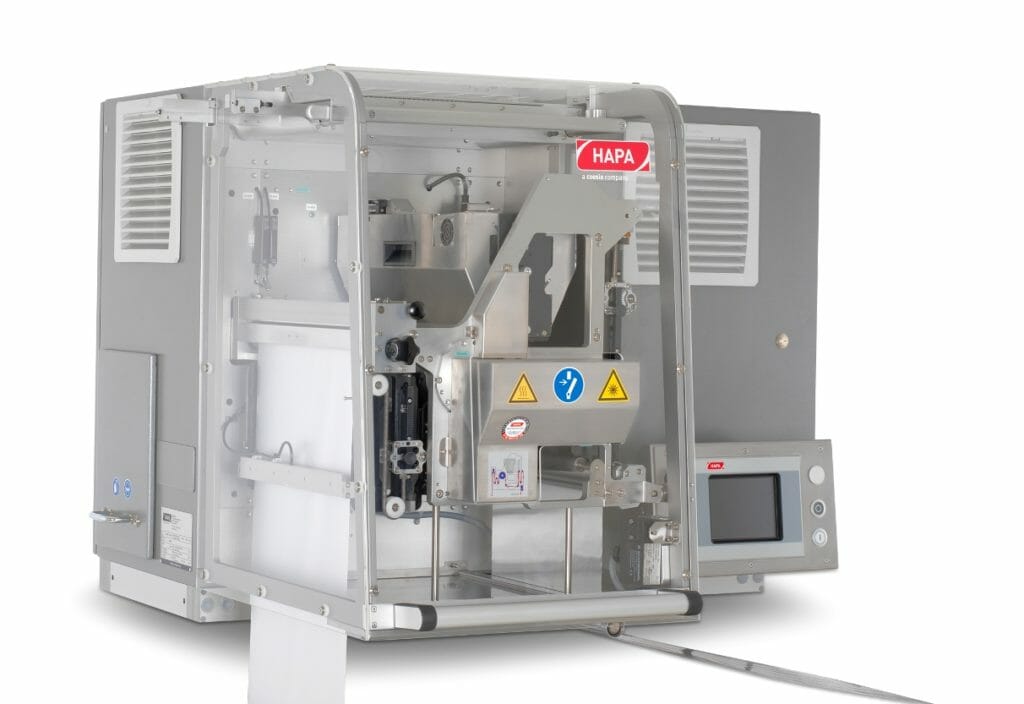
Details with regard to mechanical and electrical integration were also defined together with all major manufacturers. Designed for very different installation situations, the printer is also suitable for Existing blister systems to convert to DOD printing with UV ink.
„In order to achieve this standardisation, we worked closely with a number of blister machine manufacturers right from the development stage. Pharmaceutical companies thus receive printing processes that are optimally matched to the blister machines and benefit from standardised spare and wear parts that are available worldwide.“ James MacKenzie, Sales Director at Hapa
Inline coding solution for blister packs
Compared to the traditional embossing process, variable data printing with UV DOD technology has a number of advantages. The razor-sharp print with 360 dpi, which is completely independent of the speed of the blister foil, optimises the Readability through control cameras and helps to minimise waste. The VDP 827 is able to minimise the Complete web width of up to 288 mm and apply serialisation or another form of coding anywhere on the blister film. It supports all common symbologies and barcodes. In addition, UV DOD printing is equally readable by humans and electronic systems. The automated workflow also eliminates the need for time-consuming and error-prone retooling of mechanical parts.
UV DOD printing also has advantages over other alternative printing processes. In contrast to ablative lasers, for example, the VDP 827 No dust or dirt; This also eliminates the need for specially coated and therefore more expensive films. There are also no restrictions in terms of format size and printing speed. In contrast to thermal inkjet, UV-curing DOD printing is carried out Completely solvent-free. The ink is nevertheless immediately ready for the next inline process step and is both extremely durable and abrasion-resistant. In addition, the DOD ink can be used during operation, i.e. without machine downtime, can be refilled. There is no need to change cartridges.
„The VDP 827 is a simple, cost-effective introduction to what is probably the most advanced inline printing technology for this application,“ summarises James MacKenzie. „It improves patient safety, reduces complexity in production, lowers costs and increases OEE.“
SourceHapa : Hapa