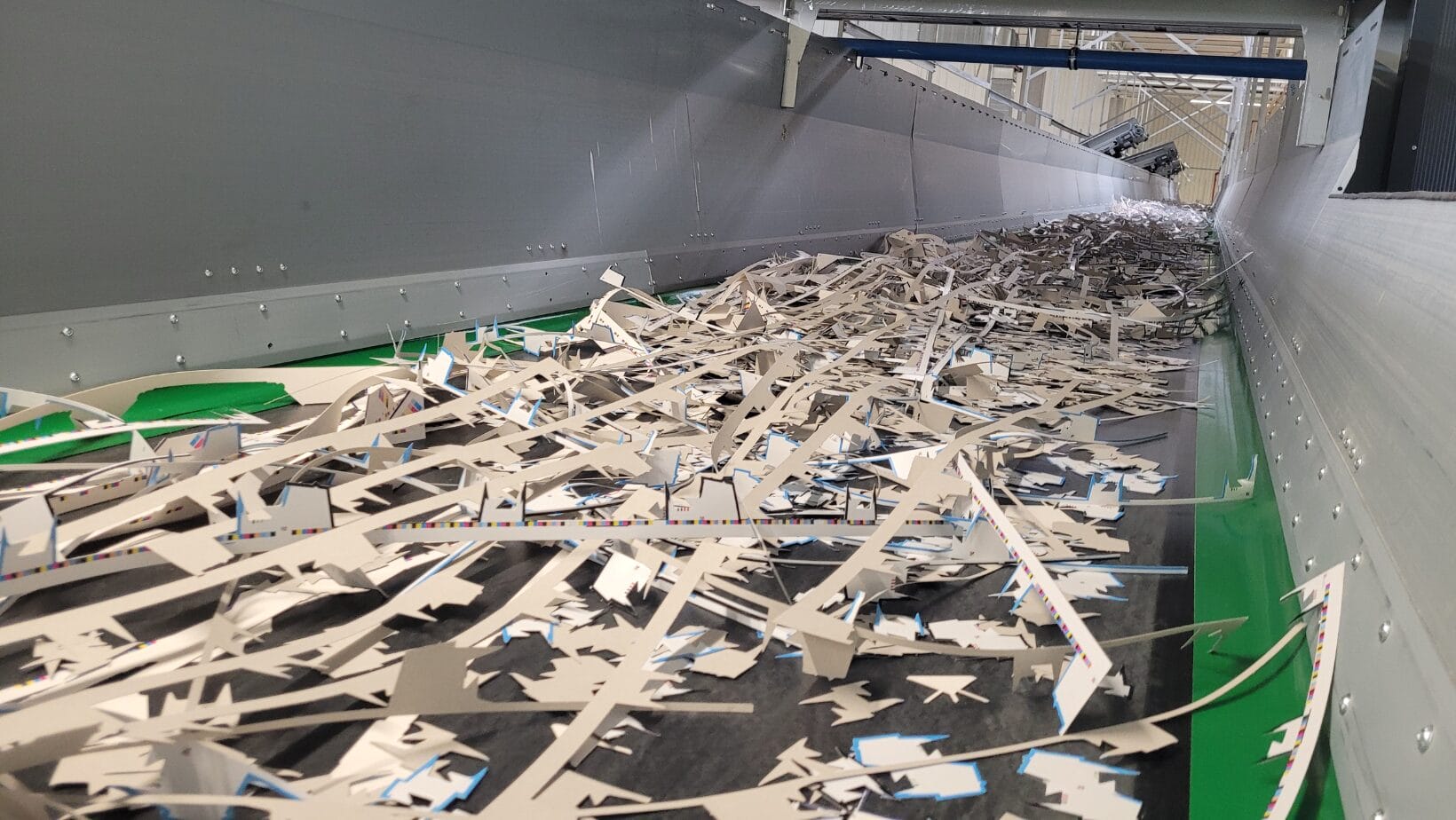
Thanks to a new type of punching waste transport and discharge system, WS Quack + Fischer GmbH achieves almost 100 per cent separation of paper types, conserves resources and reduces noise and CO2-emissions. The packaging specialist from Viersen received a grant from the Federal Ministry for the Environment's environmental innovation programme for the process, which is being used on an industrial scale for the first time. The company was supported by the Efficiency Agency NRW from Duisburg.
WS Quack + Fischer, a long-established company based in Viersen, produces high-quality Folding cartons made of solid cardboard, printed using sheet-fed offset printing become. In 2019, the company planned to relocate its production to a new site.
„At the new site, instead of the conventional method of transporting punching waste through a conventional pneumatic extraction system, we wanted to implement a conveyor system for the first time that runs flexibly across the floor and thus enables the punching waste to be removed and separated by type.“
Andreas Mis, responsible for planning and quality assurance at WS Quack + Fischer GmbH
During the planning phase, the focus was on reducing power consumption, sorting the waste by type and improving working conditions by reducing noise pollution. The company's most important requirement for the new system was the Flexibility regarding the installation of the machinesThis is necessary due to constantly changing machine technology in order to optimise production in the future,„ says Andreas Mis. The new process fulfils these requirements.

During production, it was now possible to almost 100 per cent sorting of the punching waste produced of over 4,000 tonnes per year could be achieved. The energy measurements carried out confirm that an extrapolated electricity saving of 443,238 kWh per year has been achieved, saving 238 tonnes of CO2 can be saved - which corresponds to around 85 per cent. Another advantage of the new process: compared to the old extraction system, the new conveyor technology has no impact on noise emissions during operation. The separation by type enables better recycling of the raw materials and a higher reutilisation rate.
Before the relocation, the company used Resource efficiency advice from the Efficiency Agency NRW, to uncover potential for resource conservation in operations and develop measures for the new site. The agency also supported the successful application for the new type of punching waste transport in the Environmental Innovation Programme of the Federal Ministry for the Environment, Nature Conservation, Nuclear Safety and Consumer Protection (BMUV) with its financial advice. The project was ultimately funded in 2022 with around 110,250 euros from the BMUV's environmental innovation programme. The project was completed in 2023. WS Quack + Fischer invested a total of 367,500 euros in the project.
Source: WS Quack + Fischer