Innovative recycling process for HDPE plastics

After many years of development work, the recycling service provider Interzero has patented a process that should significantly improve the recycling of HDPE plastics.

After many years of development work, the recycling service provider Interzero has patented a process that is intended to significantly improve the recycling of HDPE plastics. It is based on a chemically controlled modification and does not require the addition of newly produced plastic or the re-sorting of used packaging.

The effort required for re-sorting light polythene packaging (LDPE) waste, such as that from the yellow bin, is eliminated, as is the addition of primary plastic of the so-called PCC (post consumer commercial) or PIR (post industrial) classes. The patent relates to the production of a recycled plastic material from LVP containing at least 95 per cent HDPE. This is a mechanical recycling process with a chemically controlled rheological modification for the further production of blow-moulded products made from 100 per cent post-consumer LVP material, which were previously only suitable for extrusion processes in terms of quality.

The process was developed in Interzero's own competence centre for plastics recycling in Maribor, Slovenia. The competence centre is the only state-accredited research facility in the EU based on the ISO/IEC 17025:2017 laboratory standard that specialises in the development and analysis of recycled plastics.

„We can look back on many years of experience and expertise in plastics development and analysis,“ says Markus Müller-Drexel, CEO of Interseroh+, the recycling alliance of Interzero, Europe's leading provider of recycling solutions. The laboratory has developed steadily over the past few years and is now entering the market with an expanded range of services. In five laboratories, equipped with state-of-the-art technical devices for assessing material quality - From mechanical, thermal, chemical and rheological properties to migration, sensor technology and colour, machines for material processing and an NIR separator for simulating the behaviour of packaging during sorting are also available. The new performance capability is also reflected in the HDPE patent.

Display

„With this process, we achieve considerable savings in raw materials, energy, CO2 emissions and the effort involved in sorting lightweight packaging waste when producing recycled plastics. Thanks to these savings, the sustainability balance is world-leading compared to conventional processes. This brings us another major step closer to our vision of a world without waste.“

Dr Manica Ulcnik-Krump, Managing Director Interzero Plastics Innovations

Special combination of additives makes the difference

A special combination of additives modifies the flow properties of the polyethylene in such a way that the viscosity is increased and the melt flow rate is reduced. This enables the leap from the previous extrusion quality to the blow moulding quality suitable for bottle production. For Interzero and its customers, this means significant savings in new material and therefore crude oil and CO2 emissions. In addition, further CO2 emissions can be avoided by saving energy during sorting. Sorting plant capacities can be better utilised for the constantly increasing volume of used packaging. Manufacturers can retain their standard technologies for the blow moulding of new recycled products.

The Slovenian company Rupar Plastika is one of the first to use the new process. It produces for well-known manufacturers Plastic hollow body from the bottle to the cap and offers a range of different plastics processing technologies, such as extrusion blow moulding, injection stretch blow moulding, injection blow moulding and injection moulding. 

„When new plastics are used, changes often have to be made to the production lines. The new Interzero process saves us that. This is a huge time and cost advantage for us.“

Rok Miklavčič, Head of Production and Sales at Rupar Plastika

Source: Interzero

Interzero - More news

🎧 Podcast: What to do about the recyclate shortage?

In the new Packaging People podcast, Patrick Neumann and Jonathan Scheck from Interzero talk about the results of the latest Circular Packaging 2030 study. They show why the packaging industry is heading into a dangerous supply gap for post-consumer recyclates - and which strategies urgently need to take effect now.
Read more "
Circular Packaging 2030 - Strategies against the PCR shortage

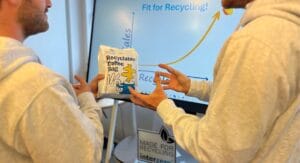
Time is of the essence: EU quotas for recyclates will apply from 2030 - but there is already a shortage of high-quality PCR. A new study commissioned by Interzero shows a looming gap of around 1 million tonnes. Those who do not act now risk high costs, bottlenecks and penalties. How companies can take countermeasures and secure competitive advantages.
Read more "
Jan Kroker Interzero

Interzero with new management

Interzero starts the new year with new management. Since January, the circular economy service provider has been managed throughout Europe by a management trio consisting of CEO, CFO and CIO.
Read more "