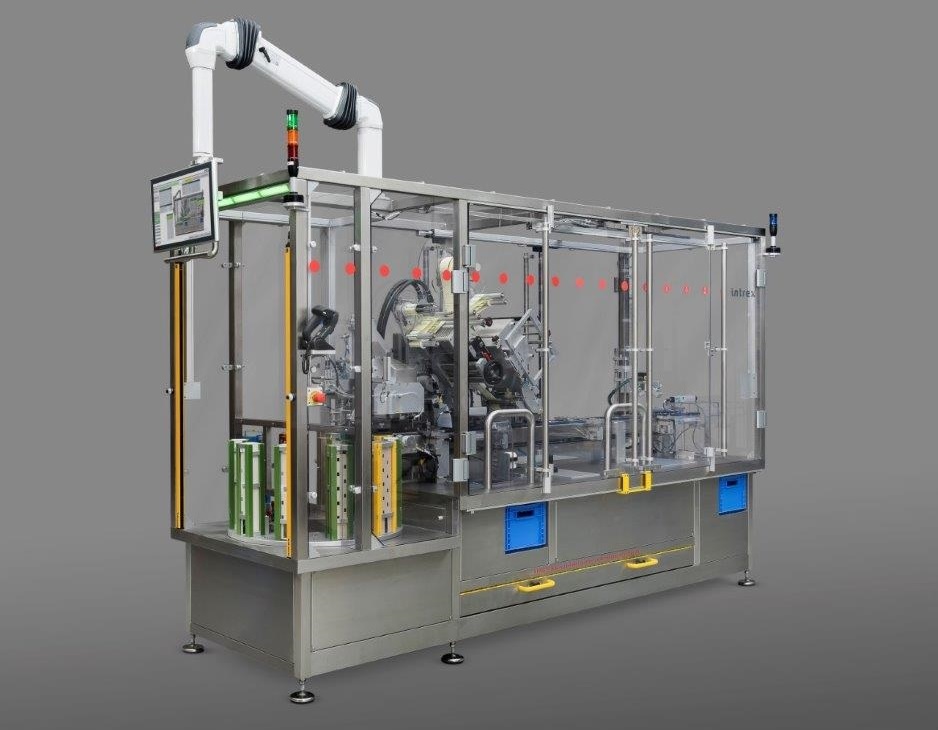
The majority of VDW's dental instruments are packaged and labelled on blister machines from various manufacturers. In order to optimise processes and to be able to label even very small batches automatically in future, the company has opted for a new solution from Intrex Deutschland GmbH.
VDW is regarded as one of the first manufacturers of root canal instruments in the whole of Europe and, as a pioneer, has decisively shaped the fundamentals of root canal treatment. Since its foundation in 1869, the company has remained true to this specialisation and continues to set new standards with its in-depth expertise and product innovations. VDW offers dentists a comprehensive endodontic system of products and services that interlock across all treatment steps. The company headquarters with its high-tech production facilities is located in Munich. From there, the products are delivered to more than 80 countries around the world.
Labelling customer-specific batches
The majority of instruments are packaged and labelled on blister machines from various manufacturers. The problem here is the High diversity of variants due to customised labels that require multiple machine changeovers every day. However, as the customer-specific batches to be labelled often only have print runs of less than 200 pieces, converting the systems is too time-consuming. Very small batches have to be labelled manually.

VDW therefore looked for ways to optimise the processes. Packaging and labelling to separate. A recommendation led to the Intrex Germany GmbH and a customised solution concept was jointly realised during a development period of twelve months.
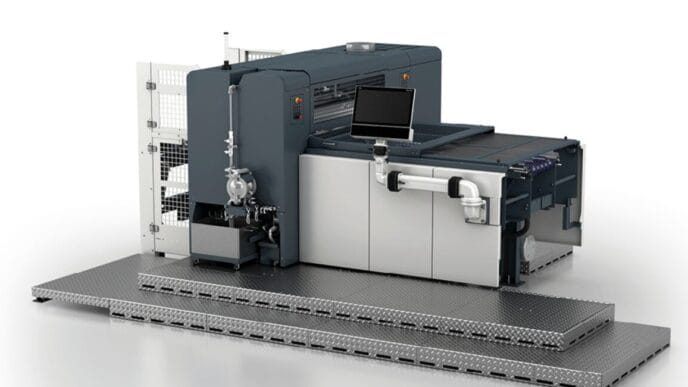
The scenario: In future, products will no longer be labelled after blistering, but will be marked with a Data matrix code which contains all product and production-related data. The blisters are then stored in so-called tubes (boxes or cardboard magazines). The system used by the Intrex Germany GmbH Newly developed LSC-100 LabellerIt can currently process four different blister formats and label them to order. The modular design enables expansion to additional formats and products.
Secure data access
With the IPC installed on an IPC KUPvision-Software all functions of the new labelling system are controlled and monitored. The software saves information such as user logins, job and format changes etc. in an audit trail. The date, time, user, function data and parameters are saved for each entry. The audit trail and the statistical data can be called up at any time and also saved separately on a data carrier.
Processing in practice
To process a customer order, the operator receives a packing list in paper form. By scanning the barcode on the order sheet, the product and order-related information from the VDW GmbH ERP system is read out by the LSC-100 labeller and clearly displayed. The labeller retrieves the products to be processed, which are in tubes, from the warehouse. Data matrix codes are attached to the tubes to indicate the contents. He then starts the labelling process on the KUPvision interface and scans the barcode on the packing list with the handheld scanner.
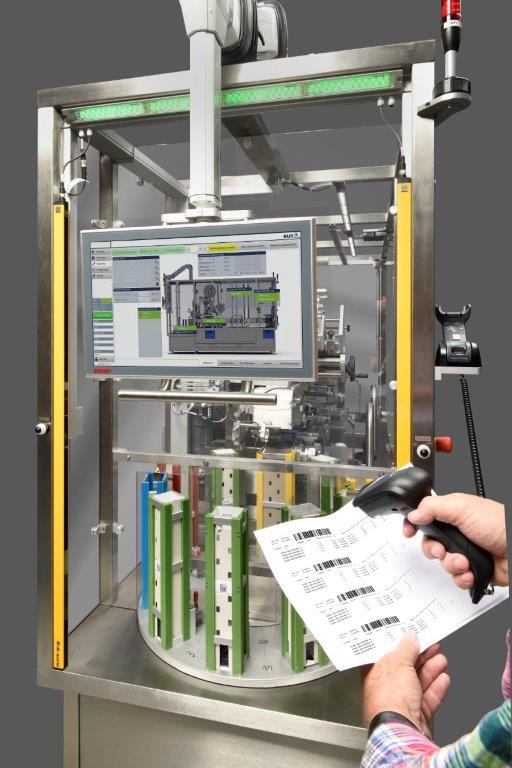
If the order data is correct, the operator is prompted with a message to load a so-called Carousels which is equipped with a total of 10 magazines. The operator places the tubes in the magazines of this carousel and then the KUPvision software runs a series of checks before starting:
- Comparison of the data matrix codes on the inserted tubes/boxes with the order data
- Summary/overview of the order to be processed
- Pre-flight check (checking the consistency of the label data)
- Synchronisation of all label layout data with a label management system.
Controlled contract manufacturing
The machine starts with the production of the order, whereby the blisters are stacked from below with a „Lift“ and removed mechanically by a feed arm of the belt feeder. The Feeder has two arms and each equipped with two pneumatic suction modules. When the first suction module places a product on the conveyor belt, another product is removed from the carousel at the same time. The arms then change position and repeat the process. Each product is placed on the conveyor belt and moved by cleats attached to the conveyor belt to ensure a stable position during labelling.
To ensure that the correct blisters corresponding to the order have been placed on the belt, the Data matrix code on the blisters. These Data check is carried out using the COGNEX® DataMan inspection system. Products that are found to be good remain on the conveyor belt for further processing, while bad products are ejected.
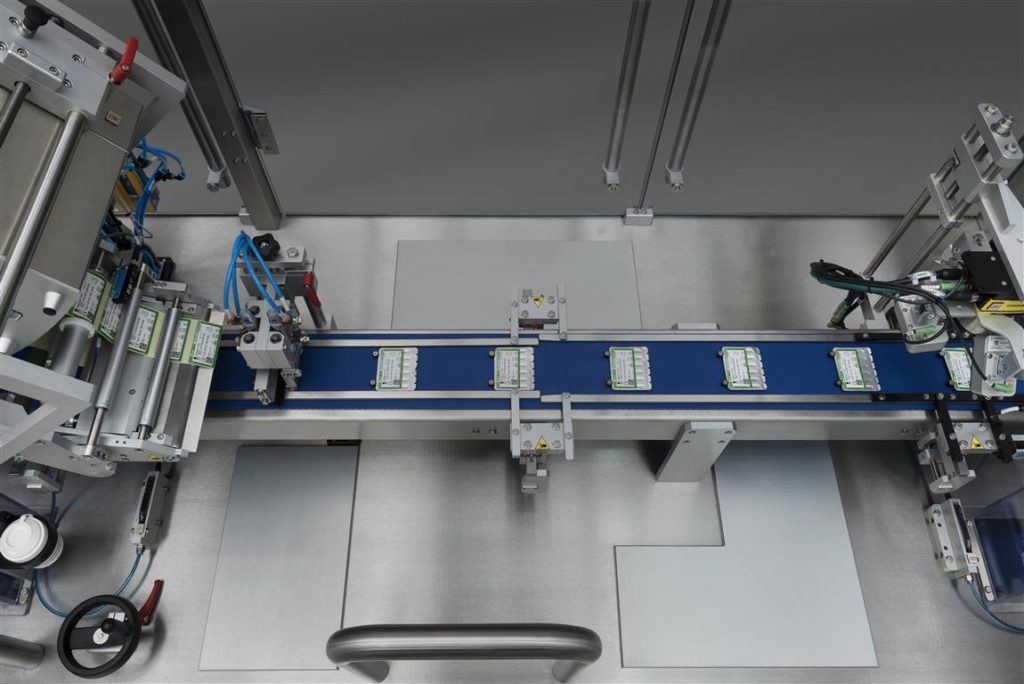
The intrex® 200+ labelling system then prints the prefabricated base labels in the Thermal transfer printing process (Domino V320i) with order-specific/variable data and uses it to label the blisters on the conveyor belt. To the Quality inspection The In-Sight 7905 camera from COGNEX is used to check the printed and applied labels. It checks the printed labels for completeness and legibility. Products rated as good remain on the conveyor belt, bad products are ejected.
The first machine has now been successfully commissioned at VDW and further systems are being planned. The subsequent packaging of the labelled products is currently still carried out manually at the company, but automated processes are already being planned here too.
[infotext icon]The design and construction of the LSC-100 labeller complies with the EC Machinery Directive 2006/42/EC, EU GMP, GAMP 5, and also fulfils FDA requirements (e.g. 21 CFR Part 11). Intrex Deutschland GmbH will be presenting its newly developed labeller at this year's FachPack in Nuremberg in Hall 3a, Stand 3A-335.