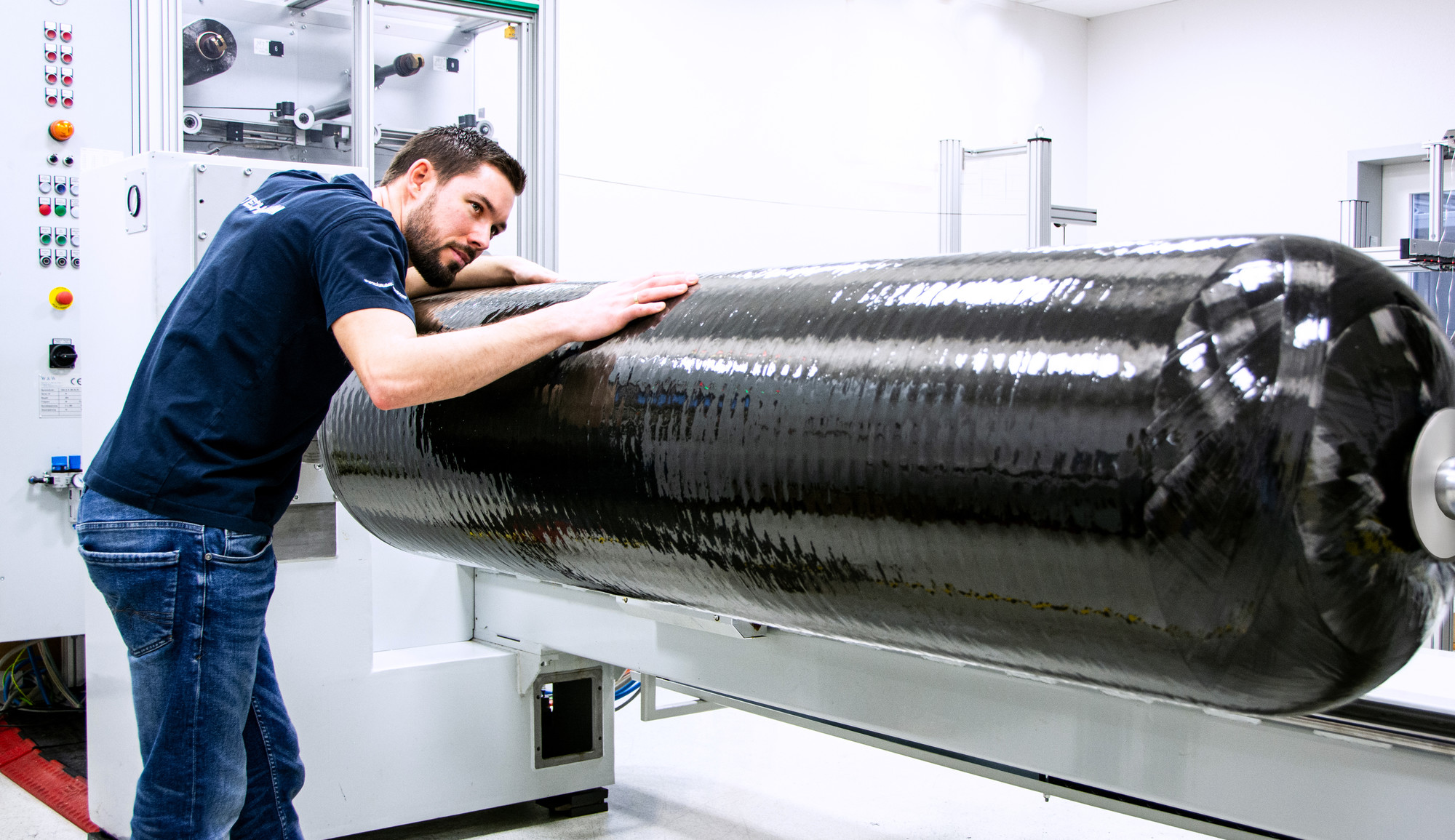
The blow moulding experts at Kautex Maschinenbau have produced a large-volume polyamide liner for hydrogen pressure vessels with a volume of 320 litres for the first time using the extrusion blow moulding process.
The liner is over two metres long and has a diameter of around 500 millimetres. This is the first time that a Liner for hydrogen containers was produced in this size using the blow moulding process.

Hydrogen places particularly high demands to the impermeability (permeability) of the liner material. As the smallest molecule in the periodic table, it diffuses through almost all plastic materials. Special polyamides (PA) therefore have the best barrier properties. However, due to the low melt stiffness and complexity of the blow moulding process, these have been difficult to process in this dimensioning up to now. A new method was needed: Newly developed polyamides and a special extrusion technique have now made this possible.

„The process of manufacturing a liner with these dimensions from polyamide has proven to be a major challenge. We are doing absolute pioneering work here. The liner size we have now achieved is just the beginning for us. We are confident that we will be able to use this process to produce significantly larger liners for pressurised hydrogen containers in the future“
Abdellah El Bouchfrati, Head of Business Development Composite at Kautex
Kautex has been working for some time on the further development of composite pressure vessels (CPV) for various applications such as for hydrogen, CNG and LPG tanks. Composite tanks consist of a thermoplastic liner, a boss part to connect the valve and a fibre winding to achieve mechanical strength. The Internal liner is manufactured using the blow moulding process.
CPV high-pressure vessels for hydrogen are generally designed for an operating pressure of 700 bar and a burst pressure of 1750 bar. The liner represents a Central component of the container represents. It is the inner shell of the tank, holds the gas, encloses the contents and seals it off from the outside. The liner is subject to high mechanical and thermal stresses from 60 °C to +120 °C.
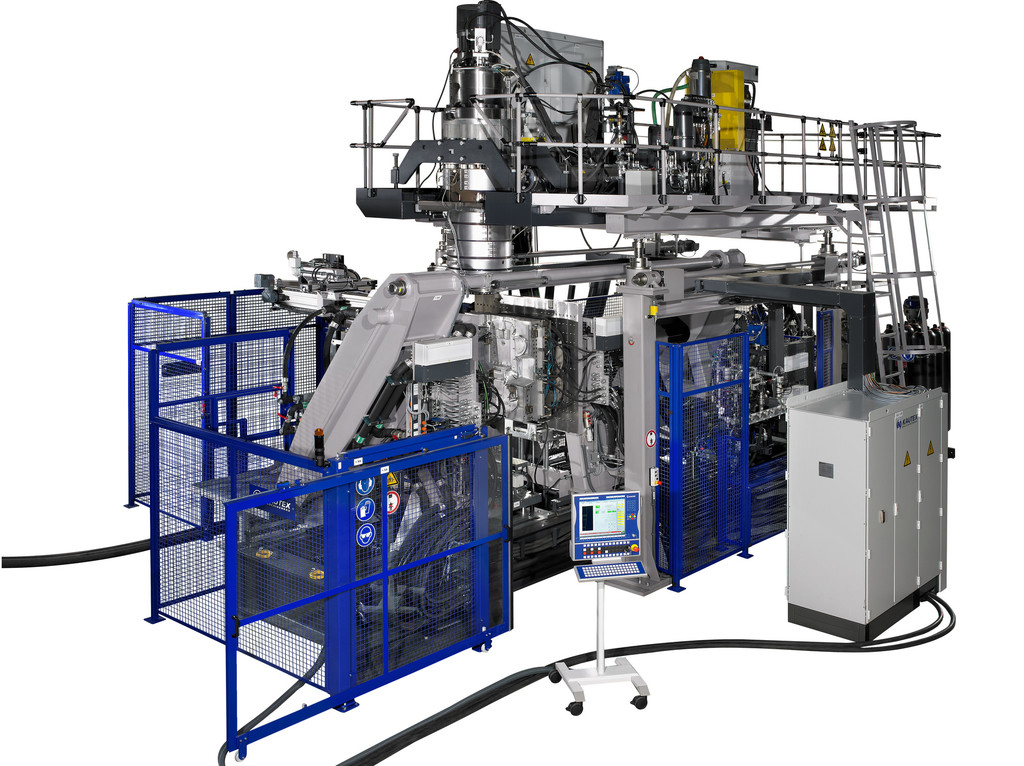
The Kautex in co-operation with a plastics manufacturer The new process developed by the company now makes it possible for the first time to produce hydrogen liners in interesting dimensions for industry using the blow moulding process, bringing an economical solution for means of transport and infrastructure within reach. Experts have long considered a one-sided focus on battery-dependent solutions for the mobility of tomorrow to be inadequate to achieve the long-term goal of a sustainable future. mobility that is as CO2-neutral as possible to reach.
While fuel cell technology in the passenger car sector does not yet appear to be economically viable due to production costs and the lack of infrastructure, hydrogen-powered drive and production technologies are already being successfully realised in other areas. The technology currently appears to be of particular interest in heavy goods transport, local public transport, shipbuilding and the aircraft industry. Light, safe and leak-proof tank systems are needed here above all. CPV tanks are not only considerably lighter than steel tanks. They are also absolutely Resistant to corrosion.
Hydrogen, especially when produced using renewable energies, is also a first-class energy storage medium. Here too Tank systems are required that can withstand the corresponding pressure and at the same time ensure that the extremely light gas can be stored safely.
Source: Kautex