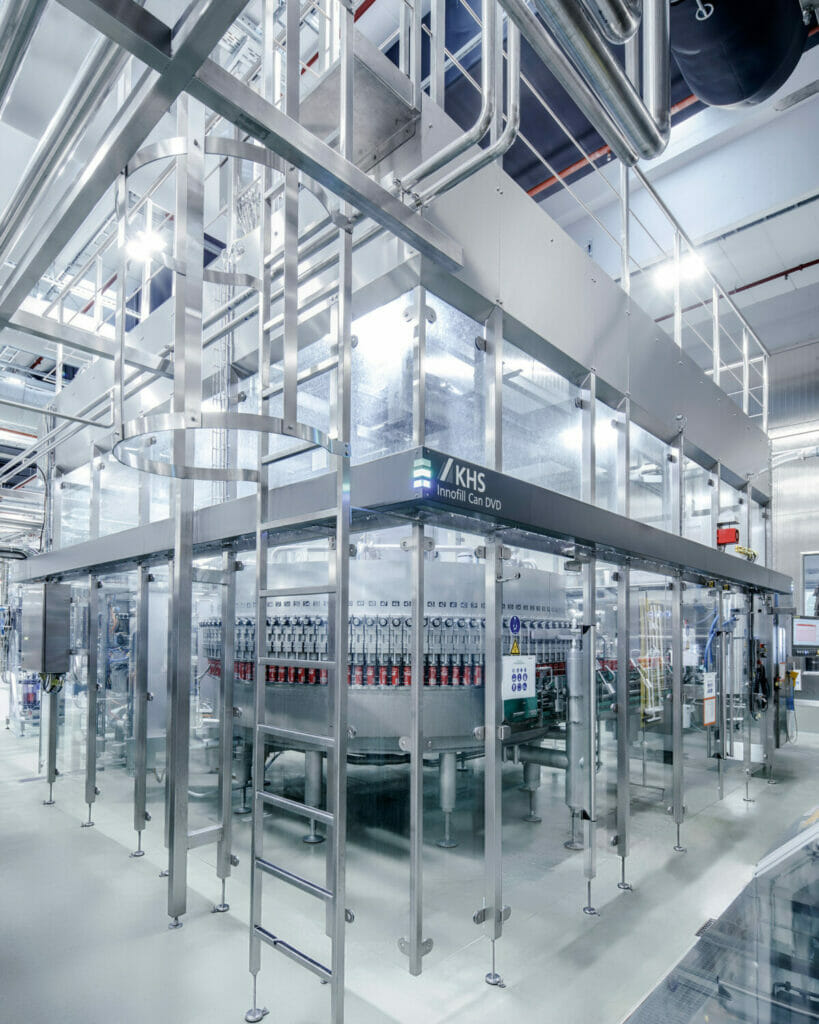
Cans are becoming increasingly popular in Europe. One of a total of six Coca-Cola HBC sites that received a new canning line from KHS last year is Edelstal in Austria. The line, which fills up to 90,000 cans per hour, was delivered, installed and commissioned in a remarkably short time and under very special conditions.
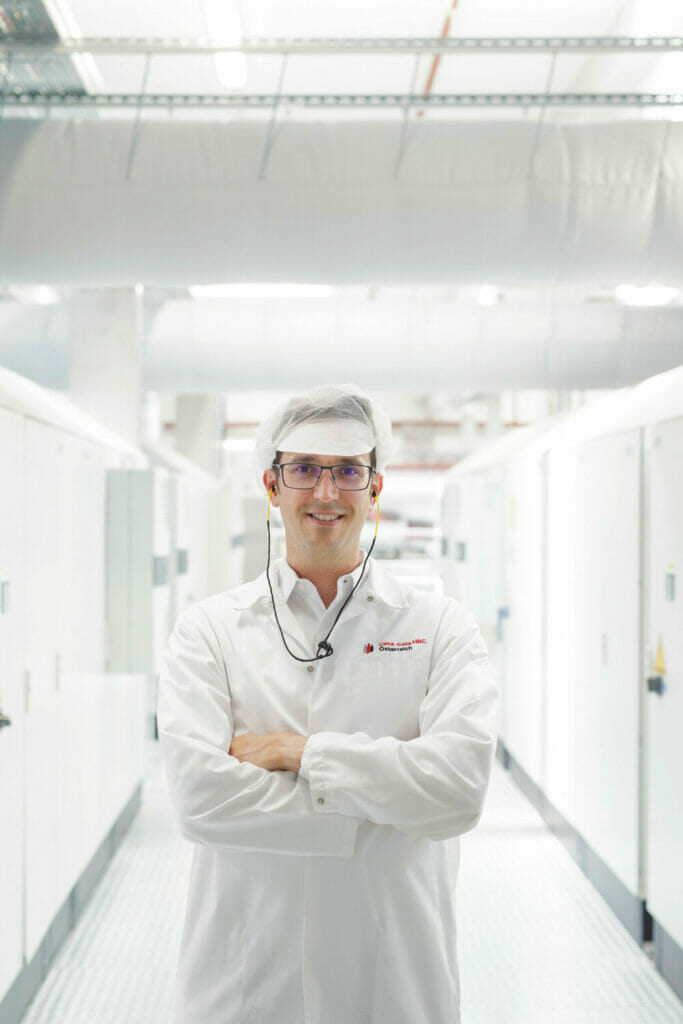
His profession at Coca-Cola HBC in Edelstal was practically born into Patrick Redl's cradle: Four years ago, he followed in the footsteps of his father, who was employed for 37 years, most recently as plant manager at "Römerquelle". This mineral spring was taken over by the world's third-largest bottler of the Coca-Cola brand in 2003. Coca-Cola HBC has one of the most diverse and flexible portfolios in the beverage industry and operates in 28 countries worldwide. According to the company, turnover for the year totalled 6.1 billion euros. In addition to Coca-Cola, Coca-Cola-Zero, Schweppes, Fanta and Sprite, Römerquelle is also one of the most popular brands. "I feel like I grew up at the plant," says Redl. He spent a lot of time there in his childhood and youth looking over his father's shoulder.
State-of-the-art filling and logistics centre
Edelstal, just a stone's throw from the Slovakian border and capital Bratislava, is an idyllic village of 800 souls in northern Burgenland. The production and logistics centre of Coca-Cola HBC Austria is located right at the entrance to the village. One of the largest photovoltaic systems in Austria is installed on the hall roofs. An indication of the current size of this plant.

A lot has happened since the beginnings in the 1940s and the transition to industrial bottling of Römerquelle in the 1960s: after the takeover, the plant is successively expanded and modernised within just ten years until it finally replaces the previous Coca-Cola plant in Vienna and a factory in neighbouring Slovakia: Since 2013, almost all soft drinks for the Austrian market have been bottled in the state-of-the-art bottling and logistics centre and delivered nationwide from here.
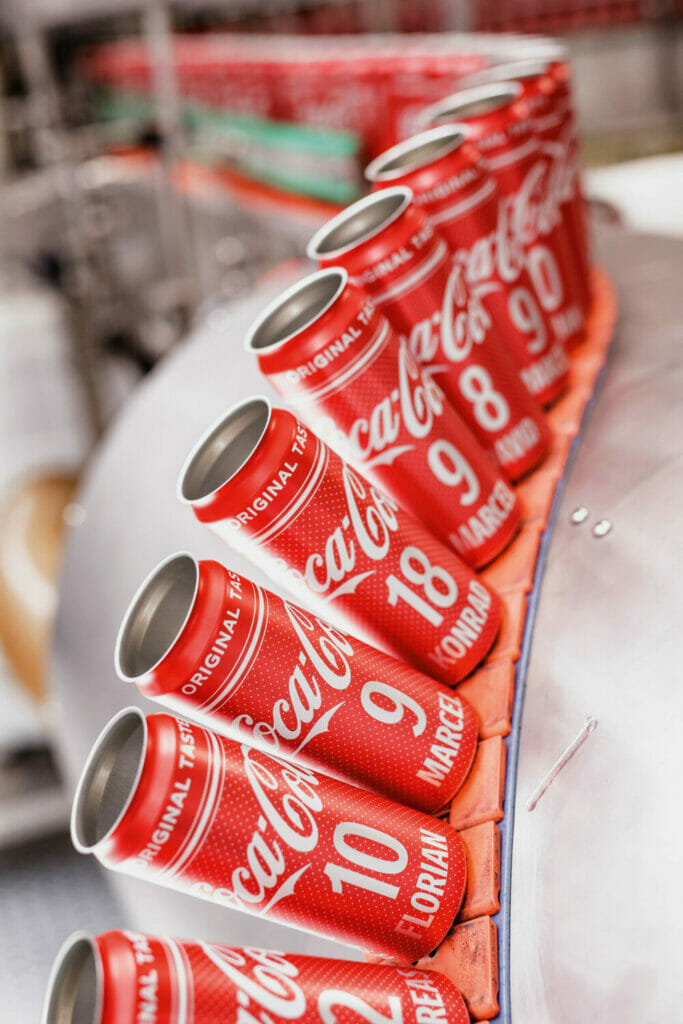
Today, a total of eleven production lines are in operation in Edelstal: Mineral water is bottled on three of them, a classic PET line, a glass line and a PET UltraClean line for bottling sensitive products. A further seven lines (three PET, one glass, one bag-in-box and two keg) are used to process soft drinks, energy drinks, juices and syrups. The most recent milestone is the first canning line in the history of the site, which was commissioned by KHS last year.
"Just as cans are a completely new category of primary packaging for us, metal is also a material that we haven't used before," emphasises Patrick Redl. "When designing the line, we placed particular emphasis on ensuring that the technology is future-proof in every respect and offers us the greatest possible flexibility with regard to future market trends and product innovations." Even during the development of the layout of the new system KHS Many constructive suggestions were made as to how this can be expanded later with little effort: for example, with a pasteuriser, an additional packaging machine or the option of processing half pallets.
Demanding timing and additional challenges
The first of several challenges was the tight timeframe for realisation: "In October 2019, we were commissioned to install a canning system and put it into operation by June 2020," recalls the plant manager. "That was a challenging task, if only because of the official approvals." The project is particularly complex because it affects the entire plant: The new line was to be installed in an area where the raw material warehouse was previously located. This was to be moved to the previous location of the stretch blow moulding machines. And a palletiser first had to make room for this. "It was like a chain reaction and required extremely precise planning. The move began in November," explains Redl.
"In the end, however, everything worked like clockwork - if I may say so as an Austrian," says Redl. "We felt we were on track to meet the deadline," he looks back. "Of course, we kept an eye on what had been brewing in China since January, but hoped that it would somehow pass us by. Despite the adverse circumstances, we never doubted for a minute that we would be able to keep to our schedule. An incredible spirit inspired us and brought us great agility. When we actually managed to complete all the preparations on time for the deadline, I think even KHS was a bit surprised."

Despite the pandemic, a safe environment was created in which everyone involved was able to concentrate fully on the installation of the line. The deadline for beverage production was met against all odds. Redl believes this is also thanks to the close-knit team of his own and KHS employees"The most important thing for me was the constant coordination, the feeling of standing shoulder to shoulder from planning and preparation through to the line-up - right up to the present day. I, for one, am very proud that we managed to do this under these conditions."
Strategic key supplier
In 2020, Coca-Cola HBC had a new canning line installed and commissioned by KHS in six countries. One reason for the investment was the increased demand for aluminium containers: "Cans are becoming more and more popular, especially in Europe," explains Theodoros Kappatos, Group Engineering Manager at Coca-Cola HBC. "As a leading beverage producer in many European markets, we naturally have to adapt to this trend. With our new line of cans, we were also able to develop a strategy to offer flavoured water from the Römerquelle brand in aluminium cans." On the other hand, the new acquisitions are part of the bottler's supply chain strategy. One of its goals is the modernisation of production lines, in particular by replacing outdated systems with new, more efficient, lower-consumption and higher-performance technologies.

Coca-Cola HBC has a long-standing and trusting relationship with KHS: "We placed this order with KHS because the company is a great partner for us," emphasises Kappatos. "This applies not only to this container format, but to our entire system portfolio. We regard KHS as a key strategic supplier at our side: a partner who understands and fulfils our demand for efficient, high-quality machines and systems. This in turn enables us to fulfil the needs of our customers and consumers. We particularly appreciate that the focus of our collaboration is not only on innovative concepts, but that unconventional ideas are also introduced. On this basis, we achieve better functionality, for example, as well as more cost-effective and simpler maintenance."
It is not only the high speed of the line, which fills up to 90,000 cans per hourPatrick Redl was impressed: "It runs twice as fast as the second-fastest of our lines." He was also surprised by the speed at which the new line was up to speed compared to all previous lines. Among other things, he was particularly impressed by a new technology that uses the innovative KeelClip cardboard clip to combine six cans at a time into six-packs.
The reduction of plastics in secondary packaging is part of Coca-Cola HBC's "World Without Waste" commitment. "We were one of the first in the world to get these brand new machines up and running," summarises Redl. "We managed this under difficult conditions with the help of state-of-the-art digital solutions such as virtual reality goggles, as the US manufacturer's technicians were not allowed to leave the country." And not least because of his family history, he summarises: "Being the plant manager who was the first to put the Römerquelle in cans is something unique."
More articles on the topic of drinks


Starbucks strengthens cup recycling

Elopak CEO Thomas Körmendi resigns

Stratus Packaging integrates Freppel

Multi-Color Corporation ensures delivery capability