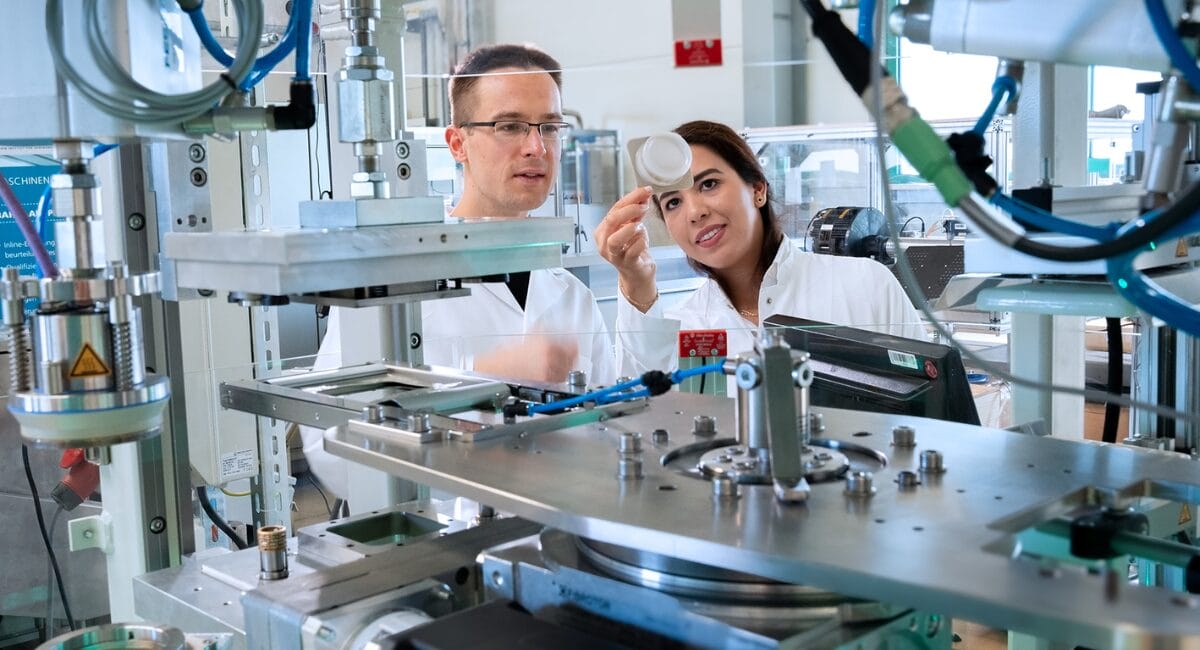
As part of the KIOptiPack project, researchers at the Fraunhofer Institute for Process Engineering and Packaging IVV are also working with 51 partners to develop AI tools to make plastic packaging fit for the circular economy.
In the KIOptiPack innovation lab, Fraunhofer IVV researchers and project partners are using artificial intelligence as a game changer in recycling and for processing recyclate into packaging in order to meet the technical challenges and high demands of packaging production. The researchers have AI-based optimisation tools developed and networked using a data room. In this way, the numerous requirements for plastic packaging can be efficiently taken into account.
In particular, this makes it possible to recycle and holistically optimise this packaging. In addition to the question of environmental compatibility and eco-balance, the aspects of functionality, design, customer acceptance and manufacturability are also taken into account. Once all the data has been fully integrated, the AI tools suggest the best possible packaging designs for a particular product while minimising the amount of material required. The data room collects and links all the necessary digital data on material properties, origins and destinations. In this way, it provides a common infrastructure for data exchange across factory boundaries. The data model on which the complete package is based, which makes data exchange between the various players possible in the first place, was also developed at the Fraunhofer IVV.

Digitalisation of material flows to protect the consumer
„A shared data room is essential in order to better incorporate recyclates into packaging solutions. Recyclate is a valuable material. But the quality of the recyclable plastic must be right. If recyclates are contaminated by undesirable substances such as foreign plastics, printing inks or degradation products, this can significantly impair their quality and even render them unusable. As soon as plastics are recycled, they can in principle contain impurities.“
Prof Dr Andrea Büttner, Director of the Fraunhofer IVV
This poses particular challenges for the industry. From recyclate manufacturers to companies that produce packaging films and the food industry, there is therefore a need for a systematic exchange of data and standardised terminology when dealing with plastics. The main focus here is on polyolefins - the largest group of plastics, which can change significantly during processing.
AI helps you choose the right recycling method
So that recyclates can be further processed to a high standard, requires AI-supported tools. „Our modular software solutions developed at the Fraunhofer IVV support the characterisation and analysis of material properties and link information flows in such a way that a suitable field of application can be identified for recyclates with fluctuating properties,“ says Dr Matthias Reinelt, Head of the Durability and Packaging Modelling Group at the Fraunhofer IVV.
„Our AI tool for packaging production uses as much information as possible about the recyclate to determine the optimum processing method, so that at the end of the process chain, for example, a sustainably produced yoghurt pot with a homogeneous wall thickness distribution and the desired shape can end up on the shelf.“
Dr Matthias Reinelt, Head of the Shelf Life and Packaging Modelling Group at the Fraunhofer IVV
The researchers also assess the quality of the recyclates using chromatographic analysis methods, which also utilise AI tools for improved substance identification. The aim is to prevent unsuitable or contaminated recyclates from entering the cycle despite good sorting. The AI-based optimisation tools and the networking data room of the Fraunhofer IVV and the project partners will be partly directly integrated into the production process of the respective manufacturers. Real-time suggestions for further processing depending on the recyclate used on the machines used on site are therefore possible.
AI tools address the recyclate gap
Although the use of recyclates in plastic products is continuously increasing, the amount of recycled plastics will not be sufficient to achieve the statutory recyclate utilisation quotas. The gap between supply and demand for recycled plastics will grow in the coming years. By 2030, the demand for recyclates is expected to exceed supply by 30 per cent. »We cannot fill the recycling gap in the plastics sector in the long term with isolated solutions. Our AI-supported optimisation tools, which interlink material and information flows, address the problem. We network the players from a wide range of industries with each other and try to respond better to resource shortages,« summarises Prof. Büttner.
Experts from science, industry, politics and associations from all over Germany will exchange views on the entire range of topics relating to plastics, packaging and its recycling. from 1 to 3 July at the „Zukunftsforum Kunststoffkreislauf“ in Berlin out. The aim is to jointly discuss innovative ways to achieve the transition to a resource-conserving circular economy - and to put concrete solutions into practice.
Source: Fraunhofer IVV