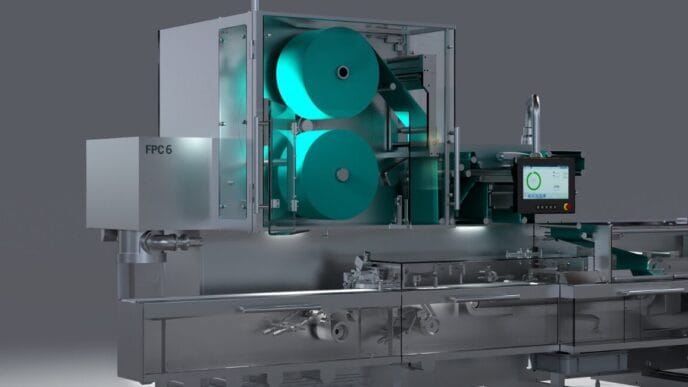
KOCH Pac-Systeme GmbH impresses with its comprehensive expertise in customised blister machines and packaging development: Involved in the relevant processes at an early stage, the specialists at the special machine manufacturer from Pfalzgrafenweiler ensure a reduced product-to-packaging ratio and optimum utilisation of the material. Machine, packaging design and material form a perfectly harmonised, productive unit.
Intelligent solutions for small batches, high performance for large runs, automated packaging in integrated processes: KOCH designs customised blister machines and line configurations in a modular design. The focus is increasingly on Sustainability.
New brand: use KOCH
The company, which is part of the Uhlmann Group, is responding to current and future requirements with a new brand: use KOCH. Each letter designates an aspect of innovative, sustainable packaging:

u like unique, as individualised packaging from Quantity one, for a personalised approach to customers, for more personality in products and brands. The s stands for smart, for example, for the integration of QR codes and wireless technologies for accessing additional information anywhere and at any time via smartphone. The letter e stands for the currently most important aspect, for ecoenvironmentally friendly packaging, which is increasingly demanded by both retailers and end customers. Packaging that is more environmentally friendly and yet, like conventional rigid or flexible film blister packs, protects the product in the best possible way and presents it attractively.
In order to minimise the Aspect „eco“ and to find out more about KOCH's expertise in this area, packaging journal has organised an interview with Product Manager Claus Weinert led.
pj: Mr Weinert, how long has the new use KOCH brand been around and what are the Background for their development?
Claus Weinert: Well, our strength has always been the development of customised packaging solutions in special machine construction. Over the years, this has resulted in an enormous portfolio with numerous innovations. In order to structure these solutions and make them accessible to the market, we first created the USE KOCH„ initiative“ was launched.
This gave rise to the new brand, which we will be presenting to a large audience for the first time at FachPack. We have been working with cyclePac one Environmentally friendly single-material packaging with a high recycling rate in the programme - but with use KOCH we are positioning ourselves much more broadly.
pj: What does that actually look like?
Claus Weinert: With use KOCH, we are addressing the current and future requirements of our customers, primarily from the consumer goods sector. On the one hand, the companies themselves have the demand, act more sustainably, on the other hand, the ecological aspect is playing an increasingly important role for consumers.
Both in terms of the product and its ingredients, as well as packaging. With smart and unique, we are bringing other aspects into play that are gaining in importance. The aim is also to make KOCH packaging technology usable for new users and to broaden our target groups.
pj: Which Focal points do you use KOCH?
Claus Weinert: The highest priority is currently clearly on the Aspect eco. The use of sustainable packaging materials, the saving of material by designing the packaging accordingly and by making optimum use of the machine format have been part of our standard scope of delivery for decades. With cyclePac, we are pioneers in sustainable forms of packaging for consumer products.
This allows customers to Completely closing the sustainability loop. s wie smart includes services such as coding and printing, e.g. in accordance with Track & Trace or UDI. Today, these applications can be networked via intelligent cloud solutions, which are part of our K 4.0 portfolio for digitalisation in special machine construction. u wie unique stands for our core competence, for highly customised packaging machines. And now also for Individualised single packaging up to quantity one.

pj: Are there any other solutions that you are pursuing with use KOCH or beyond?
Claus Weinert: Both for classic Hard or soft film blisters and cyclePac, the sustainability aspect plays a major role. Soft film blisters allow significant savings to be made on consumables and the blisters can be nested in transport packaging to save space, which also reduces the pack size.
This type of blister is ideal for flexible, bendable products such as catheters or tubes - and therefore also for our customers in the Medical technology field of application interesting. Reusable speciality plastics could soon be used for hard blisters. We are currently in the test phase with some of these materials.
pj: What do the results look like, especially with cyclePac? And how can the new packaging forms be processed in practice?
Claus Weinert: Firstly, to anticipate the answer to your second question: Nothing will change for our customers in terms of machine performance and packaging quality. We develop the optimum process for the various materials and packaging designs.
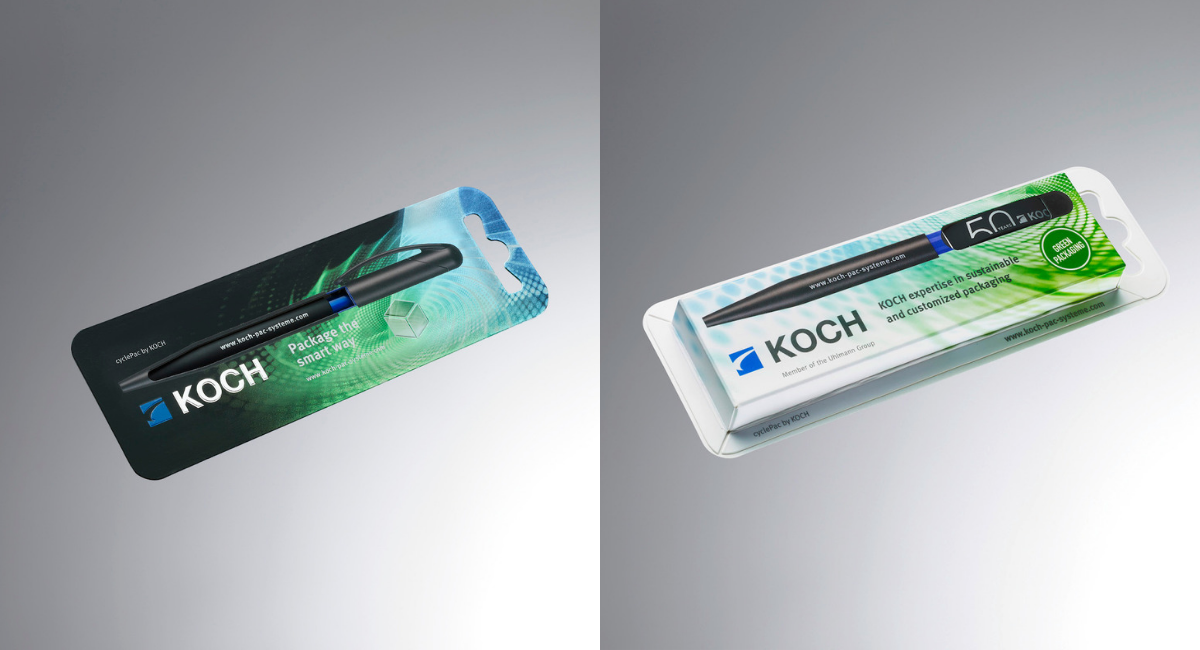
Now to the results: For individualised packaging we integrate a Drop-on-demand printer. It delivers high-resolution, brilliant results even with fine type or images. As part of cyclePac, we realise Single-material packaging based on cellulose.
In the consumer sector, these replace traditional packaging made from a mix of plastic and fibre material. This protects the environment and saves around 20 per cent of packaging licences. The packaging is designed for the top-loading filling principle and the material can, of course, also be finished in an environmentally friendly way. The packaging therefore remains, as before, a „Eye-catcher“ at the point of sale.
pj: Keyword Point of sale: Other factors also play a role here, e.g. placement in existing shelving systems. What is the situation?
Claus Weinert: The same options are available as before: packaging with feet and/or Euro perforations, with opening aids and perforations, as well as cardboard inserts to hold the products in place. In addition, windows can be punched out and the corners can be fitted with protective flaps, making the packaging more stable and sealed.
pj: What target markets does KOCH have in mind with the new brand?
Claus Weinert: First of all, clearly the Consumer area such as dental care and personal care. The first products in cyclePacs will soon be available in drugstores. In addition, all products can be packaged, from stationery to batteries, which are themselves „packaged“ and protected, so to speak. In the area of Medical technology cyclePac can be used as secondary packaging. We have been offering comprehensive expertise for these markets for years.
pj: Many of your customers continue to pack in both hard blister packs and new packaging formats. Not everyone wants to invest directly in two machines.
Claus Weinert: That is an important aspect! It's true that many customers are currently still relying on both forms of packaging and cannot process both on one machine. Either alternating or, as we will be showing at FachPack, even parallel. This means that the changeover can be completed step by step. Thanks to the modular design of our systems, we can configure new machines accordingly and retrofit existing ones on request.
[infotext icon]FachPack 2019
In Nuremberg, the company will be presenting the 100 per cent recyclable cyclePac single-material packaging made of cellulose in direct comparison with a hard blister with card: Both designs are packed in parallel on a KBS-PL blister machine with linear pallet transport. The products are fed and placed by a 6-axis robot. With three translation axes, three rotation axes and a radius of 1,000 millimetres, the robot works with high precision and can be used flexibly for a wide range of packaging tasks and formats.
[/infotext]KOCH Pac-Systeme GmbH at FachPack 2019: Hall 3A, Stand 221