The so-called Russian crypto-code law came into force on 1 January 2019 and only gives pharmacists until the end of the year to implement the demanding serialisation and aggregation regulations.
Laetus was quick to consider the effects of Markirovka and has already successfully trialled solutions for various applications in production-related tests.
Markirovka is the latest challenge facing the pharmaceutical industry. However, it is not only the tight time frame that causes problems in this context. The problems resulting from the higher data density larger Data Matrix codes with 40 x 40 modules push some cameras and printers to their limits. In addition, the ongoing adjustments to the interface to the Russian system operator for data download and upload represent an additional challenge. Uncertainty factor represent.

Applies beyond the pharmaceutical sector
The labelling of medicines is just one part of the uniform Russian system for the serialisation of various product groups with different implementation deadlines. These also include shoes, tobacco, perfume, clothing, alcohol and milk, among others. Operators of the system known as IS MDLP system known as Markirovka has been in operation since 1 November 2018. Centre for the development of advanced technologies (CRPT). This is responsible for implementing the individual timelines, generating the crypto code and managing the data.
Crypto key for verification
Decree No. 1556 „Ordinance on the system for monitoring the movement of medicinal products for medical purposes“ regulates the details of the labelling. The new serialisation code will consist of two areas, a so-called Identification area and a Verification area.
As the name suggests, the identification area is intended to ensure unambiguous identification and contains a GTIN and the unique serial number. The second part is used for checking and verification. It consists of a crypto number and a crypto key, which is created from the respective pairing of GTIN and serial number.

For data transmission, the CRPT wants to offer domestic manufacturers so-called Issues recorder make them available. These are integrated into a cloud. Manufacturers use this method to transmit the GTIN and serial number of the product and in return receive the crypto key and number associated with this pair.
The plan is to use a cryptographic information system for the allocation of this cryptographic information. Fee to collect. Foreign manufacturers are connected to the system operator via a cloud.
Challenges: high data density, large codes, small modules
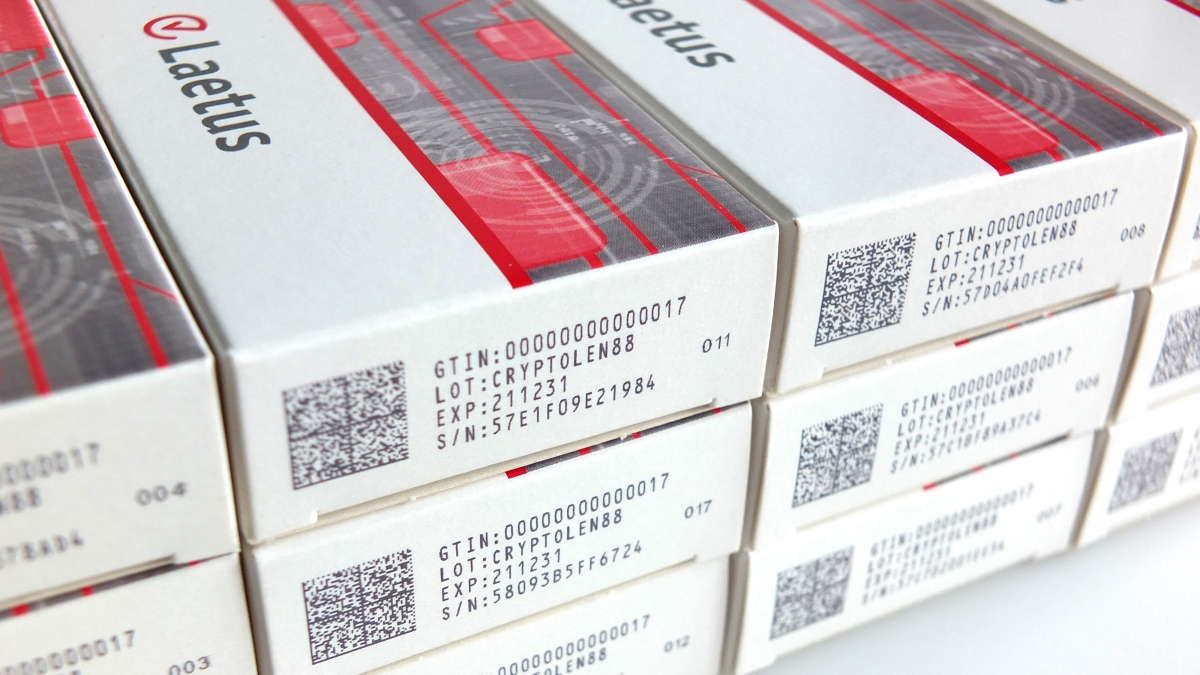
The data carrier for serialisation should be Data Matrix Codes according to GS1 standard, barcodes, supplemented by human readable text, are used. Barcode 128, also in accordance with the GS1 standard, is used for aggregation at carton level. In addition to the GTIN, serial number, crypto key and crypto number, the data matrix can also optionally contain a batch number, an expiry date and an additional product identification. The text part must consist of the GTIN, serial and batch number and the expiry date.
To encode the larger amounts of data, you need More modules for the Data Matrix Code, which becomes significantly larger as a result. If there is not enough space on the packaging, the modules must be scaled down accordingly for printing. This requires a more precise adjustment of the printers during set-up and often an adjustment of the camera resolution in order to optimise the print quality. Same field of vision size to keep.

A team of experts from Laetus GmbH, Alsbach-Hähnlein, has tested how this can be realised in practice, both under laboratory conditions and, together with CRPT, under real production conditions.
Tests under laboratory conditions
The S-TTS 2.7.2 serialisation and aggregation software, the INSPECT 1.26 camera system and the External Communicator 1.7 were used for the tests. The printing of Data Matrix codes with 40 x 40 modules and various module sizes was tested with a thermal inkjet printer at belt speeds of up to 200 folding boxes per minute.
As already suspected, the printer set-up initially proved to be Critical factor and initial tests under laboratory conditions achieved print qualities with a grade 2 (formerly C) in accordance with ISO/IEC 15415, the minimum required print quality. Ongoing tests resulted in a permanent improvement in print quality.
Tests with CRPT under real production conditions
The findings from the laboratory were incorporated into the joint tests with CRPT. In a real production environment, the team tested batches of more than 1,000 folding cartons at a belt speed of up to 200 pieces per minute. They used different code contents with 44-digit and 88-digit crypto numbers. During the tests, the testers consistently achieved print qualities of at least Grade 2 and better for code sizes with 36 x 36 and 40 x 40 modules.
The data exchange, i.e. requesting the crypto codes and uploading the codes used, was initially carried out via the API interface version 1. Markirovka pilot project The order management system provided by the operator for the serialisation of tobacco was used, as the pharmaceutical server was not ready for operation until the tests had been completed. The API interface is updated every three to four weeks, meaning that it has not yet been possible to test the final version.
Expertise for Russia Compliance
As the infrastructure is still being developed, there are still numerous uncertainties regarding the exact implementation of the Russian crypto code law in practice. However, the tests have provided important insights into how the technical challenges arising from the high data density and larger codes can be successfully resolved.
Which Adjustments The details of what manufacturers need to do in their lines depends on how the lines affected by the Russian crypto code law are currently equipped in terms of machines, printers, cameras and controllers and whether, for example, an aggregation stage is already in place.
In order to Narrow timeline manufacturers may no longer have much time to take stock and find the right solutions and implement them in their packaging lines. It can therefore be advantageous to fall back on solutions that have been successfully tested in practice and, above all, on expertise gained from experience.