The European Commission has published the guidelines on the implementation of the EU Regulation on Packaging and Packaging Waste (PPWR). The aim is to provide companies and authorities with more clarity when applying the new rules and to ensure uniform implementation across the EU.
Regulation (EU) 2025/40 has been in force since February 2025 and will apply with binding effect from 12 August 2026. With the now presented guidelines The Commission is responding to numerous open questions from industry and Member States. They are intended in particular to facilitate the interpretation of key terms and obligations, without being legally binding themselves.
Clarity on definitions and responsibilities
A key focus of the Guidelines lies in defining the core roles along the value chain. For example, it clarifies when a company is considered a manufacturer and when it is considered a producer in the sense of extended producer responsibility. While manufacturers are responsible for the conformity of packaging, producers bear the costs of collection and recycling in the Member State where the packaging becomes waste.

The definition of packaging is also being refined. Consequently, what is decisive is not solely the material or the shape, but the function – for example, whether a product serves for storage, protection, or transport.
Recyclability and design requirements
The Guidelines confirm that as of August 2026, all packaging must generally be considered recyclable. However, specific design requirements will be introduced gradually. Uniform criteria for „Design for Recycling“ are to apply from 2030, while actual industrial-scale recyclability must be proven by 2035.
This leaves companies with an initial transition period, while also making it clear that packaging design will need to be more closely aligned with recycling processes in the future.
PFAS limits and regulatory tightening
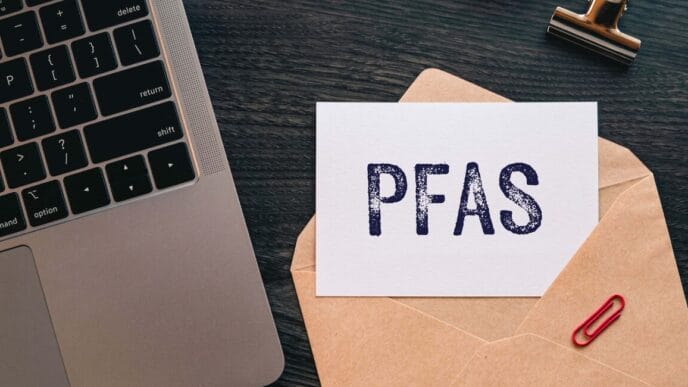
Another key point is the new limits for PFAS in food packaging. These also apply from August 2026. A transitional period for newly marketed packaging is not foreseen. However, products that were already placed on the market before this date may continue to be sold.
The Guidelines describe further testing methods and a graduated approach for determining PFAS content, as there is currently no EU-wide harmonised test method.
Harmonised labelling in the EU
From 2028, harmonised labelling for packaging is to be introduced to support consumers with waste separation. National labelling systems will largely be replaced by this. The aim is to reduce fragmentation in the internal market and improve recycling rates.
Information on recycled content or bio-based materials will also be regulated uniformly in the future, provided that companies voluntarily declare them.
Reusable quotas and deposit systems
The Guidelines They also provide guidance on the implementation of reusable targets and deposit systems. For example, Member States must achieve a separate collection rate of 90 per cent for single-use beverage bottles and cans by 2029. As a general rule, this will require the introduction of deposit and take-back systems.
From 2030, mandatory reuse quotas will apply to transport packaging and certain sales formats, affecting companies throughout the supply chain.
Classification for the packaging industry
With the guidelines, the Commission is creating a comprehensive interpretative aid for the PPWR for the first time. You are addressing key practical questions, for example concerning accountability, technical requirements, and the achievement of environmental goals.
At the same time, it is becoming clear that the regulation is interfering deeply with existing business models. Companies must prepare for new design requirements, extended reporting obligations, and stronger harmonisation in the EU's internal market.
The Commission emphasises that the guidelines should be updated as needed. Complementary to this, an FAQ document is planned that will address further practical questions.
Source: EU Commission