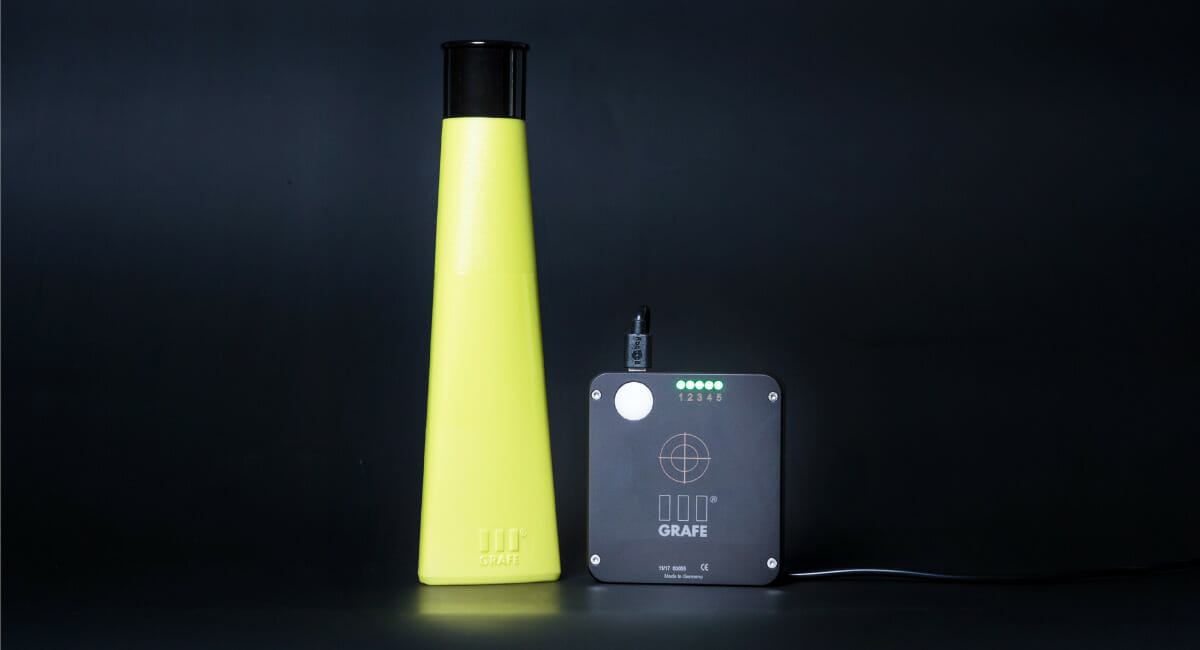
To ensure product protection and prevent brand piracy, Grafe has developed special marking substances that are added to plastics in minute quantities and can later be read using appropriate detectors.
Invisible product protection in the form of marking substances offers significantly increased counterfeit protection for original labels and thus effectively prevents brand piracy. Grafe, headquartered in Blankenhain, has been active in this area for many years and works with various partners in the field of marking materials and measuring devices for detection. Because the demand for invisible labelling of the components with masterbatch and the corresponding testing technology for a wide range of end applications in plastics processing is constantly increasing.
To ensure product protection and prevent brand piracy, Grafe has developed a simple solution that offers a high level of security. It is based on special markers. "The highly complex pigments with special physical properties designed for this purpose are used in very small quantities within the plastic matrix. With an appropriately calibrated detector, the products equipped with it can be read out and authenticated," explains Business Development Manager Florian Ludwig. At the same time, no changes in properties can usually be observed.

"Almost all sectors are affected by plagiarism and counterfeit products, resulting in high sales losses for manufacturers. Our aim is to make this more difficult by being able to determine directly on the end product whether it is an original or a copy acts. Visible product protection is usually realised with the help of labels or QR codes. These are quick and easy to integrate into a product. However, security is low as these features can be copied." Florian LudwigBusiness Development Manager
Marking materials from Grafe offer invisible product protection
Since it is a visually recognisable feature, the difference between the original and the counterfeit can no longer be seen at first glance. In contrast Product protection in the form of marking substances not so easily recognisable. "Even if the effort required to implement it is greater, the advantages outweigh the disadvantages, as safety is significantly higher. The labelling is checked using a measuring device," explains Ludwig.
How it works: An indicator substance is added during the manufacturing process. This additive can be added as a combination batch, i.e. as a masterbatch in combination with a colour, or as a special marking batch without colour. The Detectors can check within seconds by means of an LED displaywhether the marker is included in the product and whether this item is the original product.
In general, there are two possibilities: x ray and light fluorescence, i.e. fluorescent X-rays or light. With the first variant, the base colour has no influence (not even black) and the customer benefits from a low addition dosage and batch price, but this method requires a higher investment.
"With light fluorescence, on the other hand, detection is carried out using a measuring device that is preconfigured by our partner or by us directly. Different types are available, from handy hand-held measuring devices to stationary office solutions and inline spectrometers, so that checks can be carried out directly during production," explains Ludwig. With this method the masterbatch dosage depends, among other things, on the base colour. The functionality is quick and simple, and the necessary investment is manageable.
Suitable for all areas of plastics processing
"In addition to customised markers - depending on the end application and the product protection to be achieved, it may be necessary for the marker to be individually unique - we feel a Increased demand for general markers for identification, as these are already sufficient for many end applications," reports Ludwig.
From the Injection moulding, extrusion, transparent and fibre applications almost all areas of plastics processing. However, not every component geometry can be detected equally well with every measuring device. "That's why we select the marker system and the right measuring device in close cooperation with our customers and suppliers."
The markers can only be detected chemically using very complex analytical methods. The property profile required for detection can vary in structure and composition. manufactured only by the respective producer can be used. As no additional processing steps are required, the markers can either be part of a standard masterbatch finish or simply added as special marker masterbatches.
[infotext icon]The product range of Grafe includes a wide range of functional plastic compounds in addition to colour and additive masterbatches. One of the largest research and development departments in the industry is working on new technologies that equip plastics with intelligent functions. The family business was founded in 1991 by the four Grafe brothers and today employs more than 300 people who develop and produce for the national and international market at the plant in Blankenhain (Thuringia).Source: Grafe