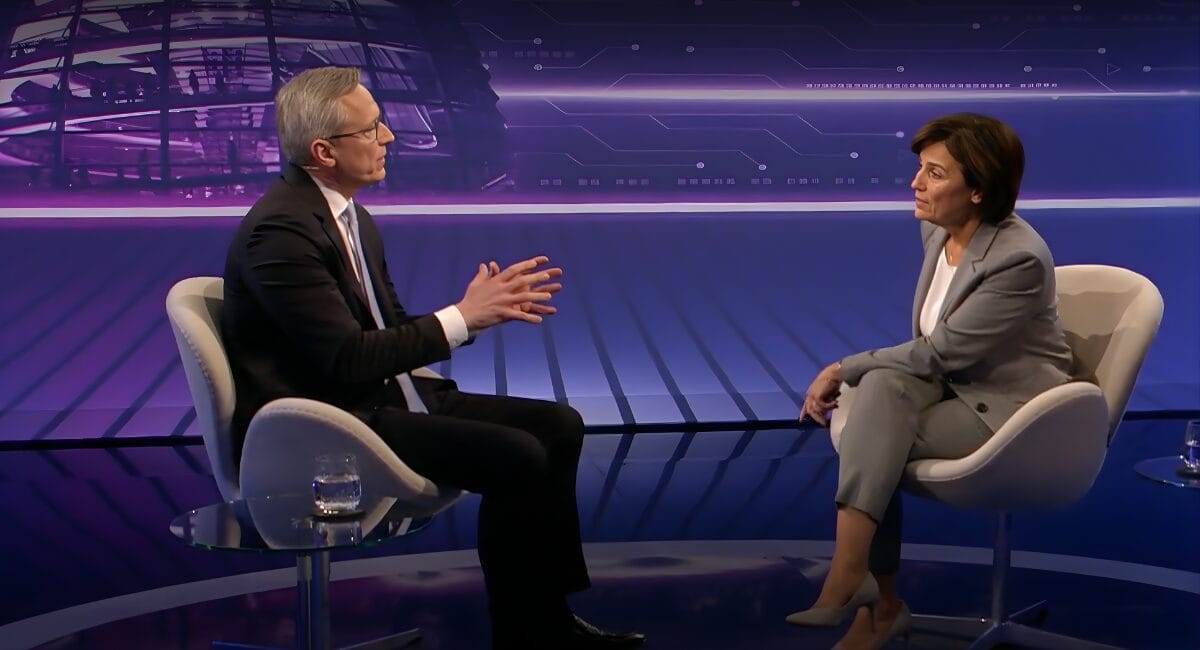
In the ARD talk show „maischberger“, Sandra Maischberger describes the case of a car dealer who allegedly has to buy in packaging in order to fulfil a bureaucratic „target“. Federal Minister Karsten Wildberger criticises the „nonsense“ - but then abruptly switches to the Supply Chain Sustainability Obligations Act. An appearance that reveals less about the Packaging Act than about political priorities?
The starting point of the discussion is not the minister, but the presenter. Sandra Maischberger gives a „real-life“ example: a car dealer has to return all the packaging she receives from suppliers, but does not get all the packaging back from her customers. In order to fulfil her supposed „target“, she buys film from farmers and additional packaging on the internet just to be able to return it.
This exaggerated story leads to the question to Karsten Wildberger whether he can fulfil his promise that such „nonsense“ will stop in future.

How realistic is this example?
The scene described illustrates a widespread feeling among SMEs: bureaucracy is so absurd that companies end up working „for the bin“. In this exaggerated form, however, the example is hardly legally tenable. The Packaging Act recognises system participation and take-back obligations, but no obligation to return the exact amount of packaging that a company has previously received - and certainly no obligation to buy in third-party film or cardboard. The real burden lies in licensing costs, take-back organisation and documentation, not in a one-to-one accounting return.
Wildberger's change of subject: From the Packaging Act to the Supply Chain Act
Things get exciting when Wildberger „exits“ the packaging issue. The sweeping criticism of „nonsense“ is suddenly followed by „good news“: the Supply Chain Duty of Care Act is being withdrawn, reporting obligations are being reduced and bureaucracy is being cut overall. He emphasises that the government is working intensively on reducing notification and reporting obligations and fighting new waves of bureaucracy in Brussels.
In doing so, he is changing the legal regime: away from environmental and waste-related packaging legislation and towards a human rights and environmental due diligence law for global supply chains. In terms of content, this has little to nothing to do with the car dealer described and her alleged packaging returns - but it fits perfectly into Wildberger's overarching narrative of „cutting red tape“ and the modernisation agenda with which he is making a political name for himself
What the appearance reveals about the priority of packaging
The appearance can be read as clear evidence that simplified packaging legislation is not currently high on the minister's agenda. He does not use the talk show example to explain where exactly the Packaging Act is impractical, which sections should be streamlined or how the German government intends to use the upcoming European PPWR implementation to simplify the rules.
Instead, he uses packaging as a springboard to talk about another law where he can promise concrete relief. Whether this is because he doesn't have a deep enough technical understanding of packaging issues or because he doesn't see any major political scope for action remains to be seen - both have a similar impact on the industry: Packaging is not the topic on which the minister spontaneously goes into detail.
This scene is symptomatic for companies that are currently struggling with new minimum standards, future PPWR requirements and increasing reporting obligations: in the talk show, real problems are explained with exaggerated anecdotes - and when things could become concrete, political attention quickly shifts to other construction sites.