In the fast food sector, customers have to order quickly. For example, burgers are freshly prepared and then ketchup, mustard or sauces are added. These are portioned from large cartridges. These cardboard cartridges are still fitted with a plastic lid. This can change with the TCM 80 capping machine from Wilhelm Fischer Spezialmaschinenfabrik (WF).
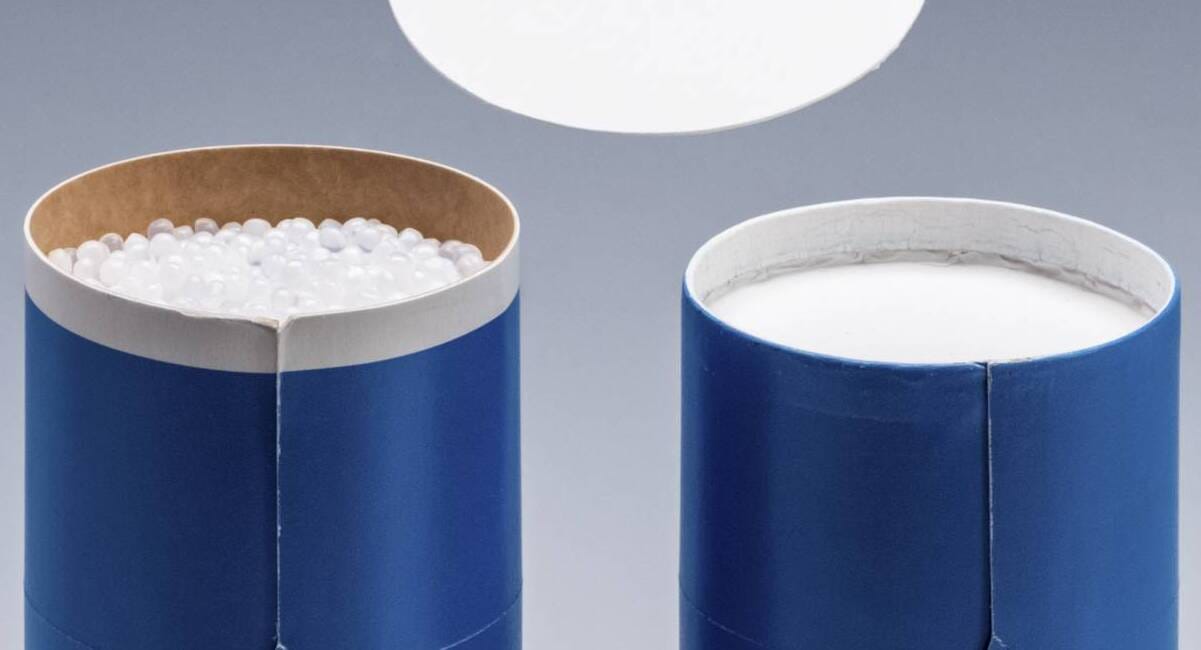
As in almost all sectors, sustainability is also a very important aspect in system catering. One factor that has not yet been satisfactorily resolved is the sauce containers. These now consist of a cardboard tube with a wafer-thin coating. This is required by hygiene regulations. However, the lid of the cartridges is made of hard and stable plastic, usually HDPE. These cartridges are inserted into a cartridge press on site. When pressed, the lid is pushed down and the contents are dispensed. The lid acts as a piston. Once the cartridge has been emptied, the plastic lid also remains: a considerable amount of waste throughout the year and by no means sustainable.
Seal cardboard boxes with cardboard lids
Wilhelm Fischer from Durach in the Allgäu region is one of the leading machine manufacturers when it comes to packaging products in cardboard boxes. The company's portfolio now also includes machines for sealing pre-filled cardboard boxes using cardboard lids. The lids are inserted into the cardboard box and then sealed. If required, the edge of the can can be crimped. The performance spectrum of the machines ranges from 40 to 320 cans per minute.

The idea was to produce a cartridge with the highest possible fibre content in order to achieve the highest possible recovery values in the design for recycling. The previous heavy HDPE plastic lid is replaced by a 70 per cent lighter PE-coated cardboard lid, the paper plug. The 26% reduction in plastic increases the fibre content to 86% and reduces the overall weight by 22%.
Develey relies on sustainable cartridges
Develey Senf & Feinkost, a traditional manufacturer of mustard and delicatessen sauces, is using the new technology in its dispensers in the Develey Quick Service division, thus creating a further milestone in its packaging strategy towards less resource consumption in addition to customer benefits.
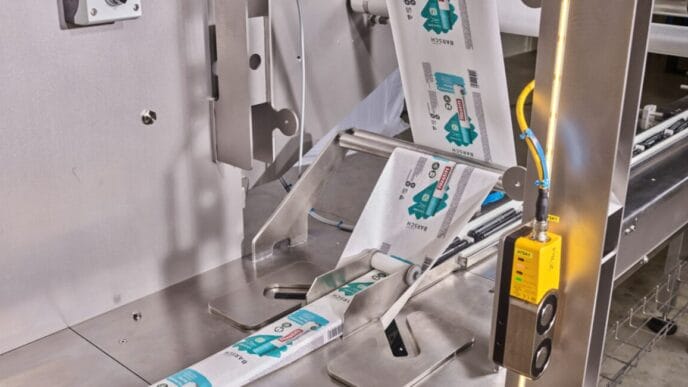
One challenging task here is the secure and leak-proof sealing of the carton lid without a backstop, i.e. „freehand“. The new TCM 80 round can seamer is also ideal for this task. The filled cartridges are fed into the machine via a conveyor belt and the flat, round carton blanks are inserted into the cartridges from above. During insertion, these are moulded into carton lids. The carton lids must be inserted with a precise fit and without any backing. The cardboard lid is then sealed tightly with the cardboard sleeve.
The entire new TCM 80 machine has a very compact design and is made almost entirely of stainless steel. The control cabinets are located on the roof of the machine, so it requires very little space. Simply install the infeed and outfeed belt, realise a 400-volt three-phase current connection and a 6-bar compressed air connection, and the machine is ready to go.
„Some people can put the lid on and seal it. But we are one of the very few who can insert and seal them securely freehand. This saves on complex and expensive parts,“ explains Robert F. Kuhn, Head of Design and Development Automation at WF. This is all the more remarkable because these are not thick, spiral-wrapped cans, but rather longitudinally seam-sealed cans with a very thin cardboard wall.
Plan sealed and tight
In the discharge area of the TCM 80, the carton lids of the sealed cartridges are checked for evenness and the correct position in relation to the upper edge of the cartridge. The lid must be sealed exactly flat down to the millimetre so that it tears off all the way round later in the press. If this is not the case for a lid, this cartridge is not processed further and is ejected. This also applies to cartridges that do not fulfil the pressure test from above. Although the lid must tear off later in the press and then move downwards like a piston, it must be absolutely tightly sealed by then. Only the „good“ cartridges leave the TCM 80 on the outfeed conveyor.
The hands-free closing of round cans and the replacement of plastic lids with cardboard lids is of course also interesting for other industries in addition to the fast food sector.
Everything from a single source
At WF, all areas are united under one roof, from the initial concept to after-sales support. The capping of cardboard cans is just one area of the company, which has been designing, manufacturing and installing packaging machines for the beverage, food and consumer goods industries for more than 70 years. In addition to customised special solutions and carton can seaming machines, Wilhelm Fischer also produces machines for the brewing and beverage industry for packaging bottles or cans in sleeves, baskets and fully sealed cartons.