With decades of experience in plastics processing, its own innovation centre and specialised production lines, Pöppelmann FAMAC is one of the leading providers of modern packaging solutions.
The division of plastics specialist Pöppelmann from Lohne not only develops customised solutions, but also actively promotes technologies that aim to conserve resources and protect the climate - including in the area of recyclable monomaterials. Marco von Döllen, Head of Sales, and Jörg Wilke, Head of Development, are very familiar with the current challenges facing the industry. In this interview, the experts from Pöppelmann FAMAC® explain how the company is using innovative processes and a clear climate strategy to support its customers in fulfilling the upcoming EU packaging regulation PPWR and why monomaterials are the key to the food packaging of the future.
The packaging industry is under increasing regulatory pressure. In your opinion, what are the most important requirements?
M. v. D.: The EU's new Packaging and Packaging Waste Regulation (PPWR) represents a real turning point for the industry. From 2030, packaging must be at least 70 per cent recyclable - this is no longer an option, but an obligation. At the same time, the use of recyclates for food packaging is difficult or even impossible due to existing regulations - and yet it will be required from 2030. For many companies, this means fundamentally rethinking their existing packaging concepts.

J. W.: At Pöppelmann FAMAC® we have been working on the development of fully recyclable solutions for years. It has always been clear to us that if you want to survive in the future, you not only have to be cost-efficient, but also think in cycles. That is why we are focussing on mono-materials, modern technologies and a more circular economy in order to combine greater environmental protection and climate protection with economic efficiency.
What makes monomaterials so valuable and effective from Pöppelmann FAMAC®'s point of view?
J. W.: One decisive advantage is, of course, the clear separation of materials. Unlike composite materials, packaging made from just one type of plastic, e.g. polypropylene (PP), is very easy to recycle. They can be collected by type in the recyclable material stream and fed into the recycling stream without time-consuming separation. This creates closed loops. This not only makes ecological sense, but is also becoming increasingly important economically. Plastics that are recycled at the end of their life cycle remain valuable raw materials and protect the environment. After all, a functioning circular economy is demonstrably the greatest lever for reducing greenhouse gas (GHG) emissions, for greater climate protection and resource conservation.
M. v. D.: At the same time, companies that invest in recyclable products at an early stage secure a leading role in the market through higher environmental standards. This not only has a positive impact on their image, but also actively supports them in achieving their own corporate sustainability goals.
What technological paths does Pöppelmann FAMAC® take to support its customers on this path?
J. W.: Our product development in Lohne consistently follows the eco-design concept. We take into account the environmental aspects of a product throughout its entire life cycle - with the declared aim of minimising the ecological footprint of a product. The eco-design concept is based on the three pillars of reduce, reuse and recycle. „Reduce“ involves reducing the use of materials and energy through optimised design and more efficient processes. Reuse„ refers to the utilisation of reusable materials and packaging concepts. Finally, “Recycle„ refers to the development of products with improved recyclability and the closing of material cycles. As it is currently still difficult or impossible to use recycled plastics for packaging in the food industry due to strict regulations, we utilise other options to reduce GHG emissions, among other things. These include design optimisations that reduce the required transport capacities and therefore emissions, as well as process adjustments that can reduce energy requirements. The use of monomaterials is particularly effective, as it ensures good recyclability, conserves resources and also reduces GHG emissions through the circular economy.
What does the practical implementation look like if a customer wants to improve their existing packaging solution in terms of recyclability or overall environmental compatibility??
J. W.: In classic injection moulding, we determine the appropriate single-material and also work specifically on reducing the material and optimising the packaging geometry. This is where our product development team demonstrates its expertise on a daily basis. Some time ago, we were faced with the task of redesigning a private label cup for quark products for a customer in terms of efficiency and environmental compatibility. We changed the packaging geometry and reduced the wall thickness of the container by using a reinforced ribbed structure. This led to material savings of around 20 per cent compared to the previous solution, which was already made of the mono-material polypropylene (PP). The new cup is also characterised by maximum recyclability, is very stable, can be processed reliably and fulfils all logistical requirements. Among other things, the new compact design means that transport capacities can be utilised even better. Overall, 20 per cent fewer GHG emissions are emitted during production compared to typical market alternatives. The optimised logistics further reduce GHG emissions. The cup was honoured with the German Packaging Award 2024 in the „Economic Efficiency“ category. This emphasises once again that ecological responsibility and economic success are not a contradiction in terms, but are essential for the packaging of the future.
What opportunities do new technologies open up?
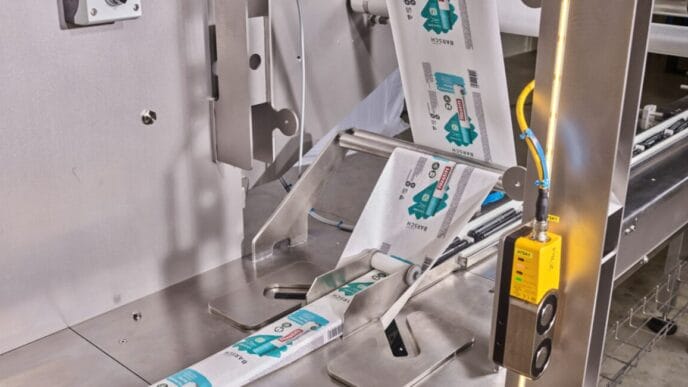
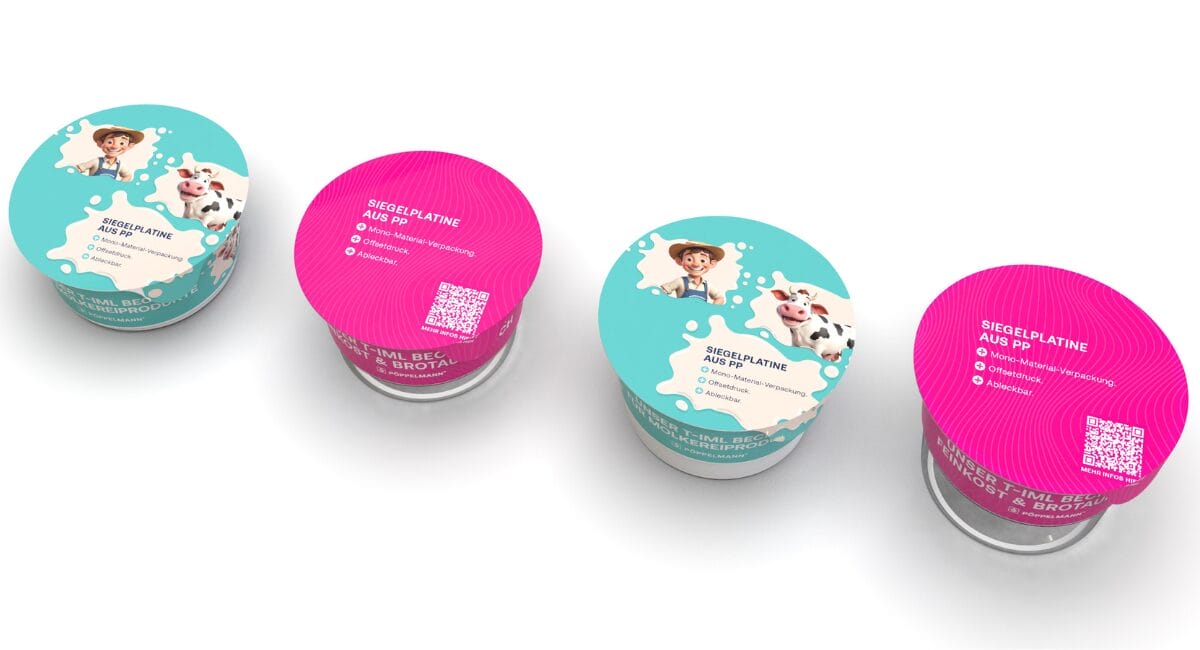
J. W.: We see the thermoforming process and its further developments as core technologies for the production of mono-material packaging solutions. Last year, we inaugurated our new T-IML system in Lohne. The T-IML process combines thermoforming and in-mould labelling. An extruded film is formed into the desired packaging shape and simultaneously provided with a pre-printed label made of the same material. The packaging and label are joined together to form a single unit. The result is an ultra-light, highly decorated cup with maximum recyclability that can also be reliably processed by machine.
M. v. D.: We developed a specific application example with a well-known company from the dairy industry. This customer wanted a new cup for its herb and spice quark range. Compared to conventional solutions, the new cup using the T-IML process is not only 25 per cent lighter, but also very easy to recycle. Because it is produced in large quantities, the GHG emissions generated during production are now reduced by several hundred tonnes each year thanks to the change in packaging. We are absolutely convinced by this combination of function, design, process reliability and recyclability - and so are more and more customers. That is why we have developed concepts with which standard programmes made from T-IML cups can be implemented economically in order to make them available for even more applications.
What about flexible packaging? Can this also be realised completely from monomaterials?
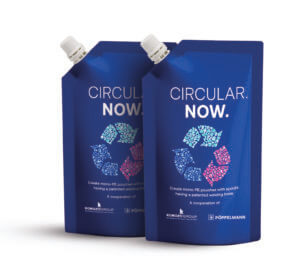
J. W.: In many cases, realising flexible packaging with monomaterials is a little more technically demanding. For example, when it comes to stand-up pouches with spouts - a very popular packaging solution. The bags are often made of composite materials that are difficult to recycle. In order to achieve good recyclability with this packaging solution too, manufacturers can switch to pouches made from monomaterials such as polypropylene (PP) or polyethylene (PE). However, due to their temperature sensitivity, bags made of PP or PE could previously only be provided with a practical spout made of the same material using cost-intensive ultrasonic welding technology, which made mono-material solutions less economical. But we have found a solution here too. Our low-sealing spouts enable processing using the low-temperature sealing process. With this economical and efficient solution, complete flexible pouches can be produced from the same material, as we can also supply the cap or lid from the corresponding plastic. The development was a real breakthrough and greatly expands the range of applications for recyclable packaging such as the popular stand-up pouches, both in the food sector and for non-food applications.
How does all this fit into your company-wide climate strategy?
M. v. D.: Climate protection and resource conservation are not a marketing issue for us, but part of Pöppelmann's DNA. We have been participating in the European Union's Eco-Management and Audit Scheme (EMAS) on a voluntary basis since 1996. In 2018, we launched the company-wide PÖPPELMANN blue® initiative, under which we bundle all our activities for more climate protection and resource conservation. The Pöppelmann Group is also pursuing a comprehensive climate strategy. Our climate targets are science-based and are orientated towards the Science Based Targets Initiative (SBTi). We calculate our corporate carbon footprint (CCF) according to recognised standards, derive clear measures from this and have set specific climate targets for 2030. The use of monomaterials in the FAMAC division's packaging development is a central component of this strategy. It promotes the circular economy, which is demonstrably the greatest lever for reducing GHG emissions. We believe that contemporary packaging solutions are lightweight, efficient and recyclable - monomaterials are ideal for realising these properties.