
More packaging waste during the pandemic

More packaging waste was generated in private households in 2020. The preliminary figures from the Federal Statistical Office show that around 6 kilograms more packaging waste was generated per capita. 

In the first year of coronavirus in 2020, private households generated more packaging waste. The preliminary figures from the Federal Statistical Office show that around 6 kilograms more packaging waste was generated per capita. The proportion of lightweight packaging in particular has increased.

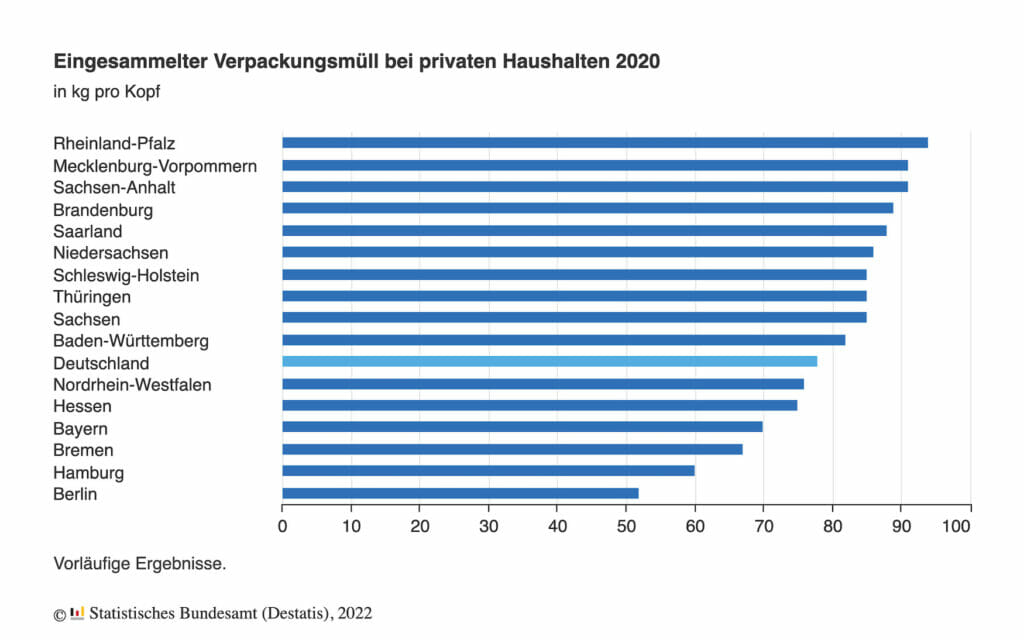
In 2020, a total of 78 kilograms of packaging waste was collected per capita in private households in Germany. This was an average of 6 kilograms more per person than in 2019. According to Federal Statistical Office the entire Volume of packaging waste, which is mainly collected separately from residual waste in yellow bins, glass or paper containers, by just under 0.6 million tonnes or 9.3 per cent to 6.5 million tonnes in 2020.

Bar chart on the volume of packaging waste in the individual federal states.

More lightweight packaging collected

At 32 kilograms per person (2.7 million tonnes in total), the so-called Lightweight packaging accounts for the largest share of packaging waste collected from private households. Lightweight packaging is predominantly packaging made of plastics, light metals such as aluminium or tinplate and composite materials. This was followed by glass packaging at 25 kilograms per capita (2.1 million tonnes) and packaging made of paper, cardboard and carton at 20 kilograms per capita (1.7 million tonnes).

As a result, the per capita volume of packaging collected from private households from Paper, cardboard and paperboard by 3 kilograms compared to 2019. In the case of glass packaging, 2 kilograms more was collected per capita. The per capita quantity of lightweight packaging has not changed compared to the previous year.

Display

79 per cent of packaging recycled

After sorting, a total of 6.4 million tonnes of used sales packaging delivered to waste treatment plants or recycling facilities. Almost four-fifths of this (79 per cent or 5.1 million tonnes) was recycled. In this mechanical recycling process, the original material of the waste is retained, so its chemical structure is not changed.

12 percent of packaging waste (0.8 million tonnes) was used for energy recovery, for example in incineration plants. The difference of 67,000 tonnes between the amount collected and the amount disposed of is due, for example, to storage quantities at handling and sorting facilities as well as sorting losses. These quantities are not statistically analysed and are therefore not shown.

Source: Federal Statistical Office

More news