Mosca: sophisticated Industry 4.0 applications or when the laundry item communicates with the strapping machine
In modern industrial laundries, strapping machines secure the laundry packages for transport back to the customer. To ensure that this process runs smoothly, all the steps must interlock perfectly - this also applies to the network-compatible strapping machines from Mosca GmbH.
12 January 2021
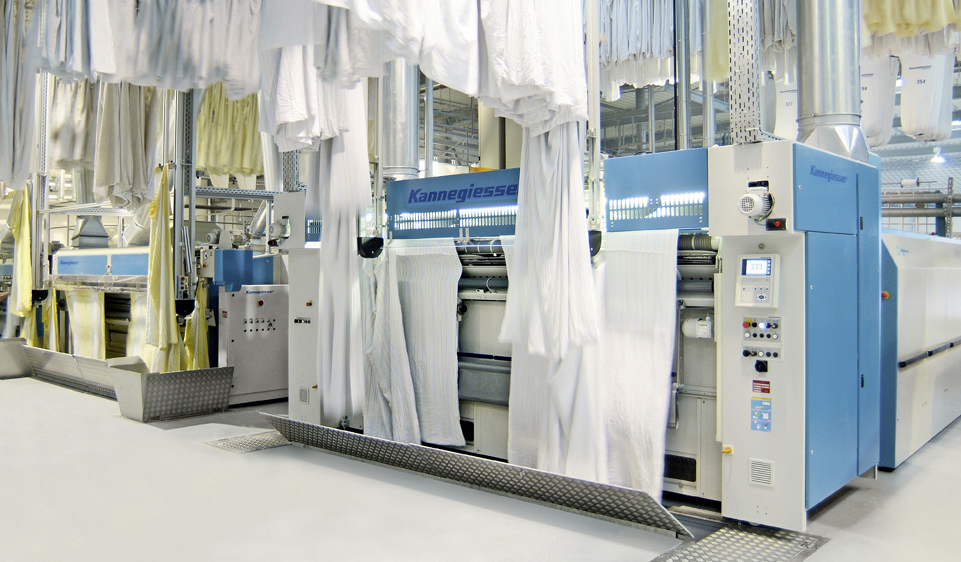
Strapping machines from Mosca are used at Kannegiesser as the final component of the fully automated lines. (Image: Mosca)
In modern industrial laundries, strapping machines secure the laundry packs for transport back to the customer. For this process to function smoothly, all steps must interlock perfectly - and all machines involved must automatically recognise and assign the laundry items. This also applies to the network-compatible strapping machines from Mosca GmbH.
Private individuals who take an item of laundry to the dry cleaner want to get it back clean - and packed quickly and safely for transport home. Business customers place the same demands on industrial laundries - but on an industrial scale. A hotel, for example, sends hundreds of tablecloths, towels, sheets and service uniforms to the laundry overnight. The challenges for cleaning and logistics are therefore great: on delivery, everything should not only arrive at the right hotel clean, but also sorted by linen type and bundled.
In modern industrial laundries, laundry is washed, dried and ironed fully automatically. At the end of the complex line, a folding machine folds the individual items and suitable machines secure the laundry packages for transport. Network-compatible strapping machines from Mosca are used by Kannegiesser, a specialist in laundry technology, as the final component of lines.
Reinhard Broghammer
„Together with our customers, we explore the possibilities of Industry 4.0 out. One challenge is certainly to make the customer aware of the problems that networking can solve. Once this hurdle has been overcome, we can develop completely new solutions,“ emphasises Reinhard Broghammer, Head of Electrical Engineering Development at Mosca.
Display
Self-controlling laundry
Kannegiesser, a supplier of laundry lines and technology from Vlotho in East Westphalia, meets these challenges with the concept of the „Smart Laundry“. „The term refers to the self-controlling laundry,“ explains Christian Wollmann, Product Line Manager Ribbon Systems at Kannegiesser. „Thanks to a centralised control system, our machines are optimally coordinated from the washing line to the folding machine and process the laundry fully automatically. As an intelligent solution, they are therefore able to track the laundry-specific data and allocate it to a delivery at any time.“
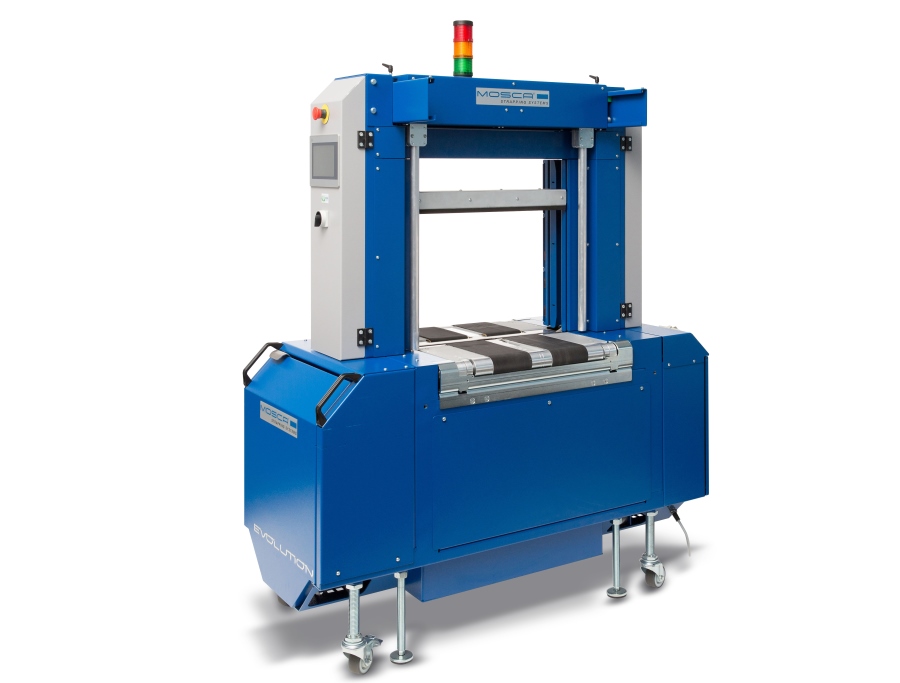
SoniXs TR-6-Pro strapping machine (Image: Mosca)
Open interfaces for a fully automated production line
Mosca machines have been used in systems supplied by Kannegiesser since 2012. Due to their Complete network capability, The use of common exchange formats such as JSON, the OPC_UA machine communication protocol and the open interfaces can make this possible. in automatic production lines be integrated. Scanners enable them to recognise incoming bundles of clean laundry and Strapping once or twice depending on requirements. „What counts for our customers is the simplicity of the system,“ explains Wollmann. „They want to put it into operation quickly according to the ‚plug and play‘ principle. The fact that Mosca machines can be perfectly integrated into our data technology pays off here.“
Laundry items are stretched in „ironing lines“ for further processing. (Image: Mosca)
Networked machine generation
Industrial laundries are just one of many areas in which Strapping machines are used. These include the corrugated board and paper industry, the food and beverage industry, newspapers, mail order and logistics. The machines should not only be easy to integrate, but above all Easy to operate leave. Here Mosca relies on apps such as Remote Monitoring Interfaces (RMI), which can be used to access and control networked machines via computer browsers.
„A simple display of the machines, their components and programmes immediately makes the operator's work easier,“ explains Reinhard Broghammer, Head of Electrical Engineering Development at Mosca. „For example, they can immediately see which machine has a malfunction or which strapping programmes have been selected.“ The IT security in the foreground. Customers access the strapping machines via their intranet. This means that potential attacks from outside can be ruled out.
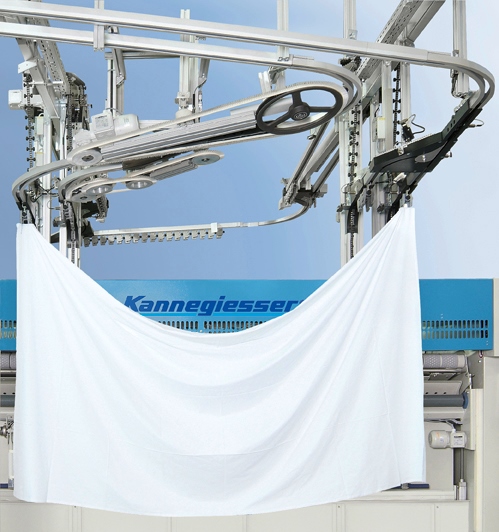
In the Kannegiesser work lines, work steps such as the pre-spreading of laundry items are fully automated. (Image: Mosca)
Once around the world thanks to remote maintenance
If a machine does not perform as expected, Mosca can contact the customer via Remote maintenance get a quick overview of the problem. To do this, experts connect to the customer's computer, which is connected to the affected machine via LAN cable. This enables them to quickly carry out an analysis via the application already used by the customer. And globally. „A colleague of mine is travelling the world every day,“ says Broghammer. „The Mosca Remote Service not only enables us to carry out a diagnosis, but also to operate all previous programmes in the same way as the user and install new ones.“
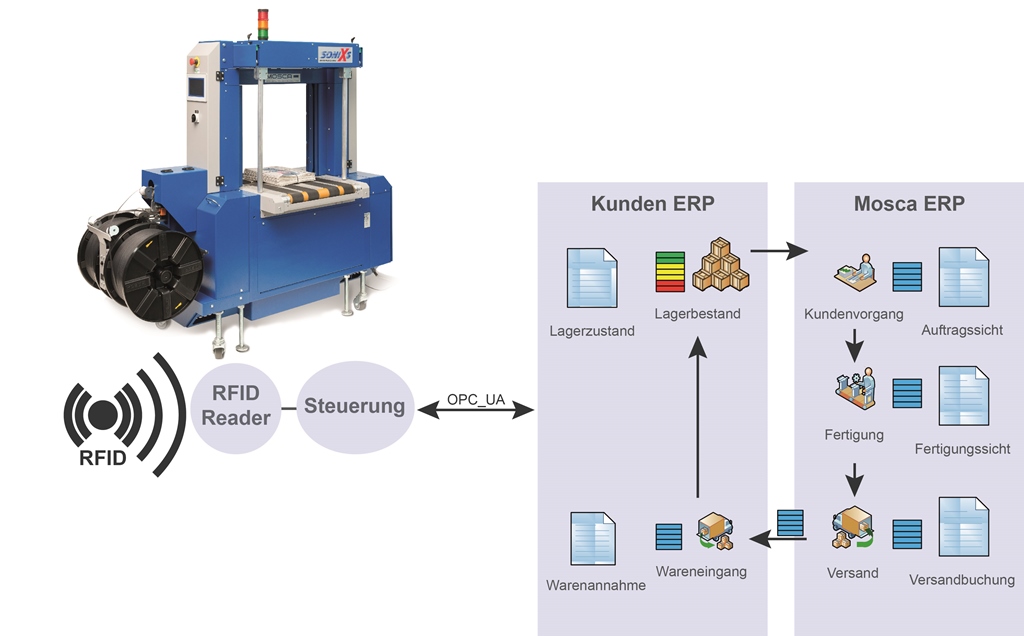
Mosca RFID circuit (Image: Mosca)
Ready for the future with RFID
Mosca's Industry 4.0 potential does not end with the strapping machines themselves. Similar to the laundry items, which are assigned to the correct pile and therefore to the customer in the industrial laundry, this also happens with the strapping manufactured in our own production. To this end, the company developed a system based on RFID tags in collaboration with ERP specialist PSI Automotive & Industry and the company Winckel. This allows customers to Tapes from Mosca Fully automatic storage and reordering. „The RFID system is a good example of what is possible for us under the umbrella term ‚Industry 4.0‘,“ explains Broghammer.