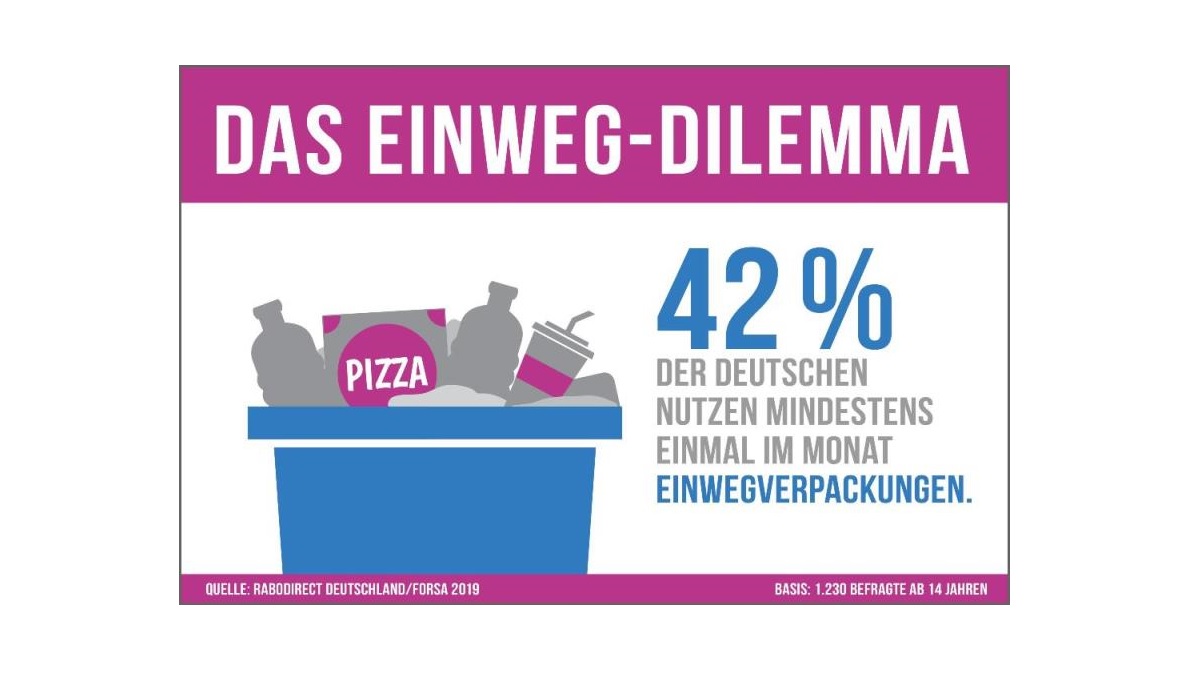
The plastic spoon in your ice cream or the polystyrene bowl from the delivery service: single-use plastic, for which there are more environmentally friendly alternatives, will be banned throughout the EU from 2021. The new directive is an important step in the fight against the flood of plastic, but 42 per cent of Germans still use single-use packaging at least once a month. This is the result of a recent forsa survey commissioned by RaboDirect.
Unpacked and thrown away: No other EU country produces more packaging waste than Germany. Per capita, this amounts to around 220 kilos. A figure that comes as no surprise when you look at the supermarket shelves. After all, multipackaged sweets and shrink-wrapped vegetables are part of the inventory.
Added to this is the triumph of disposable products: Convenient and fast consumption is firmly anchored in the German lifestyle. Nevertheless, some restaurants and shops now offer Deposit systems or enter Discount for containers you have brought yourself. But is this just a drop in the ocean? The study shows: Not necessarily, but there is still a lot of catching up to do.

To-go packaging tempts you at lunchtime
Whether it's lunch from a delivery service or a quick snack at a takeaway: 42 per cent of Germans buy food in disposable packaging at least once a month, 14 per cent even several times a month. Only six per cent of respondents confirmed weekly consumption. According to the study, men choose disposable packaging more often than women.
It quickly becomes clear why - after all, the female sex is the pioneer when it comes to Precooking for the next working day. The majority (70 %) take their own prepared meals with them instead of ordering lunch or going to the Italian restaurant round the corner. This applies to just 56 per cent of men.
Interesting: Savings awareness does not go hand in hand with Environmental awareness goes hand in hand with this. As the study shows, respondents who regularly put money aside use environmentally harmful disposable packaging more frequently (42 per cent) than non-savers (32 per cent).
Young target group often opts for disposable solutions
A look at the age groups is striking: With increasing age the need for disposable packaging appears to be decreasing. The majority (86 %) of over-60s state that they never or only rarely buy food in disposable packaging.
By contrast, 20 to 29-year-olds do this much more frequently: 71 per cent of them consume disposable products once a month. 15 per cent even do so once a week. This means that 20 to 29-year-olds consume the most packaging. The situation is similar for 14 to 19-year-olds. 68 per cent of them use disposable packaging once a month.
Bioplastics as a new alternative
The start-up TIPA-Corp offers a forward-looking alternative to the packaging dilemma: the Israeli company produces natural packaging for cereals, pasta or baked goods, for example, which can be Completely biodegradable can be used. Within six months, the bioplastic decomposes into organic matter, which in turn serves as a soil nutrient - a closed cycle.
With this innovative concept, the start-up recently won the „FoodBytes!“ competition of Rabobank attracted attention. As part of this event, Rabobank honoured young companies with sustainable ideas from the food and agricultural sector.
Details of the forsa study results can be obtained by e-mail from RaboDirectMarketing@rabobank.com can be queried.
[infotext icon]Note: For the representative forsa survey, a total of 1,230 people were interviewed on behalf of RaboDirect Germany between 21 March and 4 April 2019. RaboDirect Germany is a division of the German branch of Coöperatieve Rabobank U.A., a Dutch banking group based in Frankfurt am Main. [/infotext]Source: forsa/RaboDirect Germany