To mark today's 8th Packaging Day, five packaging industry associations are publishing the results of a recent study by the Gesellschaft für Verpackungsmarktforschung (GVM) on the development of consumer behaviour, packaging volumes and material efficiency between 1991 and 2020.
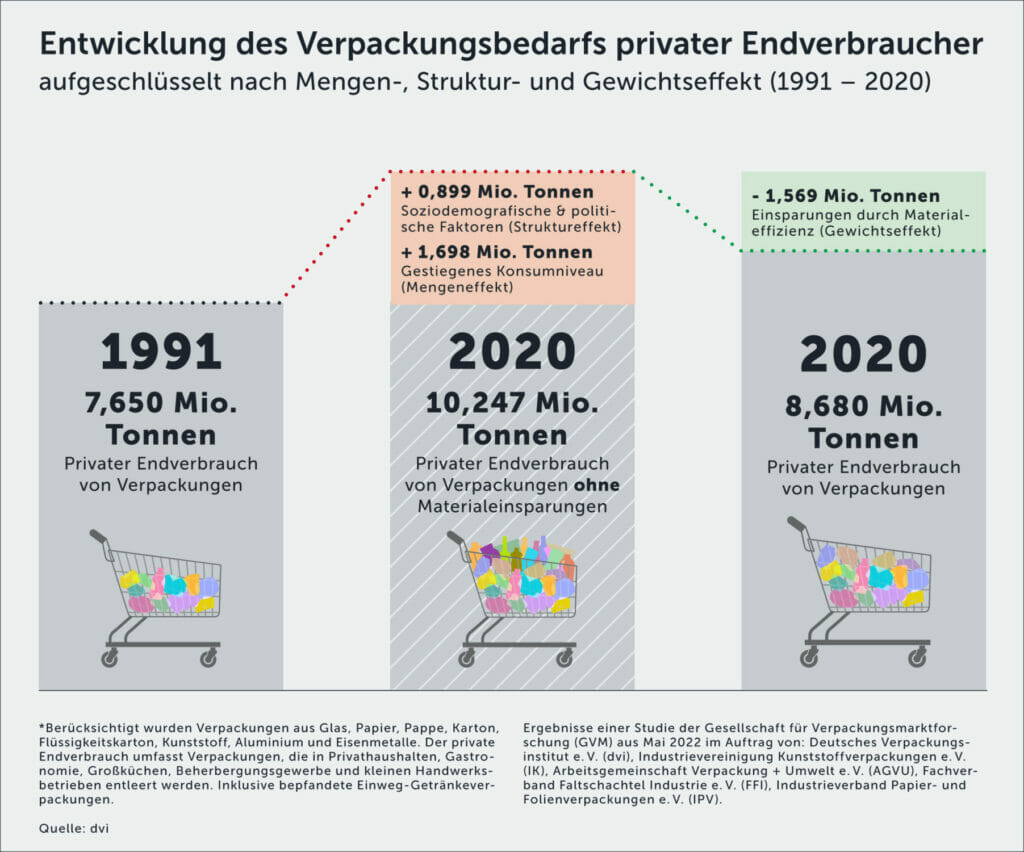
Packaging requires less and less material and raw materials. Nevertheless, annual packaging consumption is increasing. As a recent study conducted by the Gesellschaft für Verpackungsmarktforschung (GMV) on the occasion of the 8th Packaging Day shows In 2020, 92 per cent or 1.6 million tonnes of additional consumption-related packaging was saved in Germany compared to 1991 thanks to reduced material use are being realised. Overall, the material savings from lighter packaging since 1991 amount to 23 million tonnes.
The fact that packaging consumption has nevertheless increased in the same period is due to This is due to the increased level of consumption and a change in consumer behaviour. If we were to consume the same number of products today as we did 30 years ago, we could do without 1.7 million tonnes of packaging every year.

In addition to the increased number of products consumed, structural effects and socio-demographic factors have also led to an increased demand for packaging material. Aspects such as a increased number of smaller households and the increased demand for smaller pack sizes contributed a further 0.9 million tonnes to the increase in packaging consumption.
As a result of increased consumption levels, changes in the consumption structure and less the efficiency gains from optimised packaging, private final consumption of packaging across all materials increased by by 1.04 million tonnes or 14 per cent to 8.7 million tonnes between 1991 and 2020.
dvi: Protection of packaged goods is paramount
Kim Cheng, Managing Director of the German Packaging Institute e. V.: „It's a bit like the hare and the hedgehog. The industry has continuously made packaging lighter and slimmer over the last 30 years. But any progress is immediately eaten up by growing consumption. Of course, the huge efficiency gains of recent years are paying off - in terms of the environment and climate, but also with regard to the current extreme rise in prices and shortages of raw materials.
But it is also clear, that packaging cannot be slimmed down indefinitely. The first priority is to protect the packaged goods, which have a much higher value and ecological footprint than their packaging. The footprint of food, for example, is 16 to 30 times greater. These resources must be protected. The packaging industry has therefore been focussing heavily on solutions for the circular economy for several years now such as complete recyclability, the use of recyclates, reusable and refillable solutions or ever new areas of application for materials made from renewable raw materials.
Nevertheless, we need to put our consumer behaviour to the test. As consumers, we are the main cause of the increase in packaging consumption. If we want less packaging, we need to change this. Consumption habits and consumption levels are directly linked to the volume of packaging. We cannot avoid a broader consumer debate.“
AGVU: Use more secondary raw materials
Dr Carl Dominik Klepper, Chairman of the Management Board of Arbeitsgemeinschaft Verpackung und Umwelt e. V.: „The study proves dhe advances in packaging design, in particular by increasingly reducing the use of resources.
The The next milestone is the recyclability of all packaging components and the increased use of secondary raw materials, so that only small quantities of new goods are required in production. One thing is also clear: in order to make real progress in climate and resource protection, we need mindful consumer behaviour.“
IK: Study opens up a narrow view
Mara Hancker, Managing Director of the IK Industrievereinigung Kunststoffverpackungen e.V. (Industrial Association for Plastic Packaging)Product and packaging form a single unit. Simply leaving out the packaging does not make our consumption more sustainable; In fact, the opposite is usually the case. But of course, packaging also enables new forms of consumption, such as to go. This makes it all the more important that all players in the discussion are honest.
The more facts we know, the more consciously we can make decisions. With the joint study on consumption habits, material efficiency and packaging quantities becomes the view that is often narrowed down to waste is opened up. In turn, everyone can draw their own conclusions from the results: Industry, trade and consumers.
The study also shows this: There is no one game changer - Climate protection is also the result of responsible decisions made by each individual. This also includes our lifestyle and, in particular, our consumer behaviour.“
FFI: Increase circularity
Christian Schiffers, Managing Director of the Fachverband Faltschachtel Industrie e. V.: „This important GVM study documents the causes of the increase in packaging consumption over the last three decades. For example, demographic changes are leading to an increasing number of smaller households and the mobility in society, also due to labour market policy to an expanded range and greater demand for consumer-friendly and hygienic on-the-go supplies.
Continuous lightweighting programmes to reduce the specific weight of cardboard packaging have successfully, but only partially, compensated for the additional consumption of packaging. This makes it all the more important through the use of recyclates and the increase in recyclability increase the overall recyclability of packaging in order to protect the climate and natural resources.“
IPV: Changing environment
Karsten Hunger, Managing Director Industrieverband Papier- und Folienverpackung e.V.The following principle applies to the technical design of packaging As little as possible, but as much as necessary. The industry has been following this approach for a long time now with a constant stream of new optimisations. This study is impressive proof of this.
At the same time the entire environment of packaging use is changing, The changes are due to a variety of factors, including population structure, living and working conditions and consumer behaviour. The resulting changes in the quantities of products and packaging could not and cannot be fully compensated for by optimising packaging alone. This is why all stakeholders along the entire supply chain, right through to the consumer, are called upon to constantly review their own actions and decisions in terms of sustainability.“
GVM study provides detailed insights
The Study conducted by GVM in May 2022 on behalf of the German Packaging Institute e. V. (dvi), the Arbeitsgemeinschaft Verpackung + Umwelt e.V. (AGVU), the Fachverband Faltschachtel Industrie e. V. (FFI), the Industrievereinigung Kunststoffverpackungen e. V. (IK) and the Industrieverband Papier- und Folienverpackungen e. V. (IPV).
The GVM study analysed the development of total packaging consumption and breaks them down into three factors: quantity effects (consumption level), structural effects (consumption habits) and weight effects (packaging optimisation). In addition, it gives Detailed insights into the material groups glass; paper, paperboard, cardboard, paper composites, liquid cardboard; plastic; aluminium and ferrous metal and represents the Development in six selected product segments represent: Pet food, disposable plastic bottles for water, tinned food for processed fruit and vegetables, dairy products, washing, cleaning and personal care products and electrical appliances.
Sourcedvi, AGVU, IK, FFI, IPV
More news


Cycle for strapping bands

Sparxell scales plant-based textured colours

Italy shows organic expertise

Sustainable action plan for beverage packaging