The causes for the level of CO2-emissions from beverage packaging are diverse. The impact of each solution on the bottler's footprint can now be quantified using KHS calculation tools developed together with independent experts.

With the new tool, the system provider is now offering the beverage industry a reliable Guidance for planned machine conversions and the switch to a sustainable portfolio. With this new offering, KHS is adding another component to its comprehensive packaging service. In co-operation with the Hamburg Institute for Environmental Informatics (ifu), KHS clearly shows its customers which form of packaging has which effect on the climate, and whether, for example, a conversion of stretch blow-moulding machines at the bottler would have a positive impact on CO2-balance sheet.

"In addition to the cost-effectiveness and efficiency of beverage production, our agenda focuses primarily on reducing our ecological footprint."

Dennis Jacobi, Manager Service Sales and expert for conversions at KHS

This goal can be achieved, for example, by modernising KHS stretch blow-moulding machines currently on the market: Oven conversions and the recovery of compressed air in the stretch blow moulding process save energy in bottle production and thus the CO2-footprint is significantly reduced. For the ovens, the main issue is the heating energy required to heat the preforms before the stretch blow moulding process. "Depending on the machine generation and equipment our heating conversions achieve energy savings of up to 45 per cent", explains Jacobi.

CO2 balance of conversions

How these conversions, which KHS has already had in its programme for ten years, affect CO2-balance of the beverage bottler can be quantified more precisely with the new tool. "So far, we have been able to calculate exactly how many kilowatt hours the annual electricity consumption has been reduced as a result of the conversion. But how much CO2 is ultimately saved and how sustainable this actually is as a resultwe did not know until now. We simply couldn't compare it to the CO2-The company itself is responsible for the costs incurred by the measure itself," says Jacobi.

The solution is in principle a simple Excel tool in which data is stored and in the first step, all parameters that impact the climate are recorded in its input screens. These include, for example, the material used for the conversion, the packaging, the transport and the distance that technicians have to travel for the installation. The tool then calculates how much CO2 is "spent" on the measure.

The second step is to enter into the calculator how many kilowatt hours will be saved by the conversion, where the customer is located geographically and what type of electricity they use or produce themselves. Both of these factors are summarised, like how long it takes for the CO2 is saved again. "The eco-return on investment, so to speak," says Jacobi.

"The pleasing thing is that our conversions usually pay for themselves within just days or weeks thanks to the enormous energy savings." Of course, for many customers, the cost benefits are particularly relevant in view of rising energy prices. "In view of the increasing regulation that CO2-savings are rewarded with tax benefits or subsidies, for example, the environmental aspect is also becoming increasingly relevant. In addition, a growing number of companies have committed to ambitious climate targets," observes Jacobi.

Many beverage manufacturers want to become CO2-neutral

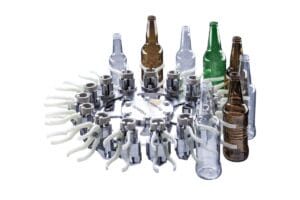
Arne Wiese, who as Bottles & Shapes Product Manager advises KHS customers on all aspects of container design and manufacture, also recognises this.2We want to become climate-neutral and ask ourselves which packaging has the smallest footprint," he says. In order to express the respective advantages of a container in figures and help beverage bottlers in their decision-making process with regard to the most climate-friendly packaging possible, tool can be used to compare the environmental impact of different primary packaging such as PET bottles made from recycled or new material, glass bottles, drinks cans, HDPE containers and cardboard packaging. In addition to the material, the location of the producer, the weight, the transport routes and the number of rounds are included in the assessment.

The calculator also takes into account water and chemical consumption during cleaning and the type of disposal at the end of the life cycle. The greenhouse gas emissions are calculated separately for each area and totalled as CO2-equivalents and provide information on which container type has the most favourable life cycle assessment over its entire service life.

"With our primary packaging CO2-calculator, we score particularly well where PET is a viable alternative to HDPE. In the milk and mixed milk drinks, cosmetics and household sectors, for example, more and more ecologically minded customers are being convinced that PET containers are the more environmentally friendly alternative."

Arne Wiese, Product Manager Bottles & Shapes KHS

The data provides reliable orientation and triggers change processes that lead to more climate-friendly packagingWiese is certain.

Calculation for secondary packaging

The calculation of the CO2-footprint of secondary packaging rounds off the KHS range of services. For the development, the systems supplier has given the ifu Institute the Parameters for all conceivable packaging in the entire portfolio in order to calculate their Global Warming Potential (GWP) in accordance with DIN/ISO 14067.

The consumption data provided was analysed with the material data stored in the ecoinvent database The GWP for each individual pack can be determined by combining data on films, corrugated cardboard and adhesives with the average values for transport routes applicable in the EU. For example, it can be quickly calculated that - depending on various parameters - a film pack placed on a tray emits 0.11 kilograms of CO2-equivalent, while a tray paper pack weighs just 0.085 kilograms.

SourceKHS : KHS

KHS - More news