A new system should reduce adhesive costs and customer complaints. PepsiCo opted for a hot melt technology from Nordson.
1 July 2024
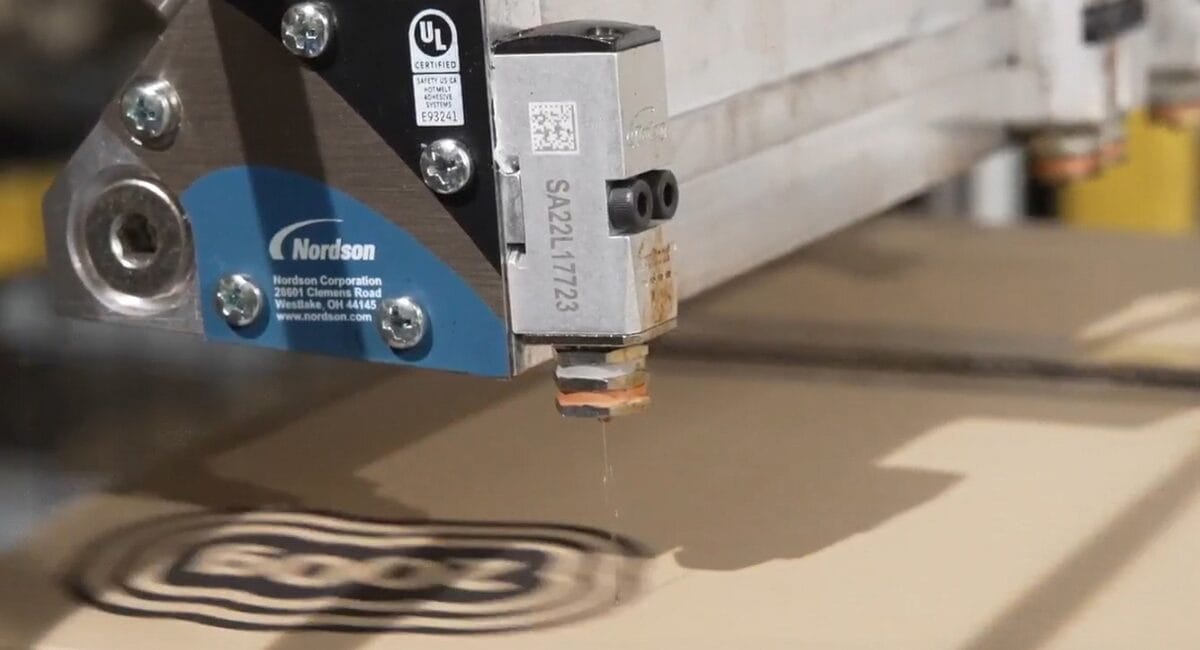
The MiniBlue hot glue applicators ensure that the adhesive is used sparingly. They apply the adhesive reliably with their precise stitch pattern. (Image: Nordson)
PepsiCo produces potato crisps in Broek op Langedijk in the Netherlands. During transport, the fragile products are packed and stacked in cartons as secondary packaging. A new system that reliably secures cartons stacked on pallets against slipping was to reduce the costs for adhesive and customer complaints. The food company opted for hot melt technology from Nordson.
Potato crisps have been produced in Broek op Langedijk in the Netherlands since 1958. The Langedijk farmers wanted to open up another market for their potatoes. Over the years, the plant developed into the largest crisps factory in Europe. Today, the production facility belongs to the food and beverage group PepsiCo, which employs around 300 people in Broek op Langedijk. Among other things, the plant produces Lays‘ brand crisps, fills them in bags, packs them in boxes, stacks them on Euro pallets and delivers them. Up to twelve to 14 layers of cardboard boxes are stacked on top of each other depending on their size.
Safety for fragile products
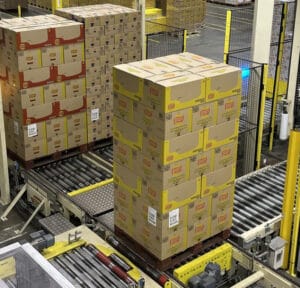
The use of plastic film in logistics can be reduced with secure pallet stabilisation. PepsiCo in the Netherlands has invested in a new system to prevent cartons from slipping during transport. (Image: Nordson)
„We have three palletising systems that collate and stack the cartons fully automatically for transport. In general, each system loads 50 pallets per hour. If required, we can increase the quantity to 100 pallets per hour. This means that up to 1,200 cartons of different sizes can be processed per hour.“
Martijn van Zuydam, Project Manager and Spark Line Lead Trainer NWE at PepsiCo
Display
The cardboard pallets are transported fully automatically in the factory and then transported by lorry via interim storage to the wholesaler for delivery. As this can sometimes be a rough and extremely bumpy process, the boxes are stacked securely and, above all, non-slip on the Euro pallet. It must also be possible to unstack them easily.
PepsiCo used to secure the cartons for transport with a cold glue system. However, increasing difficulties had become apparent here. There were repeated uncertainties regarding the handling of the system and the associated equipment. In addition High operating costs and difficulties further down the supply chain, for example, when already stacked pallets had to be restacked. The cold glue system only allows this within a defined period of time, and cartons were damaged during subsequent restacking and unstacking.
Against this backdrop and with a view to the Group's goal of manufacturing its products sustainably, those responsible have endeavoured to optimise the transport of pallets and invest in a new, future-oriented technology. to invest. An internal team - consisting of Darko Despotovic, palletising system operator, Manuel Allan, technical expert, and Martijn van Zuydam - developed the basis for a specification sheet as part of a Six Sigma Green Belt project. The new system then had to be Cost savings in adhesive consumption without compromising pallet stability contribute to this. It should be possible to adjust the amount of adhesive depending on the carton positions on the pallet. The same applies if a problem repeatedly occurs in a specific pallet position with a certain carton combination in the supply chain. Finally, the sustainable solution for reducing CO2-footprint.
Modular melter optimises transport packaging
The decision was made in favour of Nordson's melter technology, as the company was already one of the preferred suppliers and offers its customers comprehensive support in addition to innovative and high-precision application technology. At PepsiCo, one ProBlue melter was installed per palletiser in combination with the P4 pressure management system. The MiniBlue II SureBead hot melt applicators, PureFlow hoses and RediFlex II holders were also added.
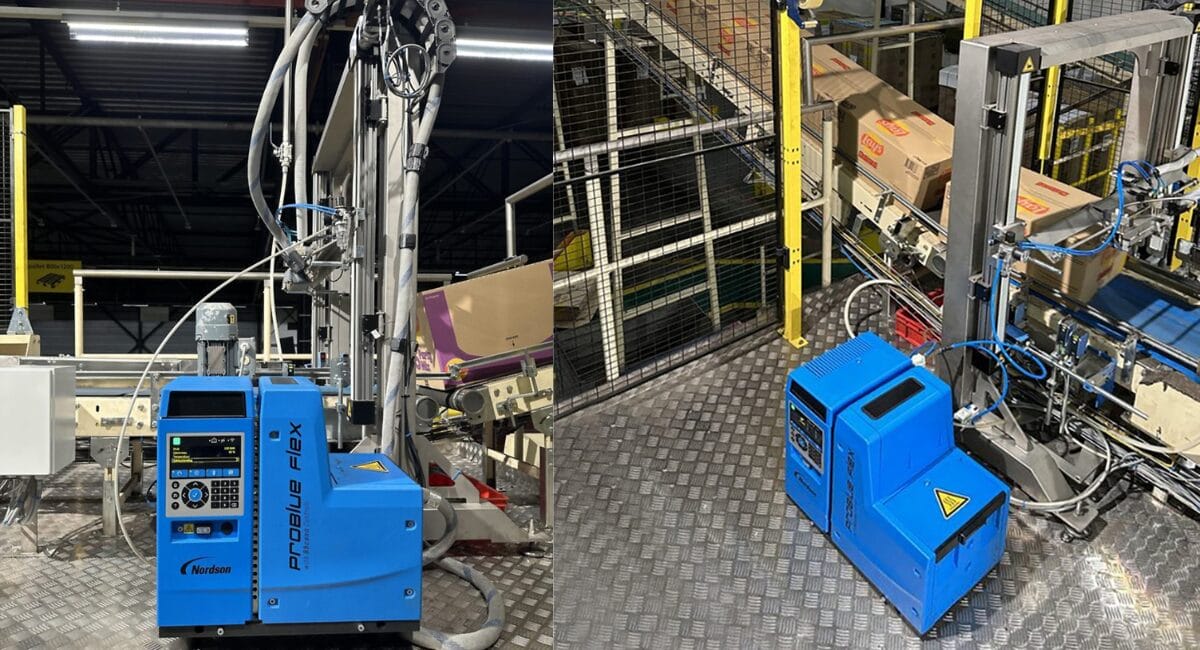
In combination with the P4 pressure management system, the ProBlue Flex melter allows the electrical control signal and pressures to be changed. This allows the adhesive application to be programmed depending on the load applied by the cartons. (Image: Nordson)
„The ProBlue melter has a modular design so that it can be individually customised to the user's requirements,“ explains Erik van Gulik, OEM & Key Account Manager at Nordson. The device is characterised by a and can be optionally equipped with an adhesive tracking system. The P4 pressure management system can be equipped with a P4 pressure sensor, which allows users to easily measure and monitor the volume and application of the adhesive. The P4 pressure management system allows the electrical control signal and pressures to be changed and the exact amount of adhesive applied to be monitored. This makes it possible to Programme the application of the adhesive depending on the load from the cartons. This means that less adhesive is applied to the lower cartons, which are more heavily loaded by the weight of the cartons stacked on top and stand securely, than to the upper cartons. The latter can easily swing back and forth on the pallet during transport, for example, and must therefore be secured more securely.
The MiniBlue II SureBead hot melt applicators apply the adhesive reliably even at high stacking speeds and their precise stitch pattern ensures that adhesive is used sparingly. PepsiCo packs its products in cartons of different sizes, which is why four applicators are installed on each palletiser in such a way that they can be positioned underneath each other. Always apply the adhesive to the varying outer edges, taking into account the different cardboard dimensions. apply.
PureFlow hoses utilise innovative technology to ensure the quality of the adhesive used and prevent material damage such as hardening or coking. This helps to reduce the downtime that can be caused by hose changes or nozzle blockages. They are installed with RediFlex II holders to optimise the flow of adhesive. PepsiCo put the new melter system into operation in February 2023.
„We have thus achieved our goals and reduced CO2-footprint has been reduced. Although we are still fine-tuning the system, this is not due to the hot melt technology, but rather to its integration into the company's overall system. We assume that we can reduce the costs for adhesives alone by around 40,000 euros per year. In any case, we have drastically reduced the number of customer complaints and rework. This alone is expected to save us around 100,000 euros per year.“