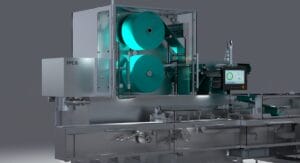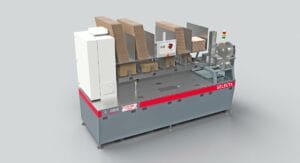
Omron's Flexible Manufacturing Roadshow demonstrates what the factory of the future could look like. The show is touring across Europe and was travelling through Germany for the first time - with collaborative solutions for man-machine cooperation. Packaging journal took a look around the event at Coreum in Stockstadt.
The requirements for palletising, transport and traceability in the factory of the future are high. The automation experts from Omron develop the right solutions. They are shown at the Flexible Manufacturing Roadshow, which made its first stop in Germany.
Over 250 participants came to Stockstadt am Rhein to find out about innovations in manufacturing. The focus was on technologies that enable companies to operate and produce more flexibly, efficiently and sustainably. These include Collaborative solutions that facilitate cooperation between man and machine and improve them in order to counter the increasing shortage of skilled labour.
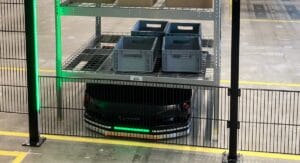
Over 1,500 square metres of autonomous robots were on display at the Coreum presentation and technology centre. Also on show Omron's heavyweight, the HD-1500 autonomous mobile robot for heavy loads of up to 1,500 kilograms as well as flexible palletising and autonomous material transport solutions.
„We are constantly expanding our range. The first robotic solutions were designed for loads of up to 60 kilograms, then for 250 kilograms - and the HD-1500 can handle one and a half tonnes. This year, we will be launching a new model for loads of up to 650 kilograms. In the future, there will be even more variety in collaborative robots, because customers want solutions that are customised to their production.“
Dr Klaus Kluger, General Manager Central East Europe at Omron Electronics GmbH
SMEs also benefit from cobots
Collaborating robots, known as cobots, and autonomous mobile robots (AMR) are suitable for both SMEs and large-scale industry. „Medium-sized companies are increasingly interested in our automated solutions, as the labour shortage means they also need to find alternatives,“ says Klaus Kluger. „If a company works in three shifts, for example, a robotic solution usually pays for itself quickly.“ Collaborative robot solutions are also becoming increasingly popular in Europe: „Mobile robots were used early on in Asia. Cobots were already travelling autonomously through industrial halls there at a time when safety was still being discussed in this country. But that is now changing. Whereas we used to generate 80 per cent of our sales in Japan, 50 per cent of our sales are now generated outside Japan. Germany is now our largest market."
Cobots take on tasks such as transport, palletising, loading and unloading machines or assembly, can be converted quickly and flexibly and can even be programmed by non-experts. However, successful integration requires expertise and partners who know their way around. Omron partner companies were therefore also present at the roadshow, including Synaos, provider of innovative software for intralogistics, EngRoTec, Specialist for digitalisation and automation and OnRobot, manufacturer of collaborative robotic gripping systems and the corresponding software.
Klaus Kluger: „The future also belongs to solutions like those from our partner EngRoTec, who place their robotic arms on our autonomously navigating robots.“ They already transport containers from A to B in pharmaceutical production, but could also restock the shelves in the supermarket at night.
Automation and robotics - More news


Dortmund becomes the meeting place for packaging and intralogistics

White paper | How to make packaging machines more dynamic through lightweight construction

Powerful automation for mills

LogiMAT 2026 showcases current trends and future-proof solutions