The requirements for intralogistics automation are constantly changing. The automation experts at Dematic see great potential in robotics for the warehouse of the future.
Dematic has, within the framework of its 200-year company history has helped drive many developments: Storage and retrieval machines, automated guided vehicles and multishuttle systems. The automation experts see great potential for the future in robotics.
„Shops have less storage space. Customers are ordering smaller, more customised items,“ says Crystal Parrott, Global Vice President of Dematic's Robotics Centre of Excellence. This is why large orders of identical products are less in demand than a mixture of very different items. These need to be put together as quickly as possible. „This is a whole new form of complexity,“ says Parrott. The machine must grip different objects in different positions. She doesn't even know which item will be placed in front of her next.

„The warehouse was static for a long time. That's no longer the case. The functions will still be the same in future, but how they are filled will be modular, depending on space and requirements.“
Crystal Parrott, Global Vice President of Dematic's Robotics Centre of Excellence
The warehouse of the future will be almost completely automated. Machines and technology no longer just carry out monotonous, standardised work steps, but should be able to use their collected data and analysis capabilities to Make decisions yourself. If they master this, it means efficiency, speed - and a warehouse in which people no longer have to work physically and the lighting can be switched off. Or at least dimmed down considerably. Hence the term „dark warehouse“.

An entire industry is researching how to teach machines how to retrieve items from a box that all look different, are soft or hard, perhaps have a greasy surface, or where the same goods were in completely different packaging yesterday because it was an anniversary edition. Technically this is possible with finger grippers or with the help of vacuum. But the Robots must become more intelligent. „They need to know exactly where their arm is in relation to the product,“ says Parrott. This requires Cameras and sensors, which in turn are not sufficient without a Artificial intelligence, that steers and converts what it sees into movement.
Digitalisation, networking and technology come together
„The engineer of the future must think more interdisciplinarily,“ emphasises Claudia Olsson, founder of Stellar Capacity and Young Global Leader of the World Economic Forum. Engineers will have to deal with Topics range from synthetic biology and neuroscience to ethical issues, when it comes to artificial intelligence. Many of the limitations of robotics are in the process of disappearing: „There are cobots, cyborgs and all kinds of variations. Our definition of a robot as a machine made of metal that can only perform limited tasks will expand significantly.“
The warehouse moves closer to the customer
Robotics is the key to numerous challenges. The few existing automation gaps will soon be closed. „Consistent automation is useful both for major customers with huge storage areas and for local retailers,“ says robotics expert Crystal Parrott. The so-called „last mile“ is also an exciting field for Dematic in many respects. Among other things, it is being actively worked on through pilot projects such as the PackMyRide system, which can process parcels of various sizes fully automatically, bring them into the desired sequence and sort them into a loading rack, which is then automatically transported into the lorry by AGV (automated guided vehicle).
„No customer wants to wait two weeks any more. That's why the warehouse needs to be closer to the customer,“ says Parrott. „The closer we get to the customer, the cheaper the last mile becomes.“ Micro-fulfilment is the keyword here, and Dematic already has solutions at the ready: systems with an extremely compact design that can assemble orders fully automatically within an hour and fit at the back of a retail shop, for example. At some point, robots will also help with stocking and clearing shop shelves. The company is already experimenting with automated vehicles or drones, that bring the goods to the customer.
Software and material flow become a competitive advantage
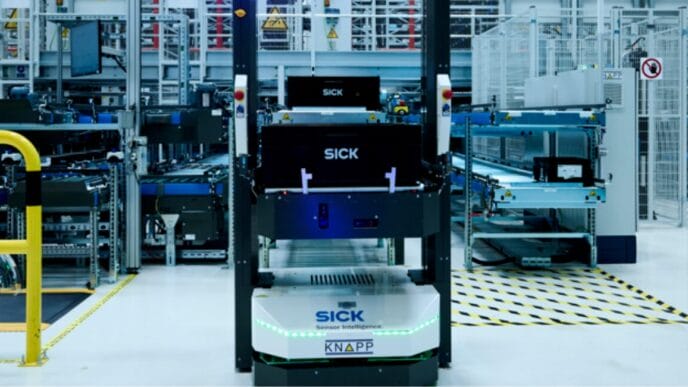
Which brings another requirement for the robot of the future into focus: its movement. It will no longer stand in one place. For a long time, the AGV was the first solution in this direction. However, it had to be managed and instructed. In the future, it will be Autonomous Mobile Robots (AMR) The new vehicles have been supplemented by a new generation of vehicles that search their way independently and do not simply stop when they encounter an obstacle, but cleverly drive round it.
„But a travelling robot alone is useless. The best thing is to combine the two: Perhaps the robot can pick and sort its products while both are moving, making the pick rate and product flow even more efficient? Current technological developments offer the opportunity to plan the entire goods process differently,“ says Crystal Parrott.
Everything becomes modular, everything becomes mobile
Technology and mechatronics will be the raw materials in the future, but software and efficient planning will provide the competitive edge. „Our declared goal is, automate all functions in warehouse logistics operations, where robots work while humans manage them,“ says Parrott. In future, the main focus will be on adapting applications flexibly for the respective customer. One challenge for the entire automation industry is still the unloading of goods and order processing. But Parrott is confident here too.

The future is closer than expected
The global Introduction of the 5G standard and the new possibilities offered by Cloud computing will unleash additional opportunities for innovation. With 5G, even more data can be transmitted even faster. „If the vehicles and devices in the dark warehouse are to communicate with each other, they need to do so as continuously as possible,“ says Parrott. 5G will make the corresponding data volumes possible.
The cloud is the only way to consistently network artificial intelligence. For example, AGVs and AMRs will then be able to coordinate with each other and exchange data at the same time - with the shelves, the human employees and the products themselves. Greater bandwidth will also allow the virtual simulation of machines, so-called „digital twins“, These can then be operated and maintained remotely without the need for a person to enter the warehouse - even simulating the entire warehouse and its flow of goods.
„At the moment, we often still think in terms of individual machines,“ says technology expert Olsson, predicting a fundamental paradigm shift. a large, integrated machine results.“ The dark warehouse. The warehouse may also become a material supply point for very individual, customised customer requirements that are realised just-in-time in production or in the 3D printer. „The great thing about technology is that it is constantly changing,“ emphasises Parrott. „In five years“ time, everything could be different.„ Much of what is currently being conceived is not far away from being realised: "The next generation of robots is coming. And probably sooner than you think.“
Source: Dematic