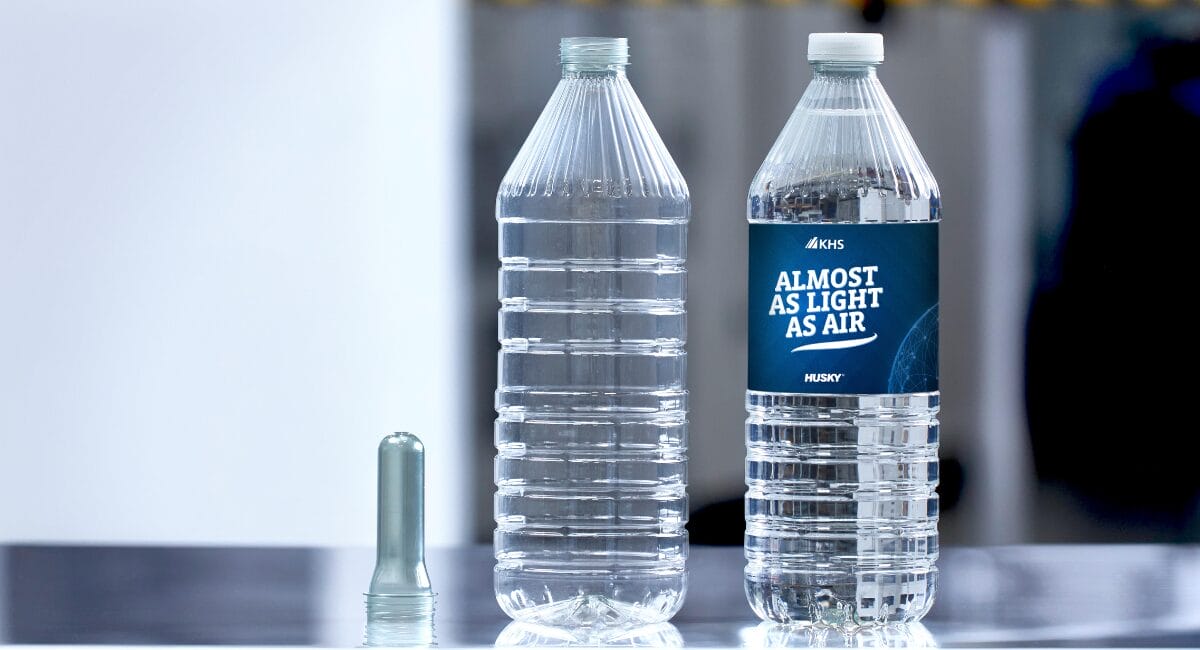
In just four months, KHS and Husky Technologies have developed the „Faktor 101“ PET bottle - weighing just 5.89 grams with a volume of 591 ml. The bottle saves 30 per cent material and, according to the manufacturer, can be produced entirely from rPET.
The new „Faktor 101“ PET bottle marks a technological milestone in beverage packaging: with a weight of just 5.89 grams and a volume of 591 millilitres (20 ounces, standard US format), it is one of the world's lightest PET bottles for non-carbonated beverages.
The bottle was developed in close cooperation between the Dortmund-based filling and packaging specialist KHS and the Canadian preform expert Husky Technologies.

Stability despite material reduction of 30 per cent
Despite the extremely lightweight material, „Faktor 101“ offers high mechanical stability. The so-called topload value is 220 newtons - a top value in the lightweight bottle segment for still water. This was made possible by an innovative shoulder and base design with functional bars and a „pop-in“ effect, which specifically increases the internal pressure and therefore the stability.
Complete development in just four months
Thanks to close coordination between the KHS development teams and Husky's preform designers, the project was completed in a record time of just four months.
The focus here was on optimising the preform geometry and the blow moulding processes on the KHS InnoPET Blomax Series V, which enables extremely thin-walled and at the same time dimensionally stable bottles thanks to precise temperature profiling, according to the company.
100 % rPET and high-speed capable
The bottle can be made entirely from recycled PET (rPET) and can be processed on high-performance lines at up to 90,000 bottles per hour. Particular attention was paid to line capability in terms of transport, labelling and secondary packaging.
„Faktor 101“ was presented for the first time at the NPE 2024 plastics trade fair in Orlando and, according to KHS, met with great interest there - especially among contract bottlers in the USA, the Middle East and South America, who are under high cost pressure.
Source: KHS