SAP Fiori apps support a large number of critical processes in logistics that are essential for smooth operations. These include inventory management in the warehouse, picking and packing goods and posting warehouse movements. Optimisation tools such as Quanto Analytics are important tools for companies to optimise their Fiori apps.
Since the introduction of SAP Fiori in 2013, the design of workflows in companies has changed significantly. The intuitive user interface of SAP Fiori was developed to simplify the complex interfaces of traditional SAP systems (SAP GUI) and improve the user experience. Especially in logistics, where speed and simplicity are crucial, Fiori apps have established themselves as indispensable tools. They make SAP processes more efficient and offer employees on the shop floor a role-based and user-friendly application. Nevertheless, Fiori apps, especially in-house developments, are not free of weaknesses such as performance problems or usability hurdles that can limit the effectiveness of the applications. Such problems have a noticeable impact on productivity and hinder the efficiency of logistical workflows. To counter these challenges, specialised tools offer targeted monitoring and optimisation options to identify errors and improve the performance of the apps.
Challenges in utilisation
„The company-specific Fiori in-house developments in particular, which cover special requirements, are indispensable as apps, as they map processes that could not be realised with standard solutions,“ explains Sebastian Wachter, Manager at Quanto Solutions. The SAP and IT consultancy is specialises in the design of optimal logistics processes with Fiori apps and their sustainable optimisation. „In practice, however, it is necessary to continuously monitor and manage performance, usability and any functional errors in order to make these processes successful in the long term.“

Typical problems that occur with Fiori apps include long loading times, data loss during transfer between offline and online mode and poor user-friendliness. These weaknesses can significantly impair the efficiency of the apps. This is where a tool for monitoring and optimisation comes in, which systematically records and analyses usage data in order to identify problems at an early stage. „This targeted analysis enables companies to quickly recognise the causes of performance problems and usability weaknesses and rectify them in good time,“ says Wachter. Such an Tool like Quanto Analytics from Quanto Solutions is specially designed for this purpose, Monitor the performance and user behaviour of SAP Fiori apps.

(Image: Shutterstock, Sergey Nivens)
Scenario 1: Inventory management in the warehouse
In a large warehouse, a company uses a mobile Fiori app to manage the current stock in real time. Barcodes of packaging units and items are scanned to record goods movements and make stock adjustments in the SAP system. However, the app has been extended, that it also interacts with a third-party warehouse management system (WMS), which is specially designed for the automated management of fast-moving items. This WMS is responsible for highly automated areas of the warehouse where conveyor belts and storage and retrieval machines are used.
The app should now ensure that stock movements are correctly recorded both in the SAP system and in the WMS and the stocks in both systems remain consistent. In practice, however, the problem repeatedly arises that these stock movements are incorrect, even though the employees have carried out the processes correctly.
Quanto Analytics is used to analyse the problem: The behaviour of the app is monitored in real time, and it turns out that the long response times of the service calls when processing certain materials are the cause, also due to an inadequate implementation of a BAdI (Business Add-In) in SAP. Especially with a high number of simultaneous requests, the calls are sometimes cancelled, which means that certain goods movements are not posted.
After a Refactoring the code and the Scaling the infrastructure the problem can be solved. The app runs stably, the stock movements are booked correctly and the number of error messages is significantly reduced.
Another problem uncovered by Quanto Analytics is the lack of visibility of error messages for employees. It turns out that although the error messages are generated, they are displayed outside the currently visible area of the app. The solution is therefore to, integrate the error messages as a pop-up overlay in the booking workflow, so that they must be actively confirmed by the employees.
Scenario 2: Picking and packing
A wholesale company uses an SAP Fiori app to control the picking of orders in the warehouse. Warehouse employees use mobile devices such as handheld scanners or smartphones to pick items from the shelves, check deliveries and prepare goods for dispatch. Although the app replace paper-based processes and increase efficiency the opposite occurs: The picking error rate increases and productivity decreases. Several causes are identified with the help of Quanto Analytics:
Initially, the app shows employees long lists of transport order items without sorting them by warehouse type and storage location. However, the fact that this becomes a problem and employees spend a lot of time trying to find the right materials only becomes apparent when analysed by Quanto Analytics: they lack route-optimised picking.
It turns out that employees are picking on a delivery-related basis instead of across deliveries as originally planned, as the delivery number (requirement number) was the leading sorting criterion for the picking sequence. They therefore walk through the warehouse several times to pick the deliveries assigned to them. This indicates that the picking process as presented in the app does not correspond to the actual warehouse process and that the interface is not intuitive enough to ensure smooth picking.
Based on the data from Quanto Analytics, the company decides to group orders by warehouse type and introduce multi-level picking. In addition a permanent navigation aid integrated into the app, which shows employees exactly where the required materials are located and the order in which they should be picked. These adjustments lead to a considerable reduction in picking errors and a significant increase in productivity.
Customised optimisation of SAP Fiori apps
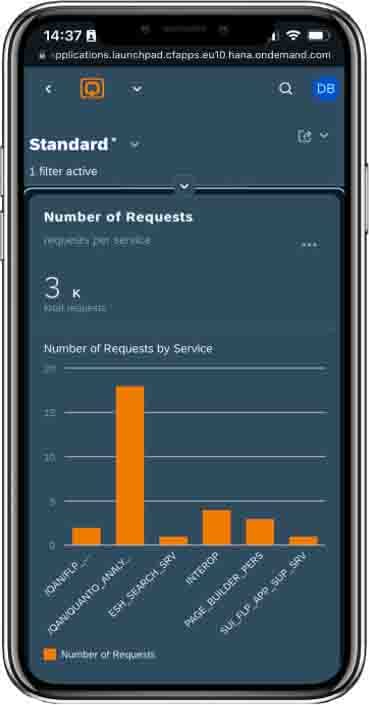
The combination of performance monitoring, usability analysis and error documentation makes Optimisation tools an important tool for companies. The targeted analysis of performance problems and usability hurdles, the early identification of errors and the continuous monitoring of the apps help to minimise the risk of errors. Increase productivity, reduce errors and increase user acceptance.
Particularly in the case of in-house developed Fiori apps that map specific company requirements, the a specialised optimisation tool high added value by enabling companies to, improve their apps precisely and in line with requirements. This not only ensures the smooth operation of logistics processes, but also lays the foundation for future developments.
Source: Quanto Analytics