On the initiative of the German Packaging Institute (dvi), nine trade associations are taking the 10th Packaging Day on 17 June 2025 as an opportunity to make two central structural causes of the current economic crisis tangible using concrete examples from the packaging industry: too much bureaucracy and inadequate regulation.
In a joint position paper they illustrate how mismanagement weakens the location and how many of the challenges for companies are not caused by global developments alone, but have their roots in national and European legislation. On Packaging Day, the associations also show what the products and services of their 1000 or so member companies do for people, the economy and the environment on a daily basis.
The packaging industry knows a thing or two about bureaucracy and regulation. Ever since the first laws and regulations on the handling of used packaging in the early 1980s, the industry has been at the centre of attention. However, according to nine trade associations in the packaging industry, politicians have long since overshot the mark. „The burden of excessive, often impractical bureaucracy and regulation is causing serious structural problems. This relates to verification, documentation and reporting obligations, constantly new or amended legal requirements and lengthy planning and authorisation processes,“ explains Dr Natalie Brandenburg, Managing Director of the German Packaging Institute (dvi).

High costs and hurdles
According to figures from a recent VDMA study, companies in the mechanical and plant engineering sector have to comply with around 3,900 regulations as part of their normal business activities. As the KfW SME Panel 2024 shows, bureaucracy costs SMEs around 1.5 billion working hours every year. „And that's just the actual measurable working hours. Especially for the mostly medium-sized companies in our sector, the limit of what they can bear has been exceeded,“ says Brandenburg.
According to the trade associations, it will There can be no sustainable upturn without fundamental reforms. With regard to bureaucracy and regulation, there is a need for moderation instead of mass and quality over quantity, reliability and predictability, more technical expertise and less regulation. Companies need room for manoeuvre for innovation, growth, competitiveness and environmental and climate protection that focuses on the result and does not achieve the opposite out of impractical idealism.
Illustrative examples
To illustrate the often abstract discussions surrounding bureaucracy and regulation, the associations are providing concrete insights on Packaging Day through a series of examples. They range from the impractical classification that all yoghurt packaging of less than three litres generally constitutes single portions for immediate consumption that are subject to a charge, to reporting obligations where identical data sometimes has to be reported more than a dozen times to different bodies and regulations that penalise the production of renewable energy and investments in decarbonisation, through to production bans that result in value creation being shifted to countries with lower environmental standards and the required goods having to be imported from there.
„Regulation is not wrong per se, but the balance is crucial. And laws must also focus on the result and not the intention. If regulations miss their target, contradict each other or are repeatedly changed, uncertainty arises instead of clarity. Companies are confronted with multiple, sometimes unfulfillable obligations and lose a lot of time and resources, which are then no longer available for research, development and actual value creation. As a result, the actual goal is missed - and this not only harms the economy, but also society,“ emphasise the association representatives.
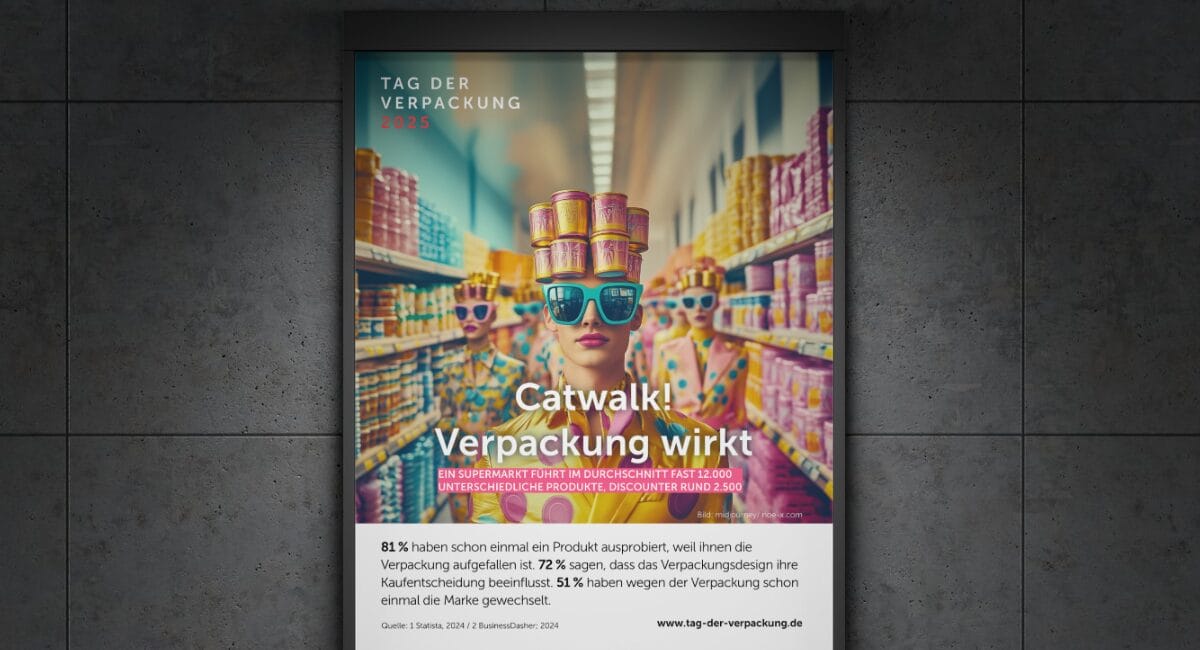
Since 2015, the German Packaging Institute the annual Packaging Day in June from.
„Packaging protects, informs, enables transport and is a key lever for greater sustainability. Packaging is not a problem, but part of the solution. It offers space for creativity, technology, sustainability and entrepreneurial thinking. It is high-tech, circular economy and room for manoeuvre. Our industry offers a wonderful mix of creativity, design, research and technology, and its value chain covers almost everything that is essential for people, the economy and the environment. On Packaging Day, we want to talk about the great achievements of packaging and the packaging industry. Because that happens far too rarely.“
Dr Natalie Brandenburg, Managing Director of the German Packaging Institute (dvi)
In a series of pictures with facts and figures, the trade associations are therefore providing information on the 10th Packaging Day about the products of the sixth largest industry in our country. What characterises it? What does packaging look like when you open your eyes to what it does every day? How has it developed in recent years? Where does it stand in terms of recycling? What are its core tasks? And why is it a success story that has been with us longer than the dog, the grain or the roof over our heads?
All detailed information on this can be found HERE.
Associations involved
- German Packaging Institute e.V. (dvi); Organiser
- Aluminium Deutschland e.V.
- Bundesverband Glasindustrie e.V.
- DFTA Flexo Printing Trade Association e.V.
- FFI - Fachverband Faltschachtel-Industrie e.V.
- Flexible Packaging Europe (FPE)
- Industrial Association for Paper and Film Packaging (IPV)
- IK - Industrievereinigung Kunststoffverpackungen e.V. (Industrial Association for Plastic Packaging).
- Association of the Corrugated Board Industry (VDW)
Source: dvi