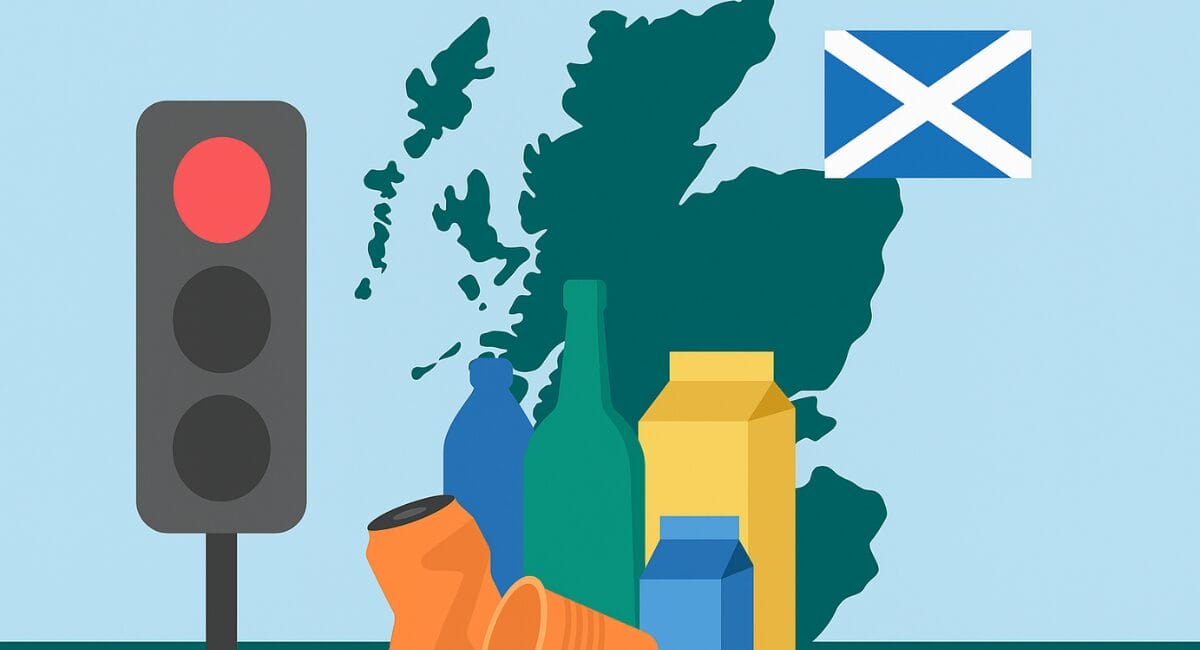
The Scottish Environment Protection Agency (SEPA) has published new figures on household waste. Although the recycling rate rose slightly to 44.3 % in 2024, the majority of recyclable packaging still ends up in residual waste.
Last year, 0.42 tonnes of household waste was generated per capita. Of this, 0.19 tonnes was recycled, 0.19 tonnes was used for energy recovery and 0.05 tonnes was sent to landfill. According to SEPA, the high proportion of packaging in residual waste remains particularly problematic - including plastic, paper and cardboard packaging, which could often be recycled. Despite the slight increase in the recycling rate, almost half of household waste is still not recycled.
Packaging central to progress in the circular economy
Ross Haggart, Chief Operating Officer of SEPA, emphasised: „Around 52 % of household waste could be recycled, including packaging materials such as plastic, paper, cardboard and food packaging. Consistent separation could significantly reduce the amount of residual waste.“ According to the authority, packaging waste is a key lever for reducing dependence on incineration and landfill.

CO₂ reduction through less packaging waste
The carbon footprint of Scottish household waste in 2024 was 5.31 million tonnes of CO₂e - around 0.96 tonnes per capita. Compared to 2023, this represents a decrease of 0.7 %, and a decrease of 21.5 % since 2011. SEPA attributes this to more efficient waste management and the increasing replacement of landfill with recycling.
At the same time, waste incineration increased by 14.7 % in 2024, while landfill volumes fell by 8.6 %. However, in order to achieve the climate targets, the authority is calling for a stronger focus on packaging recycling and waste avoidance in everyday life.
Source: The Scottish Environment Protection Agency (Sepa)